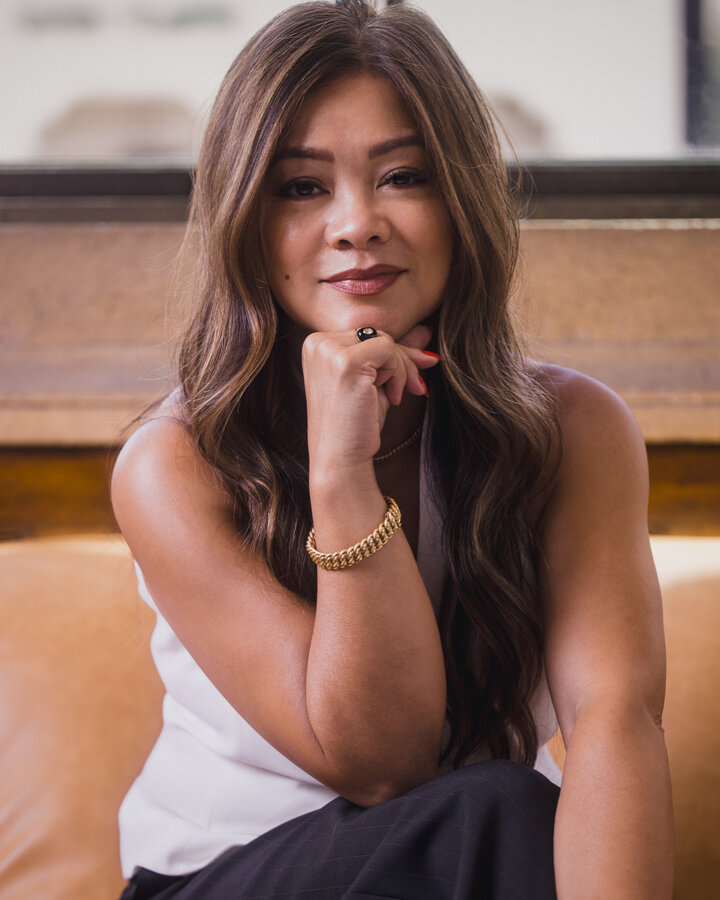
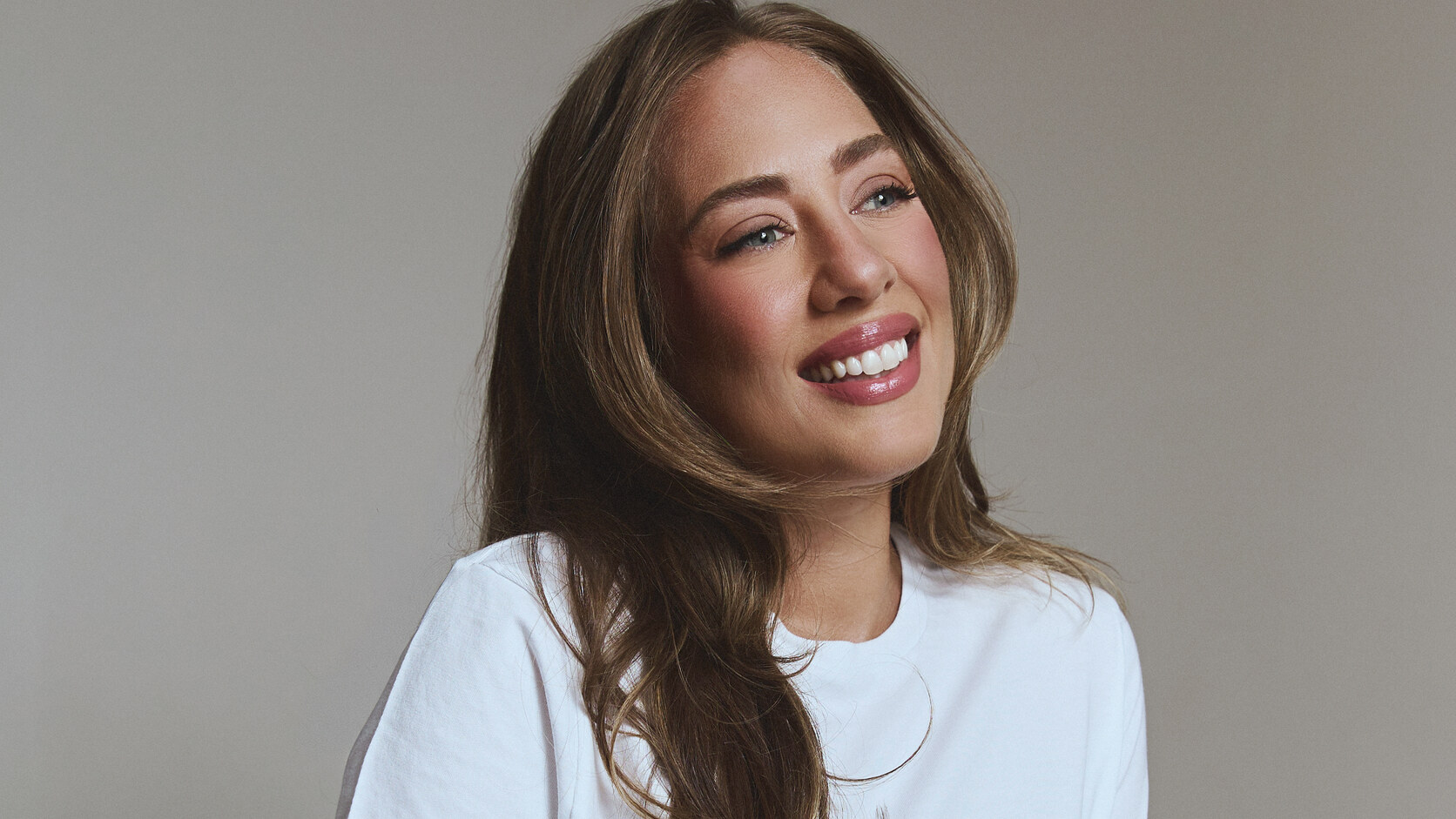
Amanda Hirsch’s best description of her job is “a person on the internet.” She would rather undersell a career that includes more than a million followers, a chart-topping podcast, and A-listers lining up to be interviewed by her than call herself an “influencer” or—gasp!—“content creator.”
But she’s working on it.
“I’ve been trying to at least muster up ‘I have a podcast,’” she says. “Give myself some credit, hey!” It’s strange to cringe at the name of the work she is clearly very good at. Stranger still, it’s also the work she says saved her.
How it actually started
Before any of this, Amanda had moved back to New York from Israel with her husband, Yaron, to start over. “I don’t know how I didn’t think that moving across the country, again, with my foreign husband, living at my mom’s, and both of us essentially starting over—with the responsibility of him being okay on me—would be stressful,” she says. “But boy, it was.”
Her first day at a new job was at a recruiting firm. “Def not the something cool I thought I’d do when coming back to NYC.” She had a panic attack on the subway. (The same train she’d ridden to high school.) “Everything came crashing down at once,” she says. “We had a good life. What is he going to do here? What am I? I always thought if I had a career here it would be doing something great, but I had no leads. Not even to write BuzzFeed listicles.”
Today, she’s better at anticipating the crashes. “Anxiety used to come out of nowhere,” she says, “but now with age it’s like, Amanda, it’s sunny, so you can get burnt, ya know?”
What eventually pulled her out started small: she started talking to a camera.
The accidental empire
It wasn’t a plan. One day, when she would usually FaceTime her sister, she decided to take to Instagram instead. Rather than write, she just talked, stream of consciousness, on a meme account she’d started a few years earlier, Not Skinny But Not Fat. “This sounds so mundane,” she says, “but I promise that in 2020 it was not.”
Promise kept. Amanda was going unscripted, face-to-camera, right around the time everyone went whoa over Busy Philipps doing the same thing. She had just had her first son, Noah, so she was postpartum—breastfeeding and bloated—and by her own cheerful account, “gross” and just talking into the phone “like I was talking to close friends about the Armie Hammer scandal or Hilaria Baldwin and cucumber.”
The feed took off. People didn’t connect to a brand. They connected to authenticity — to Amanda, in all her postpartum “gross” glory. “It was truly just recording everything I was thinking and yapping about all day anyway. I think people saw my genuine passion. It wasn’t for clicks, views, or likes. It was for community.” Then, because she cannot let a sincere sentence stand unpunished: “Ew, I know that word is gross.”
Her theory about why Not Skinny But Not Fat worked goes even deeper. “Back then, it was very curated vibes.” Today, the dominant advice is to avoid curation—to be raw and real—an oxymoronic rule that Amanda calls bullshit on, asking, “Isn’t that curated?”
She was never performing non-performance. She was just herself, which in 2020 turned out to be a radical act. One that quickly brought in the first brand deal. With a scale. It is a good thing Amanda relies on authenticity because you can’t make this shit up. A scale. A few weeks postpartum. So, she got on it and did what anyone would do: posted her weight on Instagram.
She looks back on this with pride: “Truly psycho.”
“You can be a mom and still be a dumb bitch”
This tagline—now printed on Amanda’s merch—came out of a dinner she didn’t want to be at. Her friend brought along an uninvited plus-one (the kind of move Amanda has feelings about): a 25-year-old girl who was spiraling about her future. I’m so scared to get older and have kids; everything will change, it’s so not cool. Amanda’s gut reaction was uncharitable. She sounds like a dumb bitch. But then her knee-jerk response morphed into something kinder, more universal. The dumb bitch—the light-hearted, unserious, cool girl the world tells you to retire when you become a mom—is exactly who you have permission to remain.
This girl can be a mom and still be a dumb bitch.
She knows the fear firsthand, because she had it too. Before Noah, the thing that scared Amanda wasn’t losing her cool—it was losing her ambition. “I did look around and see moms become just moms, which is okay, but that’s something I wasn’t willing to do,” she says. “I want to have this other part of me thrive.” Amanda’s husband was ready for kids before she was. She had a list of things she wanted to accomplish first, and a career she wanted to get off the ground.
Amanda had absorbed the same lie so many women do: that you can’t be successful once you have kids, that the door quietly closes. So she made herself a promise: “I’d be me—the same dumb bitch posting Instagram stories and screaming when Kourtney gets a haircut.”
And then, the receipt: “I followed the fuck through.”
Not Skinny But Not Fat took off after Noah. Not despite him. A fact that is not lost on Amanda. “That’s a constant reminder that you can do both … it can give you mazal.”
Her resolve isn’t just for herself. To every mother who has been handed the same lie, Amanda says, “How many badass successful mamas there are out there. Why do we not think it’s possible?”
Mom guilt, and other things she’s decided to skip
She also has a theory about mom guilt: most of it is manufactured.
“I truly think I’m an amazing mom,” she says. “Wow, that sounded cocky.” But Amanda stands by it. She knows how hard she works to hold the job and the kids she loves, and she has a corrective for the whole guilt-industrial complex, courtesy of her own childhood. “My mom didn’t sit and play with me all day. She went to work, and I think she did an amazing job of raising us. We’re too hard on ourselves with social media and those crazy expectations of doing DIY projects on rainy days and shit.”
Amanda’s prescription: “Put on a damn movie and pop some popcorn.”
She’s supposedly suspicious of the having-it-all, so-called balance myth, except for the fact that she just explained how hard she works to balance it all. Caught in the contradiction, she doesn’t cover, but instead laughs. “Shit, I just said I do that.”
Amanda is clearly not selling a philosophy. She’s thinking out loud, and living out loud, which is her entire product.
Once she gets going, that honesty extends to the guilt she does carry. After her second son, Lenny, was born, she sought help, which she says marks a “different life”—one that includes a nanny, a system, a husband who does pickups and drop-offs. With the different life comes a quieter worry: Noah got all of her—no help, deep in the COVID years—and Lenny is getting a different version. “I feel bad sometimes that he’s having a different upbringing and a different version of me,” she says. “But maybe that’s ok?”
Maybe it is. And then: “Of course, this is when I start thinking about a third.”
The girl at the checkout
“It is wild that I genuinely have a sense of contentment,” Amanda says. This is a word that almost no one in her line of work will say out loud. She does. Not in the serene, finished sense, but in a working one. “Of course it’s a rollercoaster. One day I’m like, wow, I’m so lucky I have this, and another day I’m like, but another person has more, why not me?”
Amanda really tries to quiet that second voice, noting that comparison is the thief of joy. “Even if I don’t have what they have, I have so much to be grateful for and pretty much built my dream life…so, like, don’t get too greedy?” She continues: “I’m legit making a wonderful living doing what I love and always dreamed of, and that’s enough.” Then she leaves the door open: “But of course I’m always open to more.”
Underneath the mic and the mom of it all, Amanda describes herself in the third person, with the fondness of someone talking about an old friend. “She’s the young girl in the supermarket with her mom, reading Star magazine at the checkout counter. A girl who loves the entertainment industry and always has and truly can’t believe she gets to be a part of it.” And then, a quick add: “Even though she really did everything she could to get here.”
The kid at the checkout became the voice at the checkout. She did everything she could to get here. And she has exactly one thing to say to the mother reading this who’s afraid she has to choose between being a good mom and being her real, ridiculous, whole self: “You can be a mom and still be a dumb bitch.”
Follow Amanda Hirsch on Instagram at @notskinnybutnotfat, and listen to the Not Skinny But Not Fat podcast.
- Photography
- Jana Schuessler
- Writer
- Kerri J. Kolen