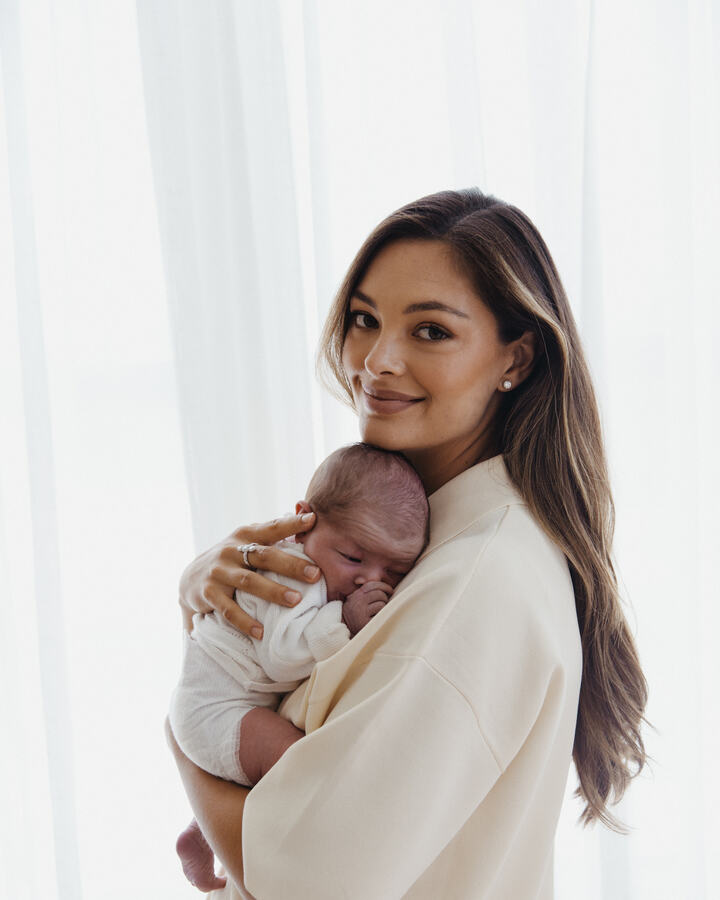


A note before you read: this piece discusses postpartum anxiety and intrusive thoughts.
Cameron Rogers has built a career on having honest conversations about the parts of life that nobody posts. As a certified health coach, mental-health advocate, and host of the Conversations with Cam podcast, she has made her name on candor about wellness and motherhood — the unedited version that doesn't fit on an announcement card. She is the expert who is supposed to have this stuff figured out.
And then she got pregnant with her third.
"This third pregnancy has humbled me," Rogers says. In fact, this has become kind of a refrain for her. Not because her first two were easy (they weren't), but because this pregnancy has been harder — physically and mentally — than she could have imagined. A familiar question keeps bubbling back to the surface: Can I really do this? Pregnancy while caring for two other kids, it turns out, is its own kind of math. Even experts are not exempt, which is somehow reassuring for the rest of us.
Both/And
If there's one thing Rogers wishes more people would say about pregnancy, it's that two opposite things can be true at the same time.
"I wish we allowed more space for the duality of emotions," she says. We're quick, she points out, to shut a struggling woman down — to play the someone-always-has-it-worse card, or to remind her that she wanted this, so she'd better be grateful. And those things may even be true. But so is the other thing.
You can be so grateful and excited to meet your baby, and pregnancy can be really freaking hard.
That and is the whole point. It's the thing the curated feed flattens, the both/and that gets collapsed into a single acceptable emotion — usually gratitude — when the lived experience is messier than that: two true things, felt at once. Rogers has spent a career making room for both.
The Part That Floors You
None of this means she resents being pregnant. The grateful half of the both/and is just as real — and it tends to ambush her in specific moments.
The anatomy scan is one. "Something about seeing the actual spine," she says, the small architecture of a person assembling itself on the screen, undoes her every time. WOAH, there is a real human in there. The first kicks are another: the strange, ordinary marvel of going about a regular day while quietly growing a person. The wonder doesn't cancel the hard parts. It sits beside them — gratitude and exhaustion, awe and nausea. The both/and, made flesh.
When the Tools Stop Working
Pregnancy comes with a cruel irony: the routines that normally keep you steady are the first to go. For Rogers, the irony doubles. She's the one who coaches other women through exactly this — and here she is, unable to coach herself.
Rogers is candid about it. Her practices shift with every pregnancy and the postpartum months — she's more tired, running on far less energy, and, in her words, "all I want to do is rot." Waking early to journal or meditate, finding the will to work out (the very things she knows help her most), becomes nearly impossible right when she needs them. "My mental health isn't great," she admits, "but I also am not prioritizing my practices the way I typically do." A double-edged sword, she calls it.
All I want to do is rot.
Her solution is to shrink everything down. Instead of abandoning the practices, she miniaturizes them into "bite-sized" versions — squeezed into whatever gaps the day affords. It's a small, practical act of self-honesty: when you can't do the whole thing, do a sliver of it. Of course, this is also the entire premise of the work she's known for — making the practices small enough to actually survive a hard season.
The Part Nobody Warns You About
Ask Rogers what nobody warned her about the fourth trimester, and the list comes tumbling out. "Where do I even begin?" she says. "The night sweats, the hair loss, the intrusive thoughts, the overwhelming joy and sadness, sometimes at once, the tears … there is so much."
It's worth slowing down on one of those, because Rogers, a mental-health advocate to her core, would want it handled with care rather than rattled off. Intrusive thoughts are one of the most common and least-discussed parts of postpartum. They are unbidden, vivid, frightening, and, crucially, not a reflection of who you are or a danger you pose. They are a known feature of the fourth trimester, and naming them is part of how they lose their grip.
Rogers has lived them. Her hardest nights came during her first postpartum stretch, in the spring of 2021, with the pandemic still humming its low note of dread underneath everything. "I had very intense intrusive thoughts, especially overnight," she says. She'd wake every hour or so, drenched in sweat and breast milk, gripped by terror that she had somehow wrapped her son in the sheets, even though he was sleeping safely in the bassinet beside her. The thought wasn't true, but the fear was. "Sleep deprivation combined with the hormone crash of postpartum is very real."
That she names the cause is the point — the terror was not a verdict on her mothering; it was sleep loss and a hormonal cliff. Saying so out loud is exactly the kind of honesty she wishes the culture offered more freely. She's glad, she says, that the fourth trimester is finally being talked about more.
Every Time Is Different
Across three babies, Rogers has learned that no two postpartums are alike. She calls the first stretch home "a bit of a fever dream," and she means all of it — the good and the impossible. With her first, it was the sheer not-knowing: she remembers leaving the hospital thinking we're just responsible for this baby now? Not much sleep, a lot of tears, a lot of happy, every day blurring into the next.
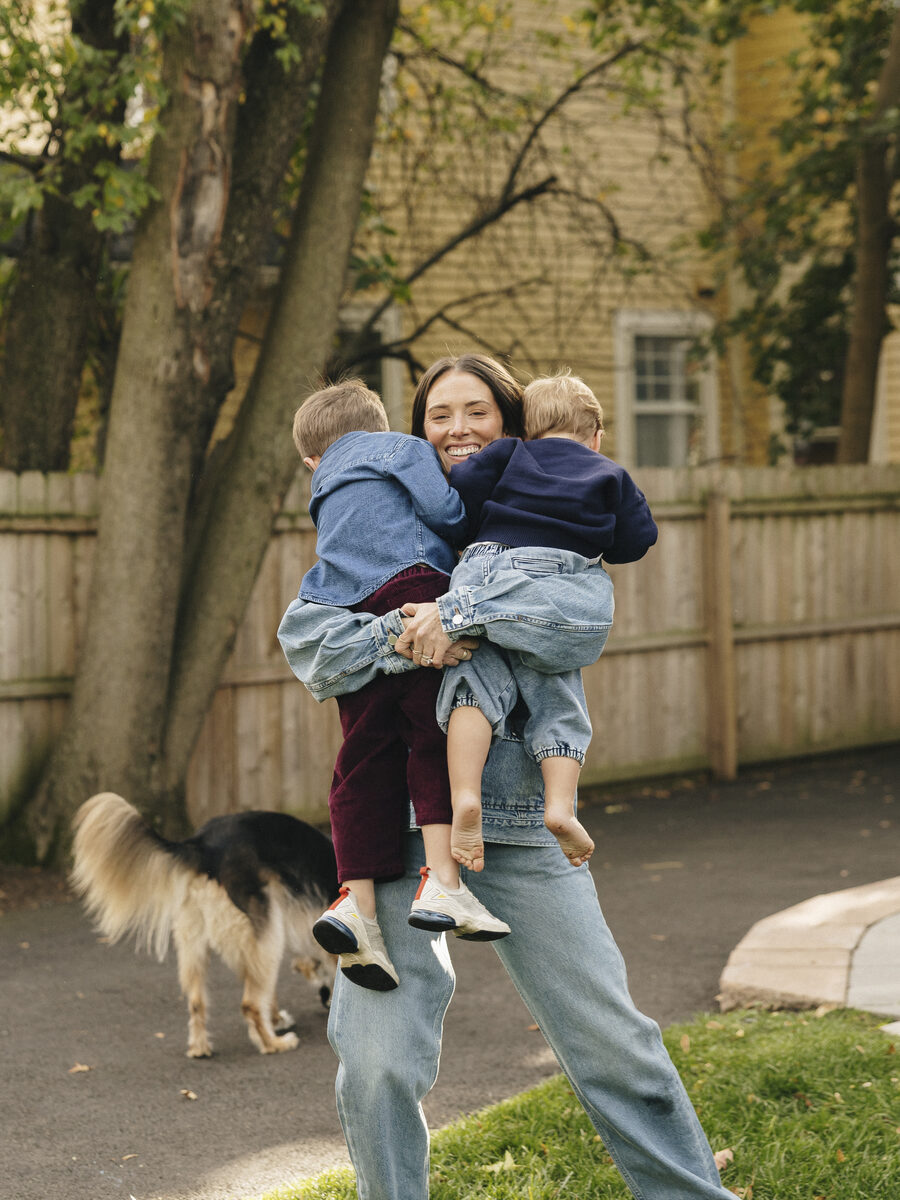
By her second, Rogers had the confidence. What she didn't have was the bubble. "That newborn bubble didn't really exist," she says, "because you have another kid to take care of." She remembers wearing her seven-day-old on her chest at her older son's Halloween parade, thinking: This is quite a different postpartum experience. Each baby, it turns out, arrives into a different life. By the third, she already knew the bubble wasn't coming. She'd be doing this one in motion.
Surrounded, and Still Struggling
All of this could read as the story of a woman alone in the dark. But that isn't the story.
Rogers describes her support system as "top-tier": her husband, her family, her friends, her nanny, even acquaintances who showed up in ways she didn't expect. Pressed on who didn't show up, she has a genuinely happy answer: no one. There wasn't a single person in her life who failed to.
It's a small but important correction to the narrative. The struggle was real, and so was the support — another both/and. What was hard about Rogers's pregnancies wasn't a hole in her village. The hardness lived inside the experience itself: in her body, in her sleep-starved brain, in the arithmetic of growing a person while raising two others. Being held by your people doesn't make it easy. It just means you're not alone in it.
Being held by your people doesn't make it easy. It just means you're not alone in it.
The Self That Goes Quiet
Pregnancy reshapes your identity before the baby ever arrives, and Rogers has felt this more acutely this time around. She describes it as a kind of disappearing act. "To be totally honest, I don't really feel like myself at all right now," she says, but the sentence doesn't end there. She talks about two moments she feels most like herself: "spending time together as a family, just the four of us at home, cuddled up in bed or on the couch," and "hanging out with girlfriends doing something completely unrelated to motherhood, pregnancy, and work." The self isn't gone. It's relocated — to the people she loves, and to the corners of her life that her roles don't touch.
That tracks with what she's let go of, and what she's kept. Since her first pregnancy, she's let go of the idea of perfection, of pleasing everyone. That release, she says, is the beautiful part of matrescence, the long psychological process of becoming a mother. "You realize you don't have time for the opinions of others you aren't asking advice from." What she guards instead is specific: her work, and her relationships — romantic and platonic.
The same discernment governs what she'll share. She can tell, internally, when something is hers to post and when it isn't — and that quiet line has grown firmer the more public she's become, especially around her kids.
It Is Not Forever
For all the honesty about how hard it gets, Rogers has been deliberate, this time, about holding onto the other end of it — the part she can see precisely because she's done this twice before.
To the women who follow her and are doing this too — pregnant, depleted, running businesses and creative lives on no sleep and less spark — she has one thing she most wants them to hear. It is easy, she knows, to mistake the present for the permanent: to believe you will always feel this tired, this uncreative, this far from yourself.
No matter how permanent this feels, it is not forever.
The spark comes back. The body that's been, as she puts it, hijacked by another person returns to you — not the old version, but an evolved one you'll recognize. That's not a bow on top of a hard story; it's the truest thing she knows, earned twice and offered freely. Both things are real: it is really, really hard, and it does not last. Cameron Rogers would just like you to be able to hold both — out loud, without apology, with someone reminding you that the second part is coming.
If you're struggling during pregnancy or postpartum, you're not alone, and help is available. Postpartum Support International (postpartum.net; call or text the helpline at 1-800-944-4773) offers free, confidential support and connections to local resources. If you're ever in crisis, call or text 988.
Follow along: Follow Cameron Rogers on Instagram @cameronoaksrogers, and listen to Conversations with Cam.