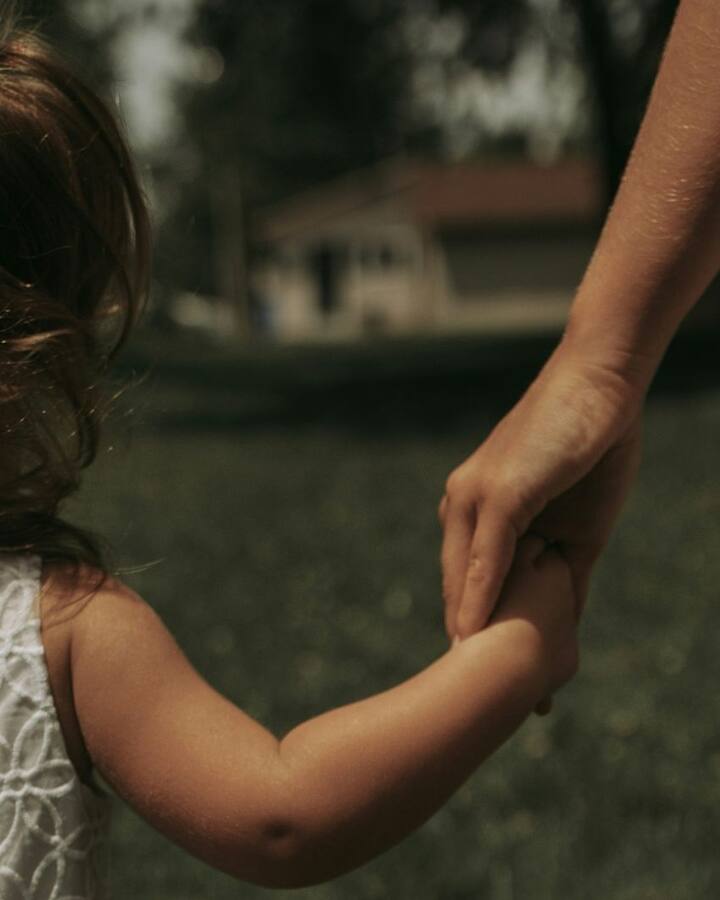


A typical morning in Heidi Montag's house is fast, loud, and almost entirely about two small boys. If she's lucky, she steals a few minutes for coffee. "Just a little moment to feel human," she says, "before the day takes over."
Then the boys are at school, and the same woman who just ran the breakfast shift turns to the other half of her life: music, vocal lessons, whatever's on the list. She's worked harder this past year than ever before — while being, by her own account, the most immersed mother of two she's ever been. Both are true at once, every day, and she's stopped treating it as a contradiction to resolve.
"I don't feel like I ever lose my identity," Heidi says. "But I'm definitely very busy. For me, it's about remembering that being busy doesn't mean losing sight of who you are."
It's a small sentence, but it begins to explain Heidi's last year and a half.
The Constant Underneath
Montag has lived much of her life in public and reinvented herself more than once along the way. Reality star. Pop artist. Wife. Mother. The internet has an opinion about every version. What she'll tell you is that none of those were ever costume changes.
"Even though I've lived so many different versions of my life, I've always been the same person at my core," she says. "Different phases of life help you grow and change, but the core of who I am has always stayed the same."
It's an easy story to get wrong. Most people assume each new version of Heidi wiped out the one before it. But she doesn't see it that way. The part that stays the same isn't the public role — it's the person underneath it, who has wanted more or less the same things all along.
Ask her to define success now, and Heidi doesn't reach for anything abstract. "Success is about accomplishing the goals I've set for myself," she says. "It's making sure my children are happy, having food on the table, and one day owning a home again."
That last item lands differently once you know what she means by it.
What She Won't Put on Display
Of course Heidi doesn't mind cameras. "I've always loved photographers and never really minded the paparazzi following me around," she says. For most of her life, being watched was just the weather she lived in. Then she had kids.
"It wasn't until I became a mom that it started to bother me," she says. With it came a new sympathy for every public figure trying to raise kids in the frame. She points to Jennifer Garner, who helped push for California laws protecting children from paparazzi. "Now I completely understand why."
The reason isn't simple, and it isn't about her. "My kids get scared, and they don't like photographers," she says. "They deserve the chance to just be kids, to have tantrums, make mistakes, and grow up without the pressures of those moments becoming public." She signed up for this life. They didn't. "I don't know whether they'll choose to live public lives one day, so until they're old enough to make that decision for themselves, I want to keep their exposure to a minimum."
They deserve the chance to just be kids without those moments becoming public.
It's the same instinct the fire would later sharpen: a clear-eyed sense of what belongs to the world and what doesn't.
What a Home Actually Is
In January 2025, Montag lost her Pacific Palisades home in the devastating Los Angeles fires. The family is in Santa Barbara now. And rebuilding, for her, has turned out to be less about square footage than about a question she didn't expect to have to answer: what actually makes a home a home?
"Having a home is about so much more than the place you live," she says. "It's where you make memories, where you share moments with the people you love, and where your life unfolds."
The hardest part wasn't the structure. It was the small, unrepeatable things inside it.
"One of the hardest parts of losing our home was sorting through the emotional weight of losing all of those little treasures that you can't replace — like children's paintings and the things we collected over time," she says. "It isn't about the things themselves, but those things hold so much meaning because they represent memories and moments in our lives."
A year and a half out, Heidi treats home as a daily practice.
"I've learned that home is something you continue to create," she says. "We're making new memories, doing new art projects, and finding ways to make the home we're living in now feel as special and familiar as the one we had before."
Mothering Through the Worst of It
Mothering through a crisis is its own kind of hard, and Montag doesn't soften what it took.
"It's been the most challenging experience of my life, and hopefully it will be the hardest thing I ever have to go through," she says. "I was dealing with the loss while also feeling my own body and brain go into survival mode. As a mother, your instinct is to protect your children, so my focus immediately became making sure they were okay — getting them enrolled in school, getting them clothes, creating a sense of stability as quickly as possible. I took care of myself last, because my priority was making sure they felt safe."
There's a detail that's hard to shake: her three-year-old still talks about the house burning down every day. It's not a memory the family has filed away — it's a live thing they're working through, together, in real time. And her instinct wasn't to fix it or rush anyone past it. It was to let it be said out loud.
"Thankfully, my family is very close, loving, and open, so talking about the fire has been a big part of our healing process," she says. "I try to listen to their emotions, comfort them, and show them a positive outlook without minimizing or trying to change what they're feeling. We're learning how to move forward together."
Comforting without minimizing sounds simple and is, in practice, one of the hardest jobs a parent has. Montag was doing it while her own body was still in fight-or-flight.
"I learned that it's okay to gather myself, take a moment, and come back," she says. "Nothing is ever as big as it feels in that moment, and somehow, everything works out."
What the Fire Left Behind
Ask Heidi what the crisis changed in her as a mother, and the answer is almost counterintuitive. It made her hold on less tightly.
"The fire taught me not to care so much about the little things — especially the messes," she says. "Before, I worried about things in the home getting ruined. Now, I've learned to let them make a mess, enjoy themselves, and not put so much importance on things."
It also rearranged her relationship with time. When you've watched how fast everything can be gone, being present beats planning for a future you can't guarantee. "Life is unpredictable," she says, "and this experience reminded me how important it is to be flexible, let go of fears and worries about what's ahead, and appreciate where we are right now."
The joy, when she names it, is almost aggressively small.
"The things that brought me joy were focusing on what was right in front of me — the little fingers, their eyelashes, their toes, all of those small moments that are easy to overlook," she says. "I only have this exact moment with them once."
I only have this exact moment with them once.
The Album That Came Out of All of It
Here is the part of the story that refuses to stay heavy. At the exact moment Montag was rebuilding from the studs, she was making the most personal work of her career. On June 26, she released Masterpiece, a thirteen-track album written during that same stretch of finding her footing after losing the house.
"This album feels especially meaningful because it was created during a period of finding my footing after losing my home," she says. "Music has always been such a big part of my life and my family."
And it genuinely is a family thing — not a career kept in a separate room. In the Montag house, music is the ambient weather: her songs, Christian music, spa music, kids' music, all of it on rotation, all day.
"It lightens the mood, brings everyone together, and usually turns into a dance party," she says. "Half the time we're practically living in a musical because we're always singing, especially with the kids."
Then there was the thing she'd been building toward: on July 18, she headlined her first-ever hour-long set at Neon Skies Festival, sharing the bill with Kesha and Slayyyter. She performed much of Masterpiece live for the first time — fan favorites like "Icon," "IV Drip," "Ex Machina," "Supermodel," and "Step On The Gas," alongside her new focus track, "Summer Love."
"It feels like such a full-circle moment," she says, "to take songs that came from such an important chapter of my life and bring them to the stage." The work and the motherhood aren't competing for her. They're both hers.
The Advice She'd Give the Woman Doing All of It at Once
Montag is, by any honest accounting, doing a lot: a career at full throttle, two young kids, a home being rebuilt from memory outward. She's exactly the person a lot of mothers watch and think, how. Her answer isn't a system. It's grace — give yourself a lot of it, she says, and credit for everything you're already doing. "You can do both," she says. "Your hopes and dreams can still come true while being a mother. Keep going and keep believing in yourself."
She's quick to say she hasn't cracked it. What she's after isn't a perfectly balanced life — it's a more peaceful, more present one, a different and more forgiving target.
"I've been working on creating more moments of peace, even if it's just taking five minutes to breathe and pray," she says. "There's always a to-do list, and I can put a lot of pressure on myself to make everything perfect. I'm learning that the goal isn't perfection, but finding a way to do it with more joy and more peace."
Which brings her back to where she started — busy, but not lost. Reinvented, maybe. But clear, now, about what she won't let go of.
In Her Own Words
What's the best part of being a mom?
"Everything! I love hearing what they say, what they think, and how they see the world. They make our home feel so full, bright, and exciting. They've taught me to relearn things and appreciate the little moments again — whether it's playing with rocks or finding joy in the simplest parts of life. They bring everything back down to the basics and remind me what is truly important."
What's something your sons have taught you?
"My sons have taught me another level of love. You feel love from your spouse when you get married and from your mom growing up, but the love you experience from your children is something completely different. It's such a fierce, unconditional kind of love. In their eyes, I can do no wrong. They remind me of the beauty of unconditional love."
What's one value you want your sons to grow up with?
"I want them to grow up with respect and love at the center of who they are. Respect for other people, for their family, and for themselves is one of the most important things you can teach a child. Most importantly, I want them to know how deeply they are loved and to carry that love with them throughout their lives. If they can lead with love, treat people with kindness, and be happy with who they are, that's the greatest thing I could hope for them."
A Two-Person Job
Getting them there is a two-person job, and it's one Heidi and Spencer have had to define for themselves. They did not arrive at parenthood from the same place, and she doesn't pretend otherwise. "We come from different backgrounds, and with that comes different values and perspectives," she says.
What they built instead of sameness is a system. She reads, constantly, and she trusts the instinct that reading sharpens rather than replaces. He listens. "Spencer is really good about listening to the research I do and working with me to come to a consensus together."
Then there are the moments she steps back on purpose. "I also know when it's important to let Spencer take over, because that's part of his role as a dad." It is less a division of labor than a running negotiation, and she describes it the way people describe a marriage that works: "It's about understanding when and where that balance is needed."
On Knowing She Wanted to Be a Mother
The wanting was never in question. It was the possibility that went missing for a while. Heidi says she wanted to be a mother from the time she was young, and then, in the years after The Hills, that certainty quietly closed. "There was a phase after The Hills when I didn't think motherhood was something that was possible for me and I was trying to figure out my own path."
She was not grieving a decision. She was grieving an option she no longer believed she had. What reopened it, she says, was faith. "I went through a period where I wasn't sure, but then God came into my life, things started to get back on track, and I was able to focus on my dreams and rebuilding my own foundation."
Motherhood came back into view only after she had rebuilt the ground underneath it. "That's when motherhood started to feel like a real possibility again, and I realized how much I wanted that chapter of my life."
It would be easy to tell Heidi Montag's story as a series of clean breaks — one life ending, another beginning, over and over. She'd tell it differently. The chapters changed her, sure. But losing the house — and, before it, learning to shield her sons from the cameras — clarified something that had been true all along: what's worth protecting was never the stuff, and never the image. It was the people.
The house is gone. The album is out. The stage is next. And the woman at the center of all of it is holding a lot less tightly to everything except the people in front of her.
Listen: Heidi Montag's new album, Masterpiece, is out now. She performed her first-ever hour-long set at Neon Skies Festival on July 18, headlining alongside Kesha and Slayyyter. Follow @heidimontag for more.