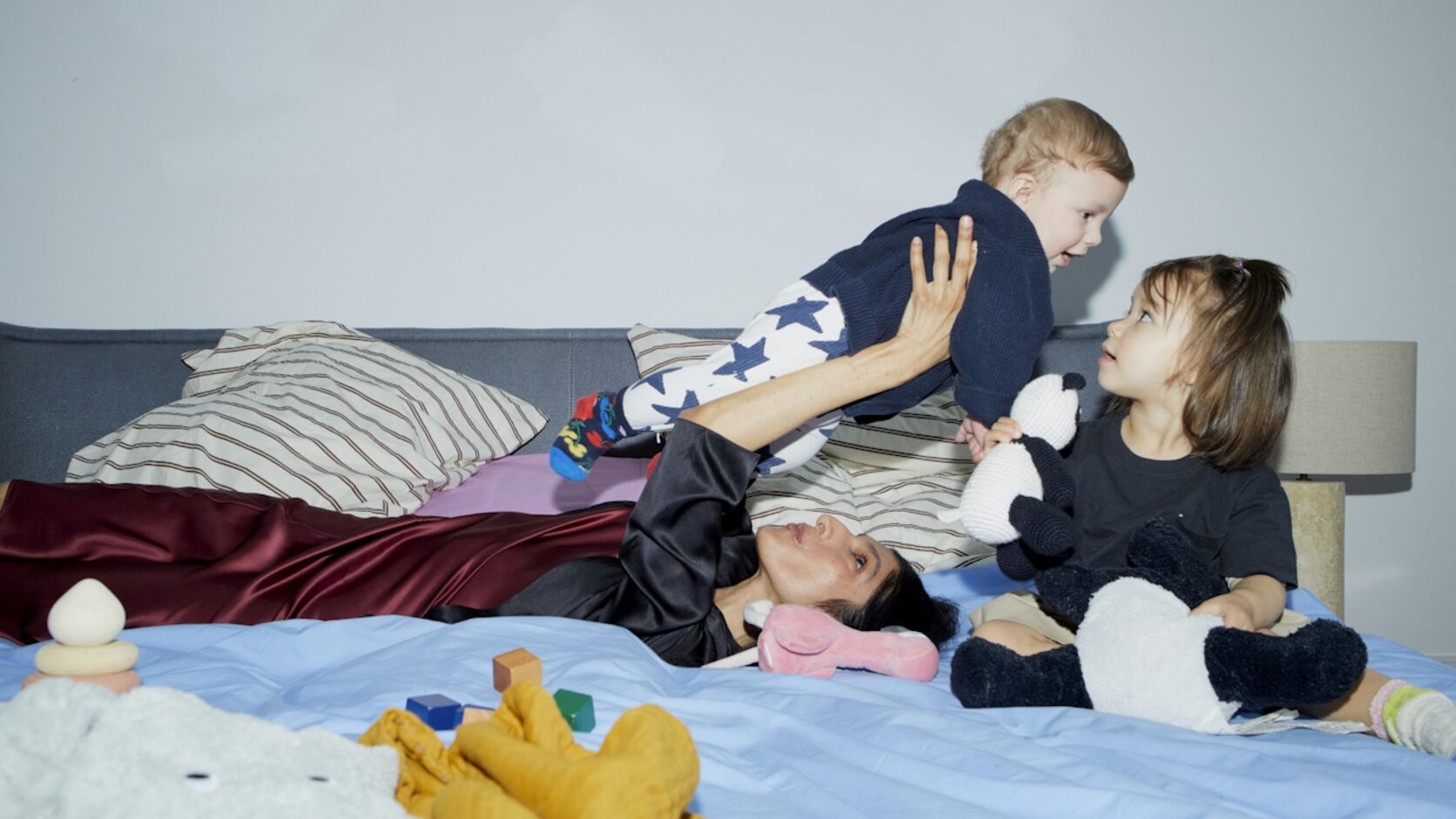
There is a specific moment many mothers can recall, even if they cannot name the date it happened. The moment when they introduced themselves as someone's mother and did not add anything else. Not their name. Not their profession. Not any of the dimensions of identity they had spent years building. Just the role. Just the relationship. Just the one name that, somewhere in the relentless accumulation of early parenthood, had quietly become the only one they were bothering to offer.
It does not happen all at once. There is no single turning point. It happens the way most significant things in early motherhood happen: gradually, without announcement, until one day you look up and the person in the mirror has an entirely different relationship to herself than the person you remember being — and you cannot quite trace the path from one to the other.
According to a 2023 Pew Research Center survey, the vast majority of mothers — 88% — say that being a parent is the most, or one of the most, important aspects of who they are as a person, with 35% saying it is the single most important aspect, compared to 24% of fathers. That number is not surprising to most mothers who encounter it. They lived inside it. What is less often named is that being most strongly defined by your motherhood is not the same as being defined only by it — and that the difference between those two things matters enormously, for the mother and for the family she is building.
The average American mother spends roughly 98 hours a week on caregiving and household management. When you are running that many hours at that level of intensity, the question of who you are outside of those hours rarely gets much airtime.
How it happens
The research on how the maternal identity eclipse occurs is more specific than the cultural conversation suggests. It is not simply that children take up time, though they do. It is that the specific cognitive and emotional demands of early motherhood restructure the interior life in ways that make other things harder to access even when time is technically available.
Research published in Women's Health Issues argues that the transition to motherhood should be formally recognised as a critical and sensitive developmental period — one comparable in scope to adolescence, with biological, psychological, social, and existential dimensions that reshape maternal identity at its core. The self that existed before is not eliminated. It is reorganised into a new configuration in which the maternal role occupies most of the available space, particularly in the early years when the demands of care are most total and the infrastructure for meeting them is least developed.
Dr. Aurélie Athan at Teachers College, Columbia University — whose work revived the concept of matrescence for modern audiences — describes this as a developmental passage rather than a loss, but one that requires conscious effort to navigate. The professional self, the creative self, the social self, the intellectual self that had opinions about things unrelated to anyone else's schedule — these selves go quiet not because they have been abandoned but because the noise of caregiving has simply been louder, longer, and more continuous than anything in the previous life had prepared anyone for.
"Losing yourself in motherhood is so common," says Heidi McBain, a marriage and family therapist who specialises in coaching mothers. "Women are often socialised to put other people's wants and needs before their own, which can be an easy pattern to continue in motherhood." It is one of the reasons the identity shift of becoming a mother can feel less like a choice than a current.
What it actually costs
The identity eclipse of early motherhood is, to a significant degree, culturally sanctioned. A mother who is entirely absorbed by her role is performing the role correctly, according to the story we tell about what good mothering looks like. The mother who insists on remaining a full person with dimensions outside of her children is, in many cultural framings, performing something slightly suspect — a selfishness dressed up as self-care. VETS founder Amber Capone, who held her family together through her husband's PTSD, puts the counter-argument plainly: "We all have an identity outside of caretaker, spouse, mom, sister, friend."
The research does not support this framing. When maternal and societal expectations outpace a woman's sense of individual identity, the result is often a feeling of losing oneself or disappearing into the role — an experience that research consistently links to increased rates of anxiety, depression, and emotional exhaustion.
A major 2025 study published in JAMA Internal Medicine, examining data from more than 198,000 mothers, found that the percentage reporting excellent mental health dropped sharply from 38% to 26% between 2016 and 2023 — a decline that crossed every socioeconomic subgroup and began before the COVID-19 pandemic, as the University of Michigan's Institute for Healthcare Policy and Innovation documented in its coverage of the findings. The erosion of individual identity under the comprehensive demands of the maternal role is one of the structural contributors to that pattern.
The 2025 Frontiers in Psychiatry paper on matrescence and maternal mental health identifies identity diversity — the experience of being a person with multiple dimensions rather than a role with no dimensions outside it — as one of the more reliable predictors of psychological wellbeing in mothers. This is not because mothers who maintain individual identities love their children less. It is because the person doing the parenting remains more sustainable, more resourced, and more present when she is also, in some meaningful way, herself.

Why the reclamation feels so complicated
Most mothers know, intellectually, that they need to reclaim the parts of themselves that have gone quiet. Most mothers also know, viscerally and in a way the intellectual knowledge does not fully resolve, that doing so feels like something they have not yet earned.
This is the permission problem that research on maternal identity consistently identifies as one of the primary barriers to individual self-recovery. The deeply internalised belief that spending time on something that serves only yourself — the writing, the friendships, the interests and opinions and creative practices that belong only to you — is a selfishness that the demands of motherhood have placed indefinitely on hold. That it will be available again later, once the children are older, once the household is more settled, once enough mothering has been done to have earned the right to do something else.
Licensed counselors who specialise in maternal wellbeing are consistent about the cost of this belief. The mother who waits until she has earned the right to be herself again tends to wait a very long time. The children grow older and the household becomes more settled and the external demands reduce — but the habit of self-effacement has become structural by then, and the identity that was supposed to return finds that the space it used to occupy has been reorganised in its absence.
The reclamation, when it works, does not wait for permission. It creates permission. It decides, in the absence of external authorisation, that the individual who preceded the arrival of children is not required to justify her continued presence. The artistic pursuit, the deep connection with friends, the bodily rigour, the career goals — these are far from indulgences to be granted only after a long season of devotion. They are the conditions under which the person doing the parenting remains a full person, which is the condition under which the parenting remains sustainable.
The reclamation is not dramatic
The cultural fantasy of maternal reclamation involves a pivot. A decision. A morning when everything feels different and the self that went quiet has suddenly, unmistakably, returned.
What the research on identity recovery in mothers actually describes is something considerably less cinematic. It is a series of very small choices, made slowly, without fanfare, with no single moment that constitutes the turning point. Putting your own name back into the conversation when meeting people. Answering "I'm a writer" or "I'm a teacher" or "I run a business" instead of "I'm at home right now" — the apologetic, hedging answer that frames professional identity as something requiring explanation when it exists alongside a child. Starting a conversation that has nothing to do with anyone's schedule.
A 2025 pilot study evaluating a matrescence-informed education program for new mothers found that participants who developed a deeper understanding of the identity shifts involved in the transition to motherhood reported gains in self-compassion, personal strength, and relationships — suggesting that simply naming and understanding the experience produces measurable benefit even before the external circumstances change.
For mothers navigating this territory, Postpartum Support International's peer support groups include resources specifically designed for the identity dimensions of the maternal transition, not only the clinical ones. The Maternal Mental Health Leadership Alliance's resources for mothers and families provides additional support connections searchable by location and need.
What the research ultimately says
The matrescence framework describes the transition to motherhood not as a diminishment but as an expansion. The woman on the other side of the transition is not smaller than the one who went in — "Simone is still Simone," as one mother of four put it, "I'm just wiser." She is more complex, more capable, and more fully realised — though she may need significant time and intentional effort to recognise herself in that description.
Research published in Women's Health Issues argues that recognising matrescence as a critical developmental period has the potential to drive meaningful improvements in maternal health outcomes, and that integrating this understanding into policy and clinical practice is urgently needed.
"Mrs. Oliver's Mom" — or whatever name the role has given you — is a real person. She is real and she matters and she has become things she could not have become any other way. She is also not the only person you are. She is one name among several. The writer, the runner, the person with opinions about cities and art and everything else that used to matter — those people did not disappear. They went quiet. They waited.
The school teacher eventually learns your name. You tell her. She writes it down.
It feels, in a way entirely disproportionate to the smallness of the moment, like something being returned.
Frequently asked questions
Is it normal to feel like "Mom" has become my whole identity?
Yes — it's close to universal, and the research names it. A 2023 Pew survey found 88% of mothers say being a parent is among the most important parts of who they are, with 35% calling it the single most important. That's not a problem in itself; the issue is the slide from being most strongly defined by motherhood to being defined only by it. The other dimensions of you haven't been erased — they've gone quiet under the sheer continuous noise of caregiving.
Why does losing yourself happen even when you love being a mother?
Because it isn't about love or time alone — it's about cognitive restructuring. The average American mother runs roughly 98 hours a week of caregiving and household management, and research in Women's Health Issues frames the transition as a critical developmental period that reorganises the interior life so the maternal role occupies most of the available space. The professional, creative, social, and intellectual selves go quiet not because you abandoned them but because the noise of care has simply been louder and more continuous.
Is reclaiming time for myself actually selfish?
The research says the opposite. The 2025 Frontiers in Psychiatry paper identifies identity diversity — being a person with multiple dimensions rather than a role with none outside it — as one of the more reliable predictors of maternal wellbeing. Mothers who keep an individual identity don't love their children less; they remain more sustainable, resourced, and present. The interests and friendships that belong only to you aren't indulgences earned after enough devotion — they're the conditions that keep the parenting sustainable.
What does reclaiming yourself actually look like day to day?
Far less cinematic than the cultural fantasy of a single dramatic pivot. It's a series of small choices made without fanfare: putting your own name back into introductions, answering "I'm a writer" or "I run a business" instead of the apologetic "I'm at home right now," starting a conversation that has nothing to do with anyone's schedule. A 2025 pilot study found that simply understanding the identity shifts of matrescence produced gains in self-compassion and personal strength — even before circumstances changed.
Where can I find support for the identity side of motherhood?
Postpartum Support International's peer support groups include resources designed for the identity dimensions of the maternal transition, not only the clinical ones, and the Maternal Mental Health Leadership Alliance offers resources for mothers and families searchable by location and need. Naming the experience — to a friend, a partner, or a counselor specialising in maternal wellbeing — is itself part of the work; the reclamation doesn't wait for permission, it creates it.
Related reading
- You Were a Whole Person Before You Had Kids. Here's How to Remember Who That Was.
- Matrescence: The Word That Finally Names What You're Going Through
- Losing Yourself in Motherhood? The Identity Shift Nobody Prepares You For
- Heidi Montag Made Her Most Personal Album Yet—All While Raising Her Boys and Keeping Them Out of the Spotlight
- When Your Children Need You Differently, Who Do You Become?