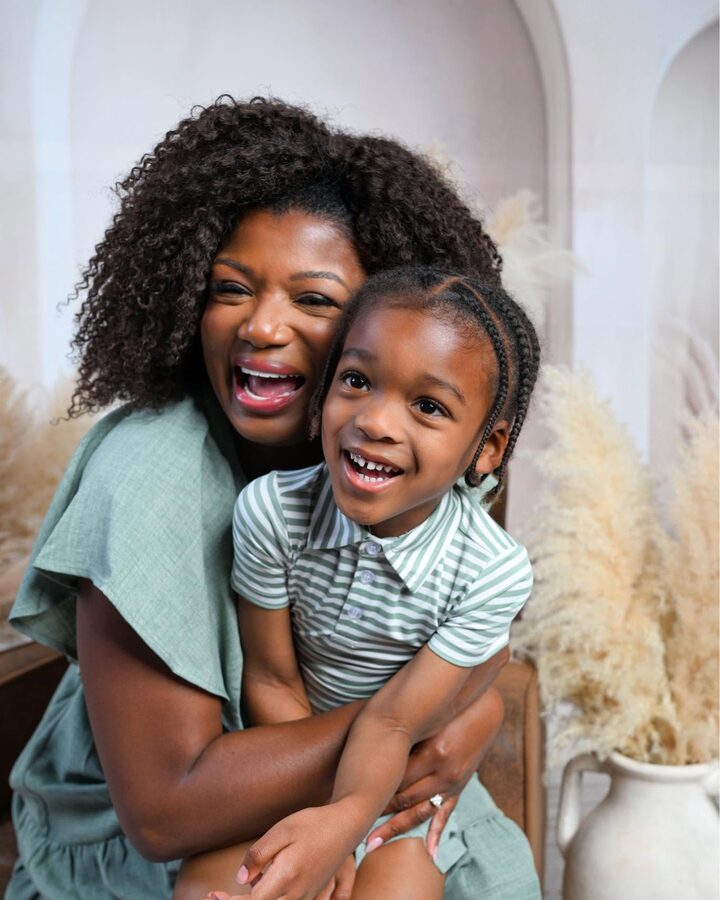

A woman who moves with quiet confidence is the most lethal weapon there is. You recognize her the way you recognize a note held perfectly in tune. She does not perform calmness, nor does she manage your impression of her, or dilute her aura and energy to shrink to your expectations of her. When you ask her a question, she does not reach for the answer that might sound better, or the one that will validate your heart. She tells you what is true, and lets the truth do its own work.
Simone I. Smith is that woman.
You probably know her by proximity. The wife of the hip-hop legend you know as LL COOL J. Jewelry designer. Cancer survivor. Mother of four. And — the title she says with the most delight, the one that has softened her — MoMa, the name her grandchildren gave her.
Simone I. Smith has spent the better part of her life being introduced by way of other people. Sit with the story she actually tells, and the woman who steps forward is one filled with fierceness, grace, and a bold unshakeable faith.
Ask her who she is beneath all of it, and she does not reach for a softer version. "I was unapologetic then, and I'm unapologetic now," she says. "Simone is still Simone. I'm just wiser. I'm greater. I'm living. And I know for sure that God's plan for my life is better than any plan I could ever have for myself."
I was unapologetic then, and I'm unapologetic now.
Simone is still Simone. This is the ethos behind everything — the marriage, the survival, the business she built out of the exact place her body was broken. This is the story of a woman the world kept trying to shrink, and who declined the invitation every time.
The Simone before
The strength, she is careful to say, did not arrive with the diagnosis. There was a Simone before the illness, before the business, before anyone called her MoMa, and that woman already had it.
"I still carry that Simone with me," she says. "She reminds me that I am strong. I've always been strong — even before I knew just how strong I would have to be. Life has tested that strength in ways I could never have imagined, but she was always there. That strength was always in me."
It is a quiet correction to the story we like to tell about hard seasons — that they forge us from nothing, that we walk into the fire as one woman and are refined into another. Simone's telling is more merciful. The fire only found what was already there, and asked it to hold.
There is a powerful distinction behind this. A woman who believes her strength was manufactured by the crisis spends the rest of her life bracing for the next one, unsure she will have what it demands. However, a woman who believes the strength was always hers walks in already carrying it, no matter what life throws her way. Simone is the second kind. She met the hardest season of her life already knowing what she was made of.
That strength was always in me.
A daily walk
Trace any thread of her life back far enough and you arrive at the same foundation. Before Simone is a designer, a wife, or a mother, she is a woman of God — and she says so before she says anything else.
"I'm not a saint," she says candidly. "It's a daily walk for me to trust God in all things, because the flesh is weak and emotions are real." The faith shows up in every role she holds — "as a wife, a mother, a MoMa, a friend, and a businesswoman" — as something she practices daily. She is, in her words, "learning every day to trust Him more and allow Him to lead me."
It is the kind of faith that only shows its strength underneath the massive load, and Simone has carried it all. Ask her what gratitude looks like on the days that do not cooperate, and there is no performance in the answer. "On the hard days, gratitude looks like prayer and trusting God," she says. "No matter what the circumstances look like, I trust that He will work all things out for my good."
Faith like this is easy to admire from the outside and harder to embody innately. It asks for the same decision every morning, made against a body that is tired and a heart that has its own opinions. Simone does not pretend otherwise. When she says the walk is daily, she means daily — a road she is still on, one deliberate step at a time.
Eight years
She met Todd in 1987. She did not marry him until 1995. In between were eight years, two children, and — by her own account — a two-year breakup and a great deal of growing up on both sides. In a culture that sells the instant yes, Simone took the better part of a decade to give hers.
Eight years is a long time to keep anyone waiting, and a long time to be certain. What she was doing across those years has a name, even if she would never reach for it: due diligence. She was studying how a man moved through the world before she agreed to move through it beside him. She knew what she was looking for. "Todd loved the Lord, and that mattered to me," she says. Perfection was never the requirement — those years taught her that "choosing a partner for life isn't about finding someone perfect." What she wanted was sturdier than that. "It's about growing together, going through life together, and trusting that when God is at the center, He can work through all of it."
The marriage that followed has been long and public, and, like every honest one, it has been tested. The lesson that cost her the most was also the plainest. "You can't change another person, but you can change how you show up," she says. She stopped fighting to win. "I had to realize that I'm not going to win every argument, and everything doesn't have to be a battle." She turned the question back on herself — "I don't speak to you that way, so why speak to me that way?" — and she found that "sometimes when people see a positive change in you, they start changing too without even realizing it."
You can't change another person, but you can change how you show up.
It is the least glamorous wisdom in any marriage and the hardest to actually live, because it asks you to set down the most seductive idea there is — that you are right, and the other person is the problem to be solved. Simone set it down, and as soon as she did, everything shifted for her and around her. It is the same quiet arithmetic that runs underneath every long partnership that survives its hardest years.
The foxhole
Which brings us to the operating room.
When Simone's illness demanded microvascular reconstructive surgery, Todd did not flinch from the foxhole. He asked whether he could give her his own tibia, because it was bigger and stronger than hers. Her surgeon had never seen anyone do something like this. "The doctor said, 'Wow, no spouse has ever offered their limb in a surgery like this, and I do these surgeries all the time,'" she recalls. For Simone, the moment carried scripture inside it. "God created woman from Adam's rib, and my man was willing to give me a piece of his limb," she says. "That's love. When someone is willing to stand in the foxhole with you and literally give a piece of themselves for you — you never forget that."
Some love announces itself in speeches. Hers announced itself through a diagnosis and a husband who was willing to do what it takes. Sit with the size of that. That is sacrificial love, one that knows no bounds and continues to stand the test of time. Love is many things all at once, but most of all, love is action, unwavering strength, and the courage to choose each other during some of your hardest moments.
Four in the morning
Survival was only the first part. What came after surgery was the long, unglamorous work of learning to walk again — and Simone did not do it alone. Her grandmother kept a standing prayer call, at four in the morning, a circle of women lifting her up in prayer before and after the surgery. She talks about needing them without a flicker of shame.
"Sometimes in life, when you're weak spiritually, you have to have someone — or someones — in your life who can pray for you when you feel like you can't pray for yourself," she says. "That's that God strength. That's that 'I can do all things through Christ who gives me strength' kind of strength. I learned that I didn't have to carry it all by myself."
There is a particular loneliness in being the strong one, and a particular grace in being allowed, for a season, to stop being the strong friend/wife/daughter/mother/leader. Simone had spent a lifetime as the woman others leaned on. Learning to walk again taught her how to lean on the strength of those around her, and let the prayer of a grandmother and a room of women stand in for her own on the mornings she had none of her own to give.
If she could reach the woman she was in that season — flat on her back, relearning how to put one foot in front of the other — she would keep the message short. "Trust God. Trust His plan and trust the process," she says. "… one day you'll look back and see that He was with you every step of the way."
She never stopped tending the body that carried her through. She had kickboxed, done Pilates, and lifted weights before the surgery; afterward, when she could not walk, she worked her upper body from where she lay. "I can't kickbox anymore, but I still work out and I never stopped," she says. "Weight training strengthens your bones, and movement keeps your body strong. Twenty-plus years later, I understand even more how important it is to take care of the body God gave you."
She is right about the mechanism, too: weight-bearing and resistance exercise is one of the few things shown to build and hold bone density over a lifetime. Twenty-plus years. That is how long she has been cancer-free.
The lollipop
Here is where Simone's story turns from survival into something that is pure devotion. The same operation that saved her disfigured a tattoo she loved — a lollipop. She could have grieved it and moved on. Instead she made it the second design of her jewelry line.
She rendered it in purple, her favorite color, and set it in diamonds. Then she partnered with the American Cancer Society, and when she learned of their "More Birthdays" campaign, she reimagined the lollipop in all twelve birthstones — one for each month, one for each birthday a survivor fights to keep. "What happened to my body became an opportunity to create something beautiful that represented hope, survival, and more birthdays," she says.
A woman merely surviving her story would have covered that scar and looked away from it. Simone found inspiration from it and turned that grief into something a stranger would wear with joy. The disfigurement became a design. The design became a fundraiser. The fundraiser became twelve stones, one for every month a survivor gets to keep. It is one thing to make it through the worst year of your life. It is another to reach back into it for raw material that continues to have timeless impact and give back to the community.
What happened to my body became an opportunity to create something beautiful.
The rest of her jewelry line runs on the same refusal to shrink. Long before high fashion turned to look, Simone was designing for a woman the industry had overlooked, and she knew her intimately. "I understood that she likes a hot hoop!" she says. "Big, bold, and she's not afraid to wear them." She built jewelry to celebrate that woman "instead of asking her to tone it down."
Understand what she was really doing there. Fashion had looked at a whole category of women — bold, styled, unafraid of a statement earring — and decided they were not the customer. Simone looked at the same women and saw herself. She built a mirror that reflected the market everyone else had ignored, and she stood in front of it first. It is the same instinct behind so many of the businesses Black mothers build: not a gap in a market study, but a need they already knew from the inside.
Her ethos — Simone is still Simone — shines through even in her jewelry line, this time cast in gold. Her whole philosophy fits inside a single hoop; a full circle, worn loud, that will not be pressed into a smaller shape. Sixteen years into the business, the lesson that stayed with her had nothing to do with metal or stone. "Business has taught me that there will be great seasons and challenging ones, but you can't give up," she says. "Sixteen years later, I'm still here, still creating, and still learning."
MoMa
The woman who built all of that started out as a girl raising girls. Simone was nineteen when she had Najee, twenty when she had Tali, then twenty-five and thirty for Samaria and Nina. "My patience was shot!" she says, laughing. "Najee and Tali really grew up with me. I was learning life while I was raising them."
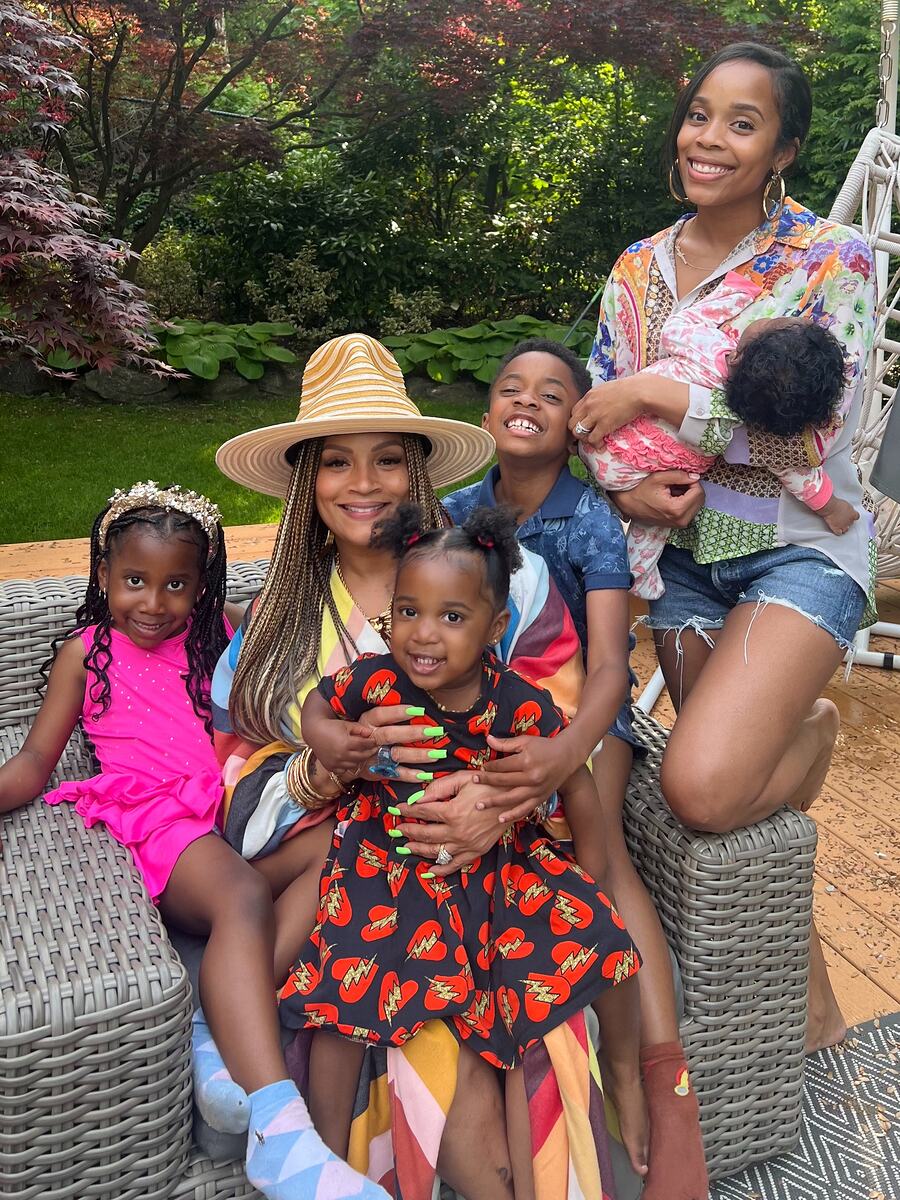
The grandmother she is now moves differently. "Being a MoMa, I'm older, wiser, and more patient," she says. "I understand now that everything doesn't have to be so serious. I can slow down, enjoy the moments, and give my grands a little more grace." The grace she pours into them is the grace she did not have the margin for the first time. It caught up with her.
Grandmotherhood, for Simone, is the promotion into the part she had to skip the first time around — the slow part, the tender part, the part where you are not also learning how to be a person while you are busy raising one.
She has exactly one piece of advice for her daughter, and she gives it with a grin: "Listen to your mother." "I've done this four times! I've learned a few things along the way," she says. "Sometimes the advice your mother gives you comes from lessons she had to learn the hard way." When she imagines what her grandchildren will one day say about her — not as LL COOL J's wife, but as their MoMa — she jokes first about the eight-year-old grandson who is not yet sold on her fashion advice, then lands somewhere tender. "More than anything, I hope they always know how deeply their MoMa loves them and that I will always be there for them."
Leading yourself
Ask Simone what a whole new landscape of leadership looks like for a woman like her — faith, survival, family, and art carried all at once — and her answer turns inward. "Leadership isn't just about leading other people. It's about leading yourself in a way that inspires others to follow," she says. "For me, true leadership is being able to stand firm, disagree passionately, and call out what's wrong without losing your grace or integrity. That's what true strength and leadership look like to me."
It is the golden thread of her whole life, said plainly, and it is the same definition the women rewriting what leadership looks like at the top keep arriving at independently. You cannot lead anyone anywhere you have not first walked yourself. And Simone has walked through it all — the diagnosis, the surgery, the long, humbling work of relearning how to put one foot in front of the other. She came out the other side holding the rarest authority there is — the kind that is innately embodied. The authority of a woman with nothing left to prove and nothing left to hide.
She has been telling us this story the whole time, in a language you can wear. The hoop that refuses to shrink — a full circle that never lost its shape, worn loud. The scar set in diamonds, unbroken. The lollipop tattoo reborn in twelve colors, one for every birthday she fought to keep. Everything the world built to make her smaller, she rebuilt into a life that is thriving, and a brand that is timeless.
This is the woman beneath the famous name. A woman of God. An artist. A survivor. A wife and mother. A MoMa. A force entirely her own; still becoming, still creating, entirely herself. Simone is still Simone. Wiser. Greater. Living. And entirely, unapologetically, herself.
Follow Simone Smith on Instagram. And check out her jewelry line, it's absolutely gorgeous!