
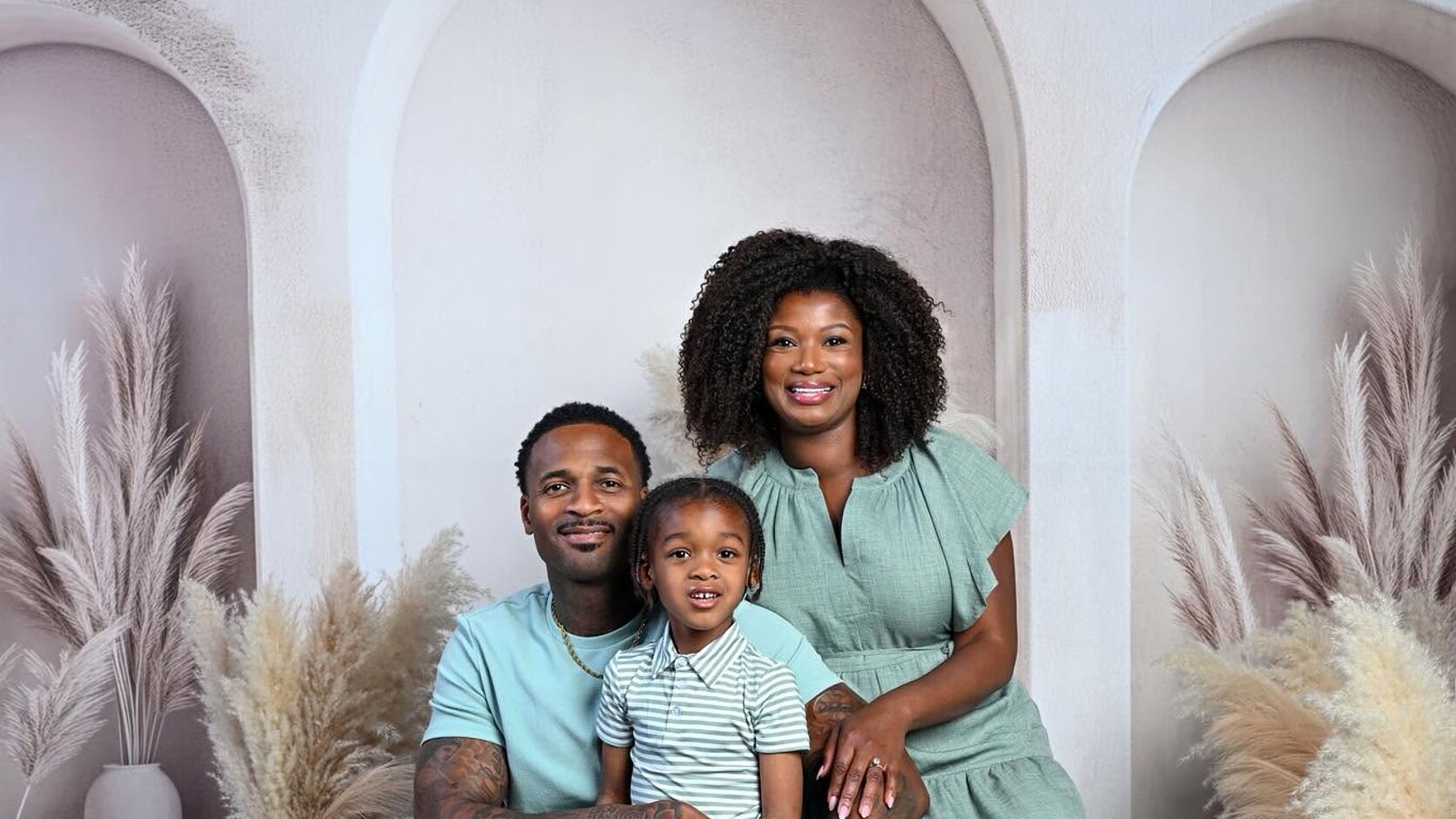
Some days she is filming content in the car between therapy appointments. Some days she is answering emails at midnight, long after her son has finally fallen asleep. And some days, she says, she has a perfectly color-coded schedule and still nothing goes the way she planned, because motherhood, especially motherhood raising a child with additional needs, teaches you flexibility whether you signed up for it or not.
This is not the life LaShonda Unseld Hopkins imagined for herself. That is exactly why she wants to talk about it.
Before she became the woman answering emails at midnight, she was, in her own words, a go-getter. "My goals were my goals," she says, "and honestly, I didn't have to think about anyone else when making decisions." She traveled often. She poured herself into her careers. She chased the next promotion, the next rank, the next rung on a ladder she had every intention of climbing to the top. There was more time then, she remembers, to pour into herself, her ambitions, and the image of success she thought she wanted.
She earned her Ed.D. She commissioned as an officer. She built a six-figure career inside the federal government and, for a long time, believed she could balance all of it. "I was the woman who handled everything, figured everything out, and kept pushing no matter how exhausted I was," she says. That version of her had a backup plan for the backup plan. That version of her believed that if you prepared well enough and worked hard enough and stayed strong enough, life would more or less cooperate.
And then it didn't.
The Only Option
Right before her son Major's third birthday, he was diagnosed with Level II autism. Around the same time, her husband was moving into the fire service, a transition that brought long hours, unpredictable schedules, and its own kind of sacrifice for the whole family. Almost overnight, their days reorganized themselves around therapy appointments, evaluations, school meetings, and the relentless work of making sure their son had the support he deserved.
"Major's therapy schedule alone felt like a full-time job," she says. As workplace flexibility began to disappear — the telework, the compressed schedules, the wellness hours, the same quiet unwinding of flexibility mothers across the country have been absorbing — she found herself caught between two people she could not both be at once. The employee she used to be. The mother her son now needed.
Eventually, she stopped trying to be both.
People love to tell her how lucky she is to be home. She understands why they say it. She also wants to be honest about what the choice actually was, because staying home is a choice that still gets treated like an explanation owed. "I didn't walk away because I stopped being ambitious," she says. "I walked away because my priorities changed." Her son needed advocacy, consistency, patience, and presence. Leaving was one of the hardest decisions she has ever made. It was also, she says, the one that gave her family a little slice of peace.
What almost no one tells you is that a decision like that comes with a grief of its own. "I had to grieve the version of myself that thrived in corporate spaces," she says, "while learning to embrace the version of myself motherhood was shaping me into."
I had to grieve the version of myself that thrived in corporate spaces while learning to embrace the version of myself motherhood was shaping me into.
Is there a version of you that you had to grieve to get here?
Hell yes. Honestly, I grieve a lot. I grieve the version of myself that thought motherhood and marriage would look completely different than this. So many women grow up with a picture in their heads of what life will be. The career, the finances, the body, the partnership, the motherhood moments. And then real life happens. Sometimes real life asks you to sacrifice versions of yourself you worked really hard to become.
I grieve career opportunities I know I would have taken if my circumstances were different. I grieve the financial stability I once had. I grieve my old body before pregnancies and stress and survival mode changed it. I grieve freedom. Simplicity. The ability to make decisions only thinking about myself.
What shocked me most is realizing how much women silently compromise. So much of motherhood is invisible sacrifice. There are days I miss the woman I used to be deeply. But she couldn't become who I am now without losing parts of herself along the way. I don't think grief and gratitude cancel each other out. Both can exist at the same time.
The Rebuild Is Not Glamorous
Rebuilding financially after leaving a guaranteed paycheck has been, she says, one of the most humbling things she has ever done. When you are used to benefits and stability arriving every two weeks, entrepreneurship feels like standing on a floor that keeps moving. "There's no clocking out mentally," she says, "because your income is directly tied to your ability to create, market, network, and keep showing up, even on hard days."
So she shifted her mindset and got to work. She turned to social media, content creation, brand partnerships, and affiliate marketing — the same kind of from-scratch reinvention a growing number of mothers are building in the space their old careers used to occupy. She leaned into her experience as a two-time gestational surrogate and began educating and advocating for other women considering the same path. What started as simply sharing her story slowly became something she never planned for: multiple streams of income, and opportunities she did not see coming.
She wants to be careful here, though, because she knows how "multiple income streams" reads online. Freedom. Ease. A woman who figured it out. The reality behind the phrase is pressure, uncertainty, and constant pivoting. "I've cried over finances, questioned myself, and wondered if I made the right decision more times than I can count," she says. She is, by her own admission, still rebuilding. Still learning. Still figuring it out day by day.
She keeps talking about it anyway, because she thinks women deserve to see the truth. "Sometimes reinvention doesn't look polished," she says. "Sometimes it looks like surviving, adapting, and creating a new version of success that actually works for your life and your family."
Major
Ask LaShonda about her son and the register changes completely.
"My son Major is truly one of the greatest blessings of my life," she says. "He's smart, funny, loving, energetic, and honestly teaches me something new every single day." The autism diagnosis, which arrived just before his third birthday, shifted their lives in countless ways. It never once changed who he was. "An amazing little boy deserving of love, patience, support, and understanding," she says.

He is thriving. He is making enormous progress. And she wants people to understand what usually sits invisible behind those two facts: the therapy schedules, the evaluations, the endless phone calls, the research into treatments, the fighting for services, the constant adjusting of routines. "People see milestones online," she says, "but they don't always see" everything it took to get there.
Her husband is, she is quick to say, an amazing father, and they work as a team. Realistically, though, she is the default parent, and that role can feel very heavy. She is the one coordinating therapies, communicating with doctors and schools, managing the calendar, researching interventions, and making sure her son's world feels safe. It is the mental load at its most consequential. Autism parenting, she says, means you are always thinking ahead. Always planning. Always advocating. Always on.
She has learned to celebrate the things the world tends to overlook. A new word. A moment of connection. A new food. Eye contact. Joy. "Things many parents may take for granted become huge victories in our home," she says.
And she is honest about the grief that lives alongside the joy. There are moments she mourns the small pictures she once had of motherhood: the long conversations, the funny videos made together, the answer to "how was your day." She carries fear too, the kind that keeps a parent up at night. She worries about her son being misunderstood, left out, made fun of because he may not respond to a question or look at a camera. "I hate feeling like I constantly have to explain my child to the world just so people will extend him patience and kindness," she says. "And honestly? Sometimes it's really fucking hard."
Then, in the next breath, the strength she did not know she had. "I've learned that I am far stronger than I ever gave myself credit for," she says. She remembers crying, convinced Major might never be potty trained. And then one day, he was. "That experience alone taught me that Major is capable in his own way and in his own time."
What do you wish people understood about raising a child with autism that they don't talk about enough?
I wish people truly understood that autism is not one-size-fits-all. It's called a spectrum for a reason. Every autistic child is different, every family's experience is different, and what works for one child may not work for another. People are constantly looking for one simple explanation or one success story to compare every autistic child to, and it just doesn't work like that.
I also wish people understood that most parents of autistic children are making this look way easier than it actually is. Behind the cute videos and the milestones are exhausted parents researching therapies at 2 a.m., advocating at schools, stressing over finances, managing meltdowns, grieving expectations, and carrying fears they rarely say out loud.
And honestly, I wish people would stop minimizing autism with old-school comments like "oh, he'll grow out of it." That mindset is ignorant as hell, because with autism you truly never know. Some children become conversational, some don't. Some gain independence, some need lifelong support. The uncertainty is one of the hardest parts, because you're constantly wondering what your child's future will look like while trying not to let fear consume you.
I just wish there was more compassion, less judgment, and more willingness to understand that autism parenting is not linear, predictable, or easy. But our children are still worthy of patience, inclusion, respect, and love exactly as they are.
What She Had to Unlearn
The hardest lesson was not a skill she had to acquire. It was a belief she had to put down.
"I had to unlearn the idea that if I planned everything perfectly, worked hard enough, or stayed strong enough, life would always go according to plan," she says. Before motherhood, before autism parenting, she believed that preparation and discipline and ambition could solve almost anything. She was the person with the schedule, the goals, the ability to push through.
"Life humbled me," she says. "Motherhood humbled me. Raising a child with additional needs humbled me." She learned that no one is ever fully prepared for what life can throw at them, and that being unprepared is not the same as failing. "Sometimes strength looks like adjusting. Pivoting. Letting go of expectations. Starting over. Asking for help. Crying in the shower and still showing up the next day."
Sometimes strength looks like adjusting. Pivoting. Letting go of expectations. Starting over. Asking for help. Crying in the shower and still showing up the next day.
She also had to unlearn the belief that her worth was tied to her productivity, her titles, her income, her output. Walking away from her career forced her to sit with a frightening question: who was she outside of achievement? It is the same question underneath the identity shift nobody prepares you for. "Now I understand that life isn't always about control," she says. "It's about resilience. It's about finding beauty in the unexpected version of your story." It is nearly the same definition VETS founder Amber Capone arrived at from a different crisis entirely: "the conviction to continually show up for something you believe in."
It would be easy to read all of this as a story about a woman who gave things up. She has thought carefully about whether she sees it that way. She does, and she doesn't. "I'd be lying if I said it didn't feel like sacrifice," she says. She has sacrificed career opportunities, financial stability, freedom, time for herself, and pieces of her own identity. But she has come to believe that growth and sacrifice often arrive together. "Every transformation in my life required me to let go of something," she says. "I don't think sacrifice always has to mean loss in a negative way. Sometimes it means choosing what matters most in a particular season of your life, even when the choice is incredibly hard."
Every Version at Once
There is a detail she wants to correct, gently, because people tend to file her under a tidy headline. She did not fully leave service behind. She still serves, now as a commissioned officer in the Air National Guard. And the degree is an Ed.D., not a PhD. The precision matters to her, because her whole point is that she is not one clean story.
"The best way I can describe myself is that I'm a chameleon," she says. "I've had to learn how to adapt to every season of my life, even the ones I never expected." For years she identified fully with achievement: the military service, the leadership, the education, the corporate success. She is still proud of all of it. But she no longer believes she has to choose one self and retire the rest.
"I don't think I'm just one version of me anymore. I'm all of them at once," she says. The officer. The mother. The advocate. The entrepreneur. The educated professional. The content creator filming videos between therapy sessions. The wife figuring life out in real time. Some days those identities coexist beautifully. Some days they clash terribly. "I've learned that reinvention is part of womanhood," she says. "We adapt because we have to."
That same clear-eyed honesty is how she talks about surrogacy, a chapter she has lived through twice. For her, it was about helping a family experience a kind of love they may have feared was out of reach. It was also, she is unflinching in saying, physically and emotionally enormous: the medications, the injections, the appointments, the legal contracts, the recovery, all while still showing up for her own family. And yes, the compensation genuinely helped her family during seasons when they needed it. "People are sometimes uncomfortable admitting that financial compensation can coexist with compassion and genuine passion for helping families," she says. "But it can. Both things can be true."
There it is again. The sentence that runs underneath everything she says.
What has your son taught you about yourself that nothing else could?
My son has taught me more about myself than any degree, career, title, or life experience ever could. He's taught me what unconditional love really looks like. The kind of love that exists without expectations, timelines, or conditions. The kind that completely changes the way you see the world.
He's taught me patience in a way I honestly never understood before. Autism parenting forces you to slow down and realize that progress doesn't always happen when you want it to, or in the way you imagined it would. Through him, I've learned to celebrate every little victory instead of constantly chasing the next milestone.
He's also taught me how to be fearless. Before Major, I cared so much about appearances and expectations and what people thought success should look like. Now I'll advocate for my child in any room, challenge systems that don't serve him, and speak up even when it's uncomfortable. Motherhood gave me a voice I didn't even realize I needed.
Most importantly, he's taught me how resilient I truly am. He's made me softer and stronger at the same time. Major didn't just make me a mother. He transformed me as a human being.
What Thriving Looks Like Now
Five years ago, she was pregnant with Major, which still feels impossible to her when she says it out loud. Back then, thriving meant achievement. Degrees, promotions, financial stability, titles, travel, the ability to say she was successful on paper. She measured it in productivity, in how much she could accomplish.
Thriving looks nothing like that now.
"Thriving today looks like peace in my home," she says. "It looks like my son making progress and feeling supported. It looks like being emotionally present instead of constantly burned out trying to prove something to the world." Some days it is as simple as making it through without feeling mentally drained. Some days it is a single new word from her son, or watching him engage in an activity, or seeing him happy and regulated. "Those moments mean more to me now than any title ever could."
She still has ambition. She still has goals and dreams for herself. What has changed is the definition. "My version of success includes softness, presence, balance, and purpose now," she says. "Not just achievement. And honestly, I think that version of thriving feels a lot more real."
Near the end of our conversation, she offered something without being asked, the way people do when they have been carrying it a while.
"If there's anything I'd want people to take from my story, it's that two things can exist at once," she says. "You can deeply love your child and still grieve parts of your old life. You can be grateful and exhausted. Fulfilled and overwhelmed. Strong and struggling." She thinks a great many women live in that space of contradiction and simply never say so, because women are so often expected to carry everything gracefully and silently.
She is not interested in carrying it silently anymore.
"My life may not look the way I planned it," she says. "But it's real. It's messy. It's beautiful. And for the first time in a long time, I think I'm finally learning how to honor every version of myself instead of apologizing for them."
And if there is one thing she knows now, she says, it is this: sometimes the woman you become after life breaks your plans apart is the woman you were meant to be all along.