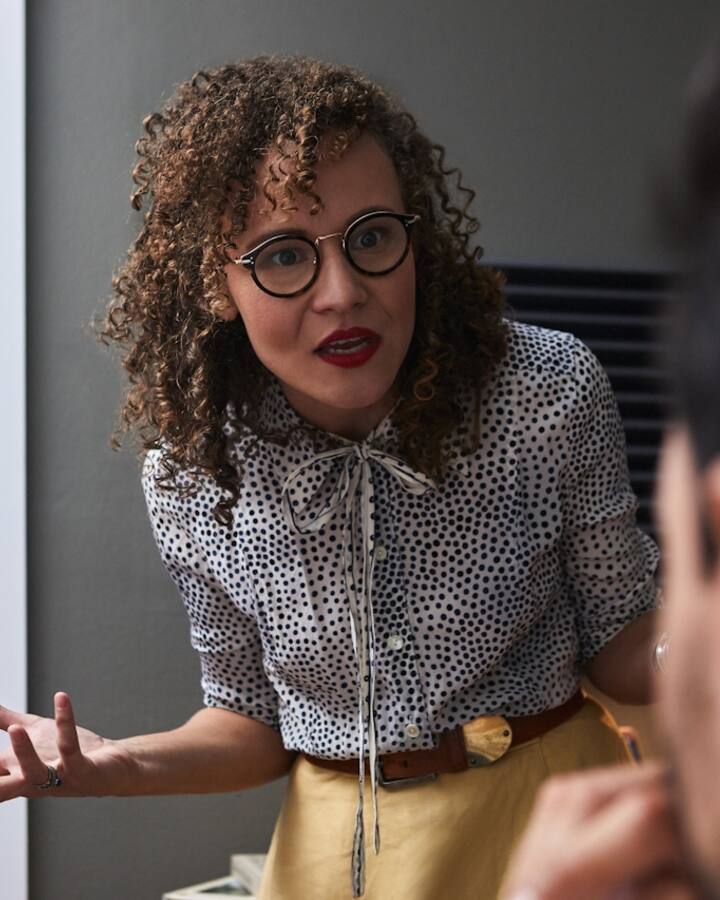

She was going to be a patient mother.
She had thought about this, with the particular confidence of someone who has not yet been tested by the specific person she would be required to be patient with. She was going to be calm in the chaos, present in the tedium, creative in the face of boredom, firm without being harsh, warm without being permissive — and she had a general picture of what this would look like that was detailed enough to be aspirational and vague enough to be entirely uncontaminated by reality.
Then she met her actual children.
Her actual children were specific. They had specific temperaments, specific sensitivities, specific ways of encountering the world that she had not anticipated and could not have anticipated, because they did not exist until she met them. Her eldest escalated when she used a calm voice — which meant the calm voice she had prepared was precisely the wrong tool for the situation she actually found herself in most frequently. Her youngest required a quality of sustained, undivided attention that was incompatible with the simultaneous management of everything else that required managing, which meant the presence she had intended was regularly unavailable in the moments it was most needed.
She yelled. Not often, and not without the repair she had also committed to, but she yelled. The patient mother she had planned to be would not have yelled. The person she actually became was a mother who occasionally yelled but repaired the connection reliably. Her love was genuine and whole, yet it bore little resemblance to the pristine image she had created before she truly understood the unique children she was raising.
This is the gap. The one nobody prepares you for — not because it is rare but because the culture around preparing for motherhood is almost entirely organised around the ideal version of the experience rather than the actual one. The gap between the mother you imagined being and the mother you actually are is one of the most quietly painful features of early parenthood, and one of the least openly discussed, because admitting it feels like admitting failure. It is not. It is the opposite. It is evidence that you took the role seriously enough to have imagined it carefully — and the beginning of the more demanding, more interesting work of figuring out who you actually are as a mother, rather than who you planned to be.
Of mothers experience significant emotional and identity changes in the first year of motherhood — including the collision between the mother they planned to be and the one they actually encounter themselves being. This collision is normal. It is developmental. It is not a verdict on the quality of the mothering.
The research that names it
The Maternal Mental Health Leadership Alliance estimates that more than 80% of women experience significant emotional and identity changes in the first year of motherhood. That figure includes the clinical conditions the maternal mental health system is trained to identify and treat. It also includes the much larger and less clinically categorised experience of the emotional changes of early motherhood: the collision between the imagined mother and the actual one, experienced by nearly every mother in some form and discussed by far fewer.
Research published in Frontiers in Psychiatry in 2025 frames the collision within the broader developmental passage of matrescence. The ideal self — the patient, consistent, calm, endlessly resourced mother of the pre-baby imagination — is, researchers argue, not a failed aspiration. It is a developmental scaffold: a direction of travel that provides orientation without constituting a standard against which daily performance can be fairly measured. The distance between the ideal and the actual is not a measure of how good a mother you are. It is a measure of how challenging the actual work of parenting specific children in specific circumstances actually is.
A 2025 study in JAMA Internal Medicine found that maternal mental health has declined significantly over the past seven years. The shame that accumulates from the persistent gap between the ideal and the actual is one of the structural contributors to that decline that is simultaneously very common and almost entirely absent from the clinical conversation about what is driving it.
Where the ideal mother comes from
Understanding where the ideal mother comes from helps, in practice, with the work of releasing her — because the ideal mother is not a spontaneous internal construction. She is assembled from a specific set of cultural inputs that have been operating on women long before they became mothers, and understanding those inputs makes it possible to evaluate the ideal more critically rather than simply failing to meet it.
The cultural input
The cultural narrative around good mothering in the contemporary Western context draws from a specific set of images, norms, and standards that have intensified, paradoxically, as women's lives have become more complex. The attachment parenting literature emphasises sustained physical proximity, responsiveness, and a quality of emotional attunement that is genuinely valuable and also, in its more prescriptive forms, capable of producing significant guilt in mothers who cannot maintain it consistently. The gentle parenting movement emphasises calm, validated responses to children's behaviour in a way that is well-supported by the developmental research and also entirely incompatible with the actual emotional and physical states of parents who are sleep-deprived, time-pressured, and carrying the full weight of the mental load.
The cultural ideal is not wrong in its aspirations. It is wrong in presenting those aspirations as achievable standards rather than as directional values, and in the shame it attaches to the inevitable distance between the aspiration and the daily reality.
The social media input
The curation dynamics of social media platforms amplify the cultural ideal in ways that are well-documented and deeply consequential. Research from the American Psychological Association has found that social media use is associated with increased stress and decreased wellbeing in parents, with the gap between curated online representations of parenting and actual parenting experience as a primary driver. The mother consuming images of serene, patient, creatively engaged parenting while sitting in the kitchen at 8 p.m. with a level of exhaustion incompatible with any of those qualities is receiving a specific kind of harmful comparison that was not available to previous generations of mothers — and that has no analogue in the research on how those earlier generations navigated the gap.
The personal input
The ideal mother is also assembled from the mother's personal history: her relationship with her own mother, the parenting she observed and experienced growing up, the specific commitments she made to herself about what she would and would not do with and to her children. These inputs are the most personal and often the most emotionally charged, because departing from them — yelling when you committed to not yelling, repeating the pattern you committed to not repeating, losing patience with the specific child you committed to always meeting with patience — carries a weight of self-betrayal that the external inputs do not.

The shame response, and why it makes everything worse
The harm caused by the gap between the ideal and the actual is not primarily the gap itself. The gap is normal, developmental, and universal in the sense that virtually every mother experiences it in some form. The harm is the shame response to the gap — the internal narrative that says I am failing at this in a way other mothers are not, and this failure says something permanent and damning about who I am as a mother.
This narrative is not accurate. It is, however, remarkably common and remarkably consistent across the research. A survey of new and expectant mothers found that 6 in 10 talk themselves out of seeking help because they believe their problems are not serious enough, according to Postpartum Support International. The shame of not being the mother you planned to be is, in many cases, precisely what prevents seeking the support that would make being more like that mother more possible.
Brené Brown's research on shame and vulnerability documents the specific ways shame operates to prevent the connection and repair that would reduce it. Shame thrives in silence and isolation. It loses its power when it is named, shared, and met with the recognition that the experience is common rather than singular. The mother who says to another mother "I yelled at my child this morning and I feel terrible about it" is not confessing a unique failure. She is offering an invitation to the kind of honest conversation about the actual emotional experience of parenting that the ideal version of motherhood has no room for.
The scaffold and the standard: holding the ideal lightly
The most useful reframe available for mothers navigating the gap between the ideal and the actual is the one that research on matrescence provides: the ideal mother is a scaffold, not a standard. A direction of travel, not a destination. A developmental orientation, not a daily performance metric.
This distinction is not trivial. Standards produce failure when they are not met. Scaffolds produce movement toward something without requiring the scaffold itself to be occupied at all times. The patient mother is where you are trying to go. The days when you get there are the evidence the scaffold is doing its work. The days when you do not are the days when you repair, and try again, and discover — incrementally, imperfectly, across the years rather than in any single moment — who you actually are as a mother.
The repair is part of the practice. This is one of the most important and most underemphasised things available to be said about the gap: the capacity to repair after losing patience, after yelling, after being less than the mother you intended to be in that moment, is itself one of the most valuable things a parent can model for a child. The ideal mother never had to repair because she never fell short. The actual mother repairs consistently — which is how the child learns what love looks like when it is accompanied by accountability, which is a significantly more useful thing to learn than how love looks when it is accompanied by perfection.
Positive Parenting Solutions and the Janet Lansbury philosophy of respectful parenting both provide frameworks for navigating the gap between the parenting ideal and the parenting actual in ways that are grounded in developmental research and that treat the repair as central rather than supplementary to the practice.
What the actual mother offers that the ideal cannot
There is something available in the actual mother that the ideal mother, by definition, cannot provide: the authentic, unperformed experience of a real person doing real work under real conditions, imperfectly and lovingly and with the kind of genuine repair that teaches a child what it looks like when someone who loves you makes a mistake and takes responsibility for it.
The ideal mother never makes a mistake. She is therefore also never required to model the repair. She is also, for precisely the same reason, not quite real — not in the way the actual mother is real, with her specific history and her specific limitations and her specific, astonishing love for the specific children she actually has rather than the hypothetical children she imagined parenting before she met them.
The actual mother yelled this morning and she is going to try not to yell this afternoon. The actual mother lost patience on Tuesday and she is going to bring more of herself to Wednesday. The actual mother is doing the practice, which is not the same as the performance, and the practice is what produces the thing the children will carry forward: not the memory of a mother who was always patient, but the memory of a mother who was always trying, and who always came back, and who taught them through the constancy of her return that love does not require perfection in order to be real.
She was going to be a patient mother
She was going to be a patient mother. She turned out to be a loving, present, frequently impatient mother who was trying very hard and who repaired consistently when she fell short. Her children will have a more accurate picture of how love actually works than the children of the perfect mother she imagined being. They will know that love includes accountability. That it survives mistakes. That it keeps showing up — not because the person doing the showing up has mastered some ideal version of themselves, but because the love is real enough to keep trying even when the person carrying it is imperfect.
She was not the mother she planned to be. She is a better one: more honest, more real, more clearly herself than any ideal could have been, because the ideal was built before she knew who she was actually going to be parenting and before she had any real sense of what parenting actually required of a person.
The mother you didn't expect to be is still, in all the ways that matter, a good mother. Give yourself the evidence of the whole picture — not just the moments when you fell short of the ideal, but the ten thousand daily acts of love, presence, and repair the ideal version of yourself did not need to perform because she never got it wrong in the first place.
She never got it wrong. She also never got real. You got real. That is not the consolation prize. That is the whole thing.
Frequently asked questions
Is it normal to feel like a different mother than the one I planned to be?
Yes — it's close to universal. The Maternal Mental Health Leadership Alliance estimates more than 80% of women experience significant emotional and identity changes in the first year of motherhood, and the collision between the imagined mother and the actual one is one of the most common forms it takes. The gap is normal and developmental. It's evidence you took the role seriously enough to have imagined it carefully, not a verdict on the quality of your mothering.
Does yelling at my child mean I'm failing as a mother?
No. The person you actually became — a mother who occasionally loses patience but repairs the connection reliably — is modelling something more valuable than the mother who never falls short could: what love looks like when it's accompanied by accountability. The capacity to repair after yelling is itself one of the most useful things a parent can teach. The ideal mother never had to repair because she never made a mistake; the actual mother repairs consistently, and that is the practice.
Where does the "ideal mother" in my head actually come from?
She's assembled from three inputs: cultural narratives about good mothering (attachment and gentle parenting ideals presented as achievable standards rather than directional values); social media, where the APA links the gap between curated and actual parenting to higher parental stress; and your own personal history — your relationship with your mother and the commitments you made about what you would and wouldn't do. Naming the inputs lets you evaluate the ideal critically rather than simply failing to meet it.
What's the difference between a scaffold and a standard?
Research on matrescence reframes the ideal mother as a scaffold, not a standard. A standard produces failure when it isn't met; a scaffold produces movement toward something without requiring you to occupy it at all times. The patient mother is where you're trying to go — the days you get there show the scaffold is working, and the days you don't are the days you repair and try again. The distance between ideal and actual measures how hard the work is, not how good you are at it.
Why does shame about the gap make things worse?
Shame thrives in silence and isolation, and it prevents the connection and repair that would reduce it. A survey cited by Postpartum Support International found 6 in 10 mothers talk themselves out of seeking help because they believe their problems aren't serious enough — so the shame of not being the mother you planned to be is often exactly what blocks the support that would help. Brené Brown's research shows shame loses its power when it's named, shared, and recognised as common rather than singular.