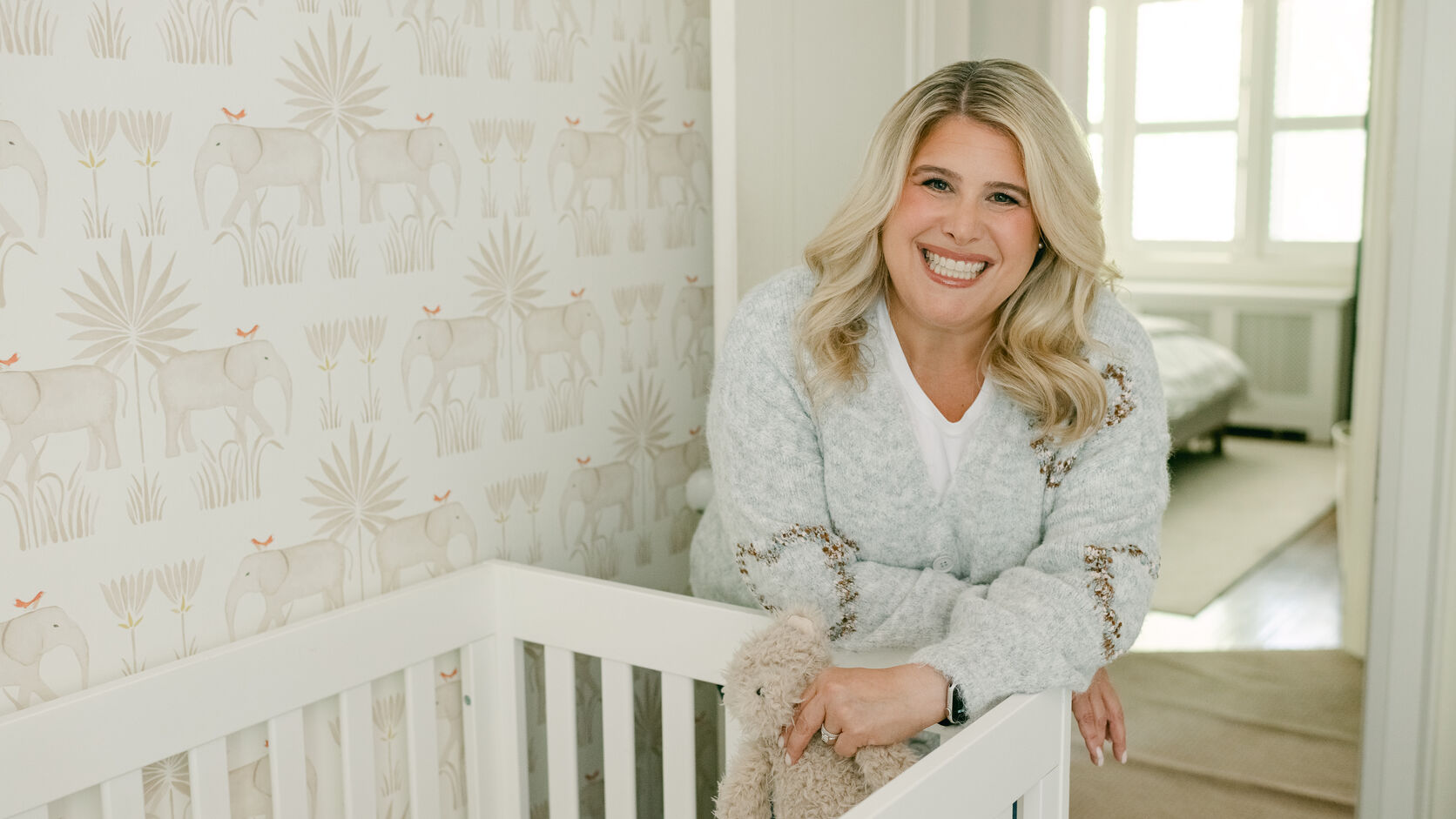

There is a particular kind of loneliness that only exists at 3 a.m. with a wide-awake baby. Andria Gordon knows it intimately. Before she became the founder of Have Baby Must Sleep — the Toronto-based sleep consultancy that has helped more than five hundred families find their way back to rest — she was a Group Account Director at an ad agency, good at a job she didn't love, and entirely unaware that her hardest season was about to become her life's work.
"I was good at it, and I loved that about myself," she says of her advertising career. "But I wasn't in love with it. I did it because I couldn't see another path for myself." That path arrived in the form of her first son, Lenny, a baby she describes with obvious tenderness, and one early, unshakeable habit. "Lenny was the happiest, sweetest baby," she remembers. "But he loved waking up at 3 a.m. ready to start his day."
Her first six months of motherhood, she says plainly, were bleak. It was only once Lenny began sleeping, and once she was properly treated for postpartum depression, that the rest of motherhood opened up to her. "I finally got to experience all the light and love of being a mom," she says. "And yes, the hard stuff too."
An accidental calling
Gordon is candid that none of this was planned. Have Baby Must Sleep was supposed to be a side project, born almost by accident while she was restless on maternity leave. "I was actually bored," she admits, "when another consultant hired me. And I found real purpose in connecting with families. My cup was filling in a way it never had before."
The turning point came fast, and it came through a mirror. One of her earliest clients was a new mother who was anxious, low, and struggling to recognize herself. "It was like looking at myself," Gordon says. "I got to know her, listened to her cry, celebrated her wins, and helped her get to the point where she felt like herself again." Supporting another woman through that darkness, she realized, meant everything. "That's when I knew I wanted to do this more and more."
When the consultant who'd hired her wasn't willing to make the role full-time, she offered Gordon a different kind of permission: maybe it was time to start her own company. So she did. What was meant to be a side hustle is now a team of more than fifteen professionals supporting new parents every day.
"My cup was filling in a way it never had before."
The hardest part
What's the most challenging experience you have faced as a mother?
"Without a doubt, it was Nate being diagnosed with Autism Spectrum Disorder and Global Developmental Delay. Nate is regressive autistic, which means that one day he was singing, talking, and counting — and then he lost those skills. It was absolutely devastating. And though it's been almost five years, this is something I will never fully get over. Accept, yes. Mourn, yes. Forget, never."
For Gordon, the best and the hardest parts of motherhood are a single, inseparable truth. Her younger son, Nate, is autistic and communicates without words, and caring for a child with additional needs has shown her parts of herself she never knew were there. "The best part, for me, is discovering how strong I am," she says. "How big my heart is, and a capacity for love I didn't know I had."
The hardest part lives right alongside it. "Knowing I won't witness the same milestones other moms do," she says. "I mourn that more often than I'd like to admit."
It is this lived understanding of how heavy parenthood can feel — not just the sleeplessness, but the grief, the anxiety, the weight — that shapes everything about how she works.
What every new mom gets wrong about the first four months
If there is one fear Gordon hears most, it is the terror that a new mother is already ruining her baby's sleep. She wants to dismantle it entirely. "You are never ruining their sleep by helping them," she says. The first four months, in her philosophy, are about rhythm and predictability — about gently supporting a baby as they adjust to life outside the womb.
What does a good bedtime routine actually look like, step by step?
"A good routine after the newborn stage is typically 30 to 40 minutes. Start with feeding, then some relaxed playtime to help them digest, followed by bath time, a massage and diapering, and then into their cozy sleep sack. Wind things down with stories or songs, place them in their crib with a sweet goodnight phrase and some gentle touch, and then leave the room. And don't forget the sound machine."
What matters most in those early months, she says, are the small wins: a first nap in the bassinet, a first stretch of night in the crib, good feeding habits, and safety above all else. "If things start feeling harder after four months," she says, "that's when we can work on building independent sleep skills."
And if she could fix only one thing about a baby's sleep, it would not be the nursery or the routine. It would be wake windows — the amount of time a baby can comfortably stay awake before needing sleep again. "Not all babies show reliable sleep cues," she explains, "so watching the clock takes the guesswork out of it." Overtiredness, she warns, is the real enemy: harder settling, more night wakings, early rising. "If naps aren't going well, do not push that final wake window. Short naps alone don't create an overtired baby. Incorrect wake windows do."
"You are never ruining their sleep by helping them."
The nursery myth
Gordon has strong opinions about beautiful rooms that don't work. Three things, she says, make the biggest difference: darkness, temperature, and sound. "Pitch black is non-negotiable," she says. Early morning light causes early rising; rooms that aren't dark enough lead to short naps. She likes the room between twenty and twenty-two degrees Celsius, and brown noise at around forty to fifty decibels, placed roughly seven feet from the crib.
The mistakes she sees even in the most thoughtfully designed nurseries? "Mini cribs, because babies outgrow them so fast. Skylights, since they're incredibly hard to black out. And too many lights or nightlights." Her reasoning is disarmingly simple. "Babies don't have a fear of the dark," she says. "There's really no need for them."
On toddlers, boundaries, and the 90-minute bedtime
For the parents locked in nightly negotiations over one more book, one more song, one more sip of water, Gordon's approach is less about willpower and more about clarity. She uses social stories to walk older children through exactly what bedtime looks like and what happens after the lights go out. "This is about making sure there are no surprises," she says.
When kids push boundaries, she believes, it's usually because the boundaries themselves aren't clear, or aren't being held. "They take their cues from us," she says. "If we can't hold the boundary, they won't respect it."
More than sleep
It was the gap between a perfect plan and an exhausted parent that led Gordon to expand her work into More Than Sleep, the mental health arm of her practice. "You can't separate a baby's sleep from the parent's experience of it," she says. She kept meeting families whose sleep plans were solid on paper but impossible in practice — not because they weren't capable, but because they were depleted.
"Especially for moms, sleep challenges bring up anxiety, guilt, intrusive thoughts, relationship strain," she says. "And no amount of 'just stay consistent' works if someone is already at capacity." More Than Sleep pairs sleep coaching with real emotional support, so parents can actually implement the changes they came for. "When we support the parent alongside the baby, everything works better," she says. "It's not just about getting a baby to sleep. It's about helping families feel better while they get there."
"You are not alone."
For the mom reading this at 3 a.m.
And to the mother reading this in the dark right now, certain she's the only one, Gordon has a message she's earned the right to deliver.
What's the one thing you'd say to a mom reading this at 3 a.m. right now — exhausted and convinced she's the only one struggling?
"I know everyone says it's a phase and it will pass, but it really will. If you're struggling, try some of the things we talked about. And if it feels like too much, there is amazing support out there and we would love to help. Whether that's joining one of our free classes or just having a 15-minute chat, we're here. You are not alone."
Follow Andria Gordon and Have Baby Must Sleep on Instagram @havebabymustsleep.