
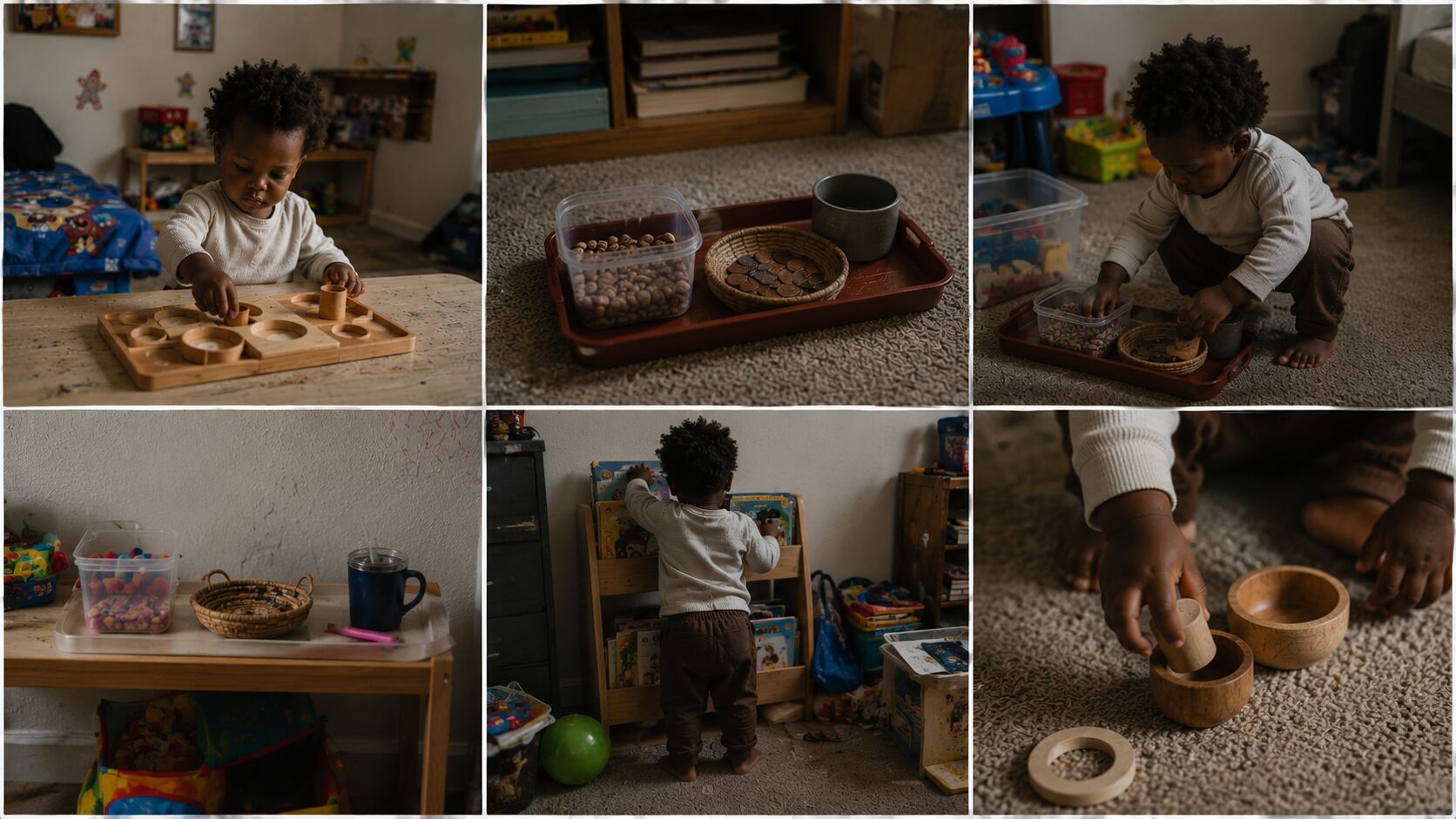

Montessori as an aesthetic has taken over Instagram. Wooden toys, neutral colours, low shelves, carefully curated trays of activities. It's beautiful — and it can also feel completely unattainable if you live in a normal house with a normal budget and a child who has somehow accumulated forty plastic toys you swore you would never buy.
Here's the thing: the beautiful Instagram Montessori room is not the point.
The point is a set of principles about how children learn and what environments support that learning. Those principles work in a small apartment with secondhand furniture just as well as they do in a purpose-built playroom.
This is what actually matters — and how to apply it without a renovation, a wooden-toy haul, or a mid-life crisis.
What is Montessori at home, actually?
Montessori is an educational philosophy developed by Italian physician Dr. Maria Montessori in the early 1900s, based on her observations of how children naturally learn. The American Montessori Society summarises it simply: encouraging order, independence, and self-motivation through a thoughtfully prepared environment scaled to the child's size and abilities.
In other words: Montessori at home isn't about products. It's about three principles, applied in any space, with whatever you have.
The 3 core Montessori principles for home
1. The child can do it themselves
In any Montessori-inspired home, the fundamental question is whether a child can navigate their space without adult intervention. The goal isn't whether they can complete a task with assistance, but whether they can do it entirely on their own.
A toy on a high shelf that requires an adult to retrieve it is a toy that removes choice, agency, and the natural motivation to engage. A toy at the child's height that they can choose, take out, use, and return themselves supports all of those things. This single principle, applied consistently, will change your home before any furniture does.
2. Order and predictability support focus
A room of stimulation — many toys visible at once, competing for attention — creates overwhelm rather than focused engagement. A limited number of accessible choices, in consistent locations, helps children settle into focused play rather than flitting from one thing to the next. This is why Montessori spaces look spare. The sparseness isn't an aesthetic choice. It's a cognitive one.
3. Beautiful, real things over toy versions
Montessori environments use real objects where possible rather than toy versions. A real small watering can for the garden rather than a plastic toy one. Real kitchen tools sized for small hands. The quality of engagement with real things is genuinely different — children take them more seriously because they are serious. Children rise to the level of trust and capability you extend to them. Real tools say: I trust you with this.
How to set up a Montessori home (4 practical moves)
This is the part you can actually do. Today. Without spending money.
1. Lower everything they need
Hooks for coats and bags at child height. Books displayed cover-out on a low shelf or ledge. Toys on low open shelves at eye level. Art supplies in a drawer they can reach. This does not require new furniture — a low bookcase, a kitchen drawer designated for their things, baskets on the floor, a repurposed coffee table. The principle is accessibility, not aesthetics.
2. Rotate, don't accumulate
Take most toys out of circulation and rotate them. What remains accessible should be a curated selection — enough choice without overwhelm. The toys in storage become interesting again when they rotate back in. This works regardless of how many toys you've accumulated. You don't have to throw anything away. You just have to keep most of it out of sight at any given time.
3. Trays and containers for activities
Loose materials — playdough, paint, sensory materials, small figures — contained in trays or baskets signal that this is a specific activity with a beginning and an end. Children take out the tray, engage with it, and return it. This is the foundation of self-regulation and sequential thinking. It also dramatically reduces the chaos of mixed-up materials across the floor.
4. An art and creative space they own
A low table, or a section of a table, with art supplies they can access independently: paper, crayons, child-safe scissors, tape, stickers. Available when they want them, without asking. This respects the creative impulse and removes the friction of having to request materials from an adult — friction that's enough to extinguish a creative moment in a four-year-old.
Montessori in the kitchen: the most underrated part
Montessori at home is as much about the kitchen as the playroom — and arguably more.
A learning tower or sturdy step stool that brings them to counter height for cooking involvement. A low drawer with their own cups, plates, and bowls they can access and return. Real food preparation — washing vegetables, tearing bread, stirring, measuring — from around 18 months. A small child-height table and chair in or near the kitchen for snacks they can manage themselves.
Involvement in real household tasks, not toy versions, is one of the most powerful Montessori principles for building competence, confidence, and sustained attention.
A two-year-old who can pour their own water from a small pitcher believes something different about themselves than one who waits to be served.
What to expect when you start
When children are first given more independence and choice, they often don't know what to do with it. A child used to being directed, entertained, or given screen time may struggle initially with an environment that asks them to choose and sustain their own engagement.
This is normal. The adjustment typically takes two to three weeks of consistent application before independent play emerges naturally.
Your role changes from entertainer to prepared-environment curator. You set up the conditions. You observe without directing. You resist the urge to intervene every time they seem uncertain. Independent play is not born fully formed — it develops, with practice, in an environment designed for it.
What Montessori at home is not
Three of the most common misconceptions, worth naming out loud — because the wooden-toy industry has a marketing budget and the principles do not.
It is not expensive
The most important elements — accessible storage, rotation, involvement in real tasks — cost nothing. Your existing furniture, lowered or repurposed, is fine. Your existing toys, rotated, are fine.
It is not about buying specific products
The wooden-toy industry has done a brilliant job associating Montessori with a particular aesthetic. The aesthetic is optional. The principles are not product-dependent. Be wary of anything sold to you as "Montessori-approved" — Montessori is not a trademark, and any product can use the word.
It is not pass or fail
You apply what works, in the space you have, with the child you have. Imperfect application of the principles is infinitely more valuable than none at all. A messy attempt at Montessori beats a perfect renovation every time.
The bottom line on Montessori at home
Lower the shelves. Rotate the toys. Involve them in real tasks. Let them do more than you think they can.
The rest is commentary.
Frequently asked questions
At what age can I start applying Montessori principles at home?
From birth. The principles of an accessible environment, limited stimulation, and sensory-rich real experience apply from the earliest weeks and evolve as your child develops. A newborn benefits from a calm, ordered, low-stimulation environment just as much as a toddler does.
Do I need to buy Montessori toys?
No. The principles apply to any toys or materials. Accessible storage, rotation, and involvement in real activities matter far more than the toys themselves. The biggest move you can make is rotating what you already own — not buying more.
How do I get my toddler to clean up independently?
Make it physically possible — accessible storage at their level, containers that make sense — and do it alongside them consistently until the habit forms. Never ask them to clean up more than they can manage. A toddler facing a floor of fifty toys will freeze; a toddler facing five clear baskets at their height will participate.
What's the most important Montessori principle for a small home?
Rotation. If you only do one thing, take 80% of the toys out of sight and rotate the remaining 20%. This single move replicates the spaciousness and focus of a Montessori classroom regardless of square footage.
Can I do Montessori at home if my child goes to a regular daycare?
Yes, and this is how most Montessori-at-home parents operate. The home environment is yours to design; the two don't have to match. Many children thrive on the contrast between a structured daycare and a more child-led home.
Is Montessori the same as gentle parenting?
No, but they overlap. Montessori is primarily an educational philosophy about environment and independence; gentle parenting is primarily a discipline philosophy about emotional connection and respect. They share a foundation of respect for the child as a capable individual, which is why they often appear together.
How is Montessori different from Waldorf?
Both are alternative education philosophies that emphasise child-led learning and natural materials. Montessori focuses more on practical life skills, self-directed work, and academic readiness through hands-on materials. Waldorf focuses more on imagination, storytelling, and delaying formal academics in favour of play. Many families pull from both.