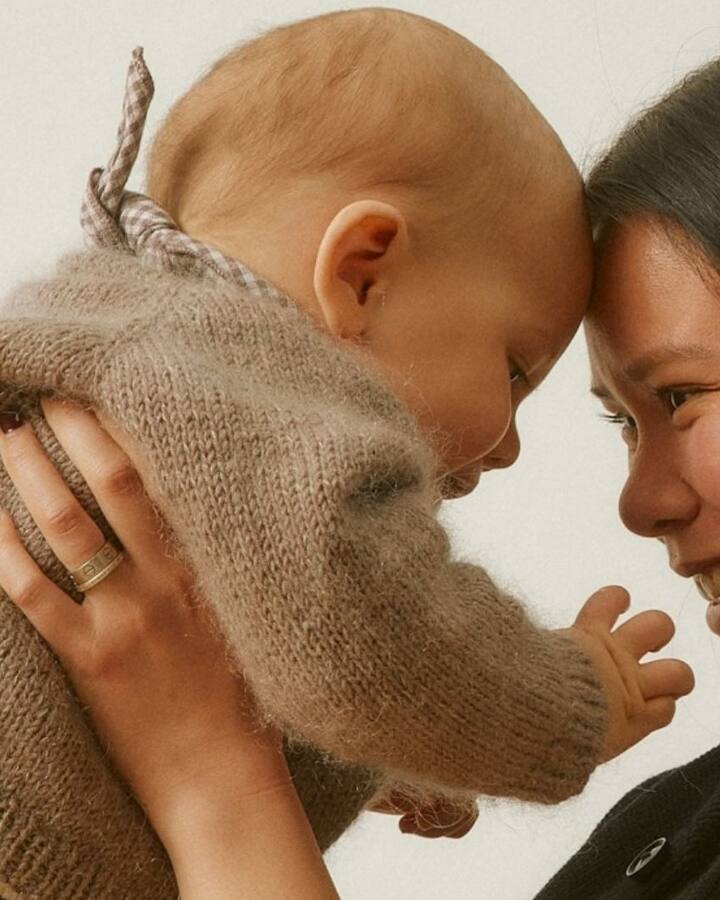

"I will never say, 'I will never…' again," Maria Roberts says with a laugh.
Like so many mothers, Roberts entered parenthood with ideas about the kind of parent she would be, the things she would care about, and the lines she would surely hold. Then came the actual parenting part, and much of that certainty went out the window. "I don't follow any rigid philosophy," she says. "My goal is to raise confident, kind kids who know they're deeply loved and have their family's support no matter what."
Roberts, a pediatric speech-language pathologist and city-mom-turned-suburb-mom, shares pieces of motherhood, humor, and style online. She is also the co-founder of The Little Glow Society, an upscale children's spa and workshop party business serving New Jersey and New York City. But the thread that runs through the way she talks about motherhood is not expertise or aesthetics. It is flexibility. The willingness to meet the child in front of her. The humility to admit that no one, even someone trained in child development, gets to parent from a script.
"There really is no rule book for parenting," she says. "You're not always going to have the right answer. I think the biggest surprise for me was coming to terms with that — with the reality that sometimes you just don't know what to do in a given moment. You make your best guess, you try something, and sometimes it works and sometimes it doesn't. There's no manual for your specific kid. And that's both terrifying and kind of beautiful."
There's no manual for your specific kid. And that's both terrifying and kind of beautiful.
What Her Clinical Work Taught Her About Letting Kids Lead
Long before Roberts became a mother herself, her work as a speech-language pathologist had already shaped how she understood children. One of the biggest lessons, she says, is that development is never one-size-fits-all. "You could have two kids with the exact same diagnosis, but approach them completely differently clinically just because of who that child is," she says. "I apply that same mindset to my parenting."
That perspective has taken pressure off the milestone race. Development, Roberts says, is not linear, and children reach things on their own timeline — a point the profession's own developmental milestone guidance frames as ranges rather than deadlines. At home, she finds herself using many of the same tools she uses professionally: following a child's lead, building on what motivates them, offering choices, and modeling rather than correcting. The point is not to force a child into a predetermined shape. It is to understand what helps that particular child thrive.
The Boundaries That Help Kids Trust Themselves
Roberts is clear about where she holds the line. Her non-negotiables are tied to safety and well-being, and she is intentional about explaining that to her children. "If I'm saying no to something, I want them to understand that it's not arbitrary," she says. "It's because my job as their parent is to keep them safe and healthy."
But outside of those safety boundaries, Roberts tries to give her children as much freedom as possible. What they wear to school, what they want to play with, and what they are drawn to are choices she wants them to feel ownership over.
How do you balance setting boundaries with giving your kids freedom to be themselves?
I want them to feel ownership over their own preferences and sense of who they are. Because I think that's how you raise kids who actually trust themselves. The boundaries exist to protect them, not to control them. And I hope that as they get older, they'll understand the difference.
Discipline Is Really Teaching
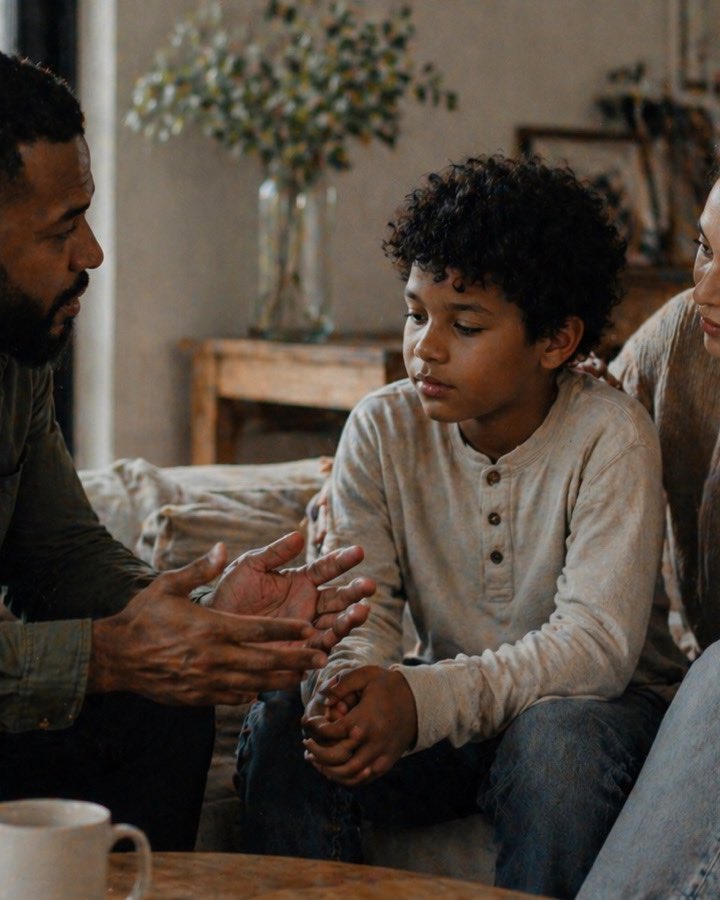
Roberts credits Dr. Becky's Good Inside with changing the way she thinks about discipline. For her, discipline is not about punishment for punishment's sake, and it is not about sending a child away and calling the matter closed. There are firm rules in her house, and there are clear expectations around what is and is not acceptable. But when something happens, she tries to sit with her children and understand why they did what they did.
Discipline is really about teaching, not just controlling behavior.
"We talk through the situation together," she says, "and I try to help them build the coping skills and resilience they're going to need. That's the real work. Punishment is easy, but understanding growth takes time. But that's where the actual learning happens." It is the same instinct behind what actually works in the middle of a tantrum — staying in the moment with the child rather than shutting it down.
The same approach extends to emotions. Roberts wants her children to know that all feelings are valid, while also helping them learn what to do with those feelings. "I aim to help them feel seen and understood so they are actually able to calm down and move through the feeling rather than feel like they are being shut down," she says. It is the difference a handful of small, repeatable phrases can make in a house.
The Moments That Stop Her in Her Tracks
For all the invisible labor of motherhood, the moments that make Roberts feel proud are often the ones she does not orchestrate. It is watching one child problem-solve for the other without her having to step in. Her son handling something for his little sister. Her daughter finding a way to comfort her big brother.
Those are the moments that make her pause. "Okay," she thinks, "maybe I'm doing something right."
The Things That Make the Hard Days Lighter
On the days when nothing seems to go right, Roberts does not pretend herself into gratitude or force a lesson onto the chaos. She texts her best friends. "I can call or text at any time and say, 'You will never believe the day I am having,' and they will have me laughing and feeling better in minutes," she says. It is one reason she loves humor content. "It's a little dose of, 'You know what, it's going to be ok.'"
There are also the small rituals that help the house feel like itself. Family dinners do not happen every night, but when they do, everyone shares their "Pit and Peek" of the day. "It's my favorite part," she says. And during the school day, Roberts tries to carve out pockets of time for herself — a weekly tennis group with friends, coffee, or a workout in the gym downstairs. It changes week to week, but the effect is the same: she feels more present and patient by school pickup.
Roberts says she and her husband, Lou, make a good team, in part because they were raised with similar values. That shared foundation helps, but so does recognizing each other's strengths. "I may be better at handling certain situations while he's better at others, and rather than seeing that as a conflict we lean into it," she says. As the children get older, the dynamic shifts, and they try to stay flexible. More than anything, she says, they communicate.
Trusting Herself, Trusting Them
The best parenting advice Roberts has ever received is the simplest: trust your own instincts. Everyone will have opinions, she says, but the advice that stayed with her was to quiet the noise and trust herself. "I know my children better than anyone."
And when she thinks about what she hopes her children carry with them, it comes back to that same steady center: kindness, resilience, respect for themselves and others, and the confidence to be who they are without apology. "I want them to know who they are and never feel pressure to be someone else," she says. "I think if my kids leave our home with confidence, self-trust, respect, and compassion, I'll feel like we did our job."
Follow along: Follow Maria Roberts on Instagram @mariaroberts, and find her children's spa and party business at The Little Glow Society.