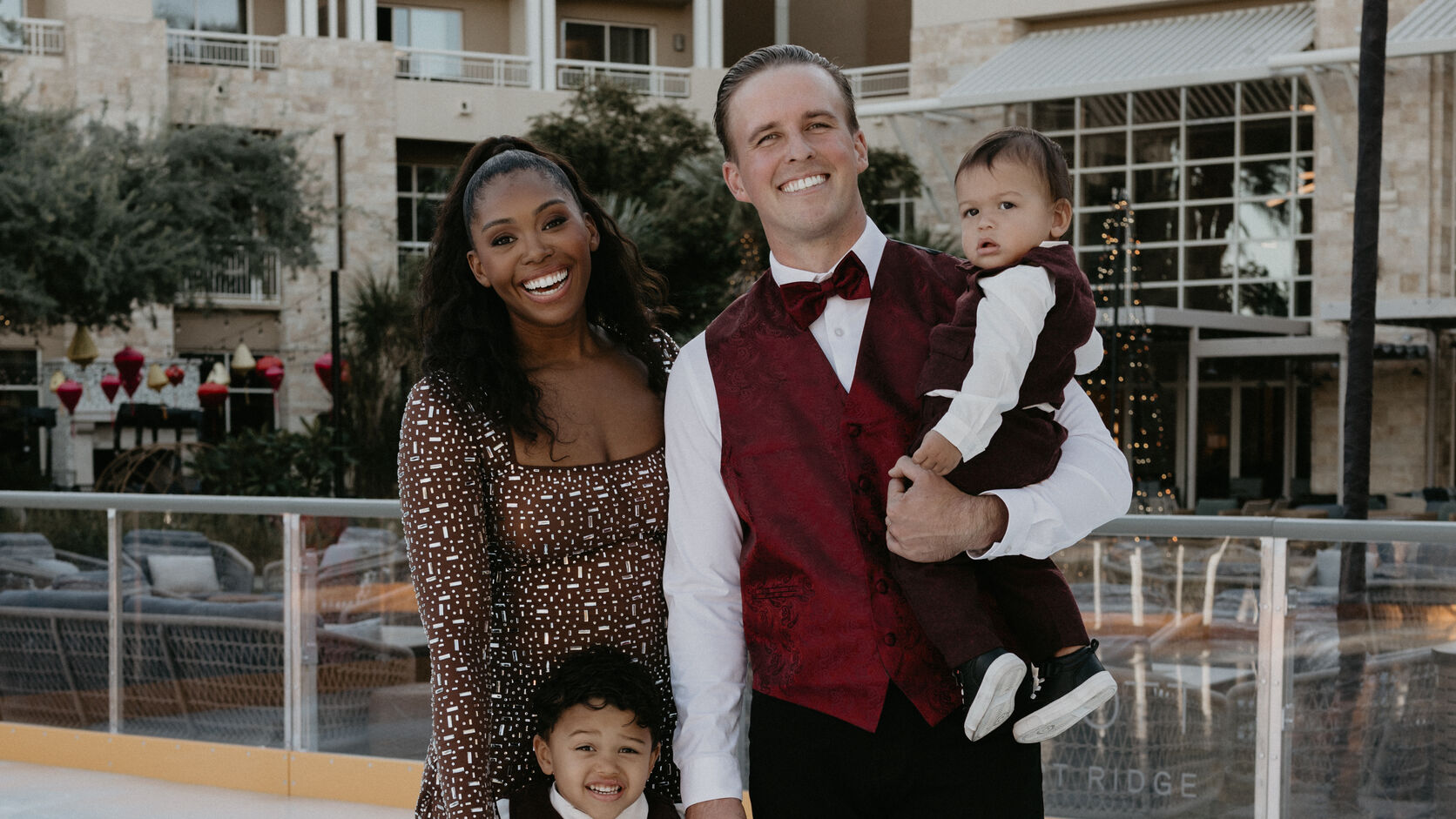
Mariyah Gerber grew up in a rink. Before she was anyone’s mother, she was a competitive figure skater and a Disney on Ice performer, a kid who learned early that effort and excellence were held to very different standards. “I had to be the best, I had to succeed,” she says of those years, “and I think that’s a lot of mental load to carry as a child.”
You might assume all that discipline would make for a demanding parent. It did the opposite.
Softer, on purpose
“Growing up as an athlete made me a softer parent, because I understand what it’s like to put so much pressure on yourself as a kid,” she says. When she catches that same tendency in her boys, she steps in gently. “I try to help them realize they’re doing a good job. I say a lot of positive affirmations. I try to make sure they understand that trying is good enough, because as a kid, I felt like trying wasn’t good enough.”
That reframing is deliberate. Mariyah is not trying to raise athletes; she is trying to raise children who do not confuse their worth with their results.
Ready for the mess
Elite sport runs on the pursuit of perfection, and by the time Mariyah became a mother, she had already spent that pursuit down to the studs. “The competitiveness I experienced for so many years meant that by the time I became a mom, I was ready to move on,” she says. “It wasn’t that difficult of a transition for me to deal with the messiness.”
She had watched what perfectionism cost. “Having that mentality causes so much unnecessary stress, and I was ready to step out of that version of myself and into the version that is open to the chaos.” That openness has limits, of course; nothing fully prepares you for the day motherhood actually hands you. But she made her peace with the plan changing before the plans ever started changing.

Humbled, daily
Ask her for the moment that humbled her more than any competition, and she laughs at the premise. “Motherhood humbles me every single day.”
She points to the newborn fog, running on no sleep while trying to decode what this particular baby needs, and to the fact that sometimes your absolute best still is not enough. Then come the toddlers. “Toddlers run the house. You never know what you’re going to get, and every day is different.” The through line, stage after stage, is a kind of radical beginner’s humility: “I’m doing this for the very first time, I’m trying my best. Some days I feel like I’m doing an amazing job, and some days I absolutely feel like I need to go back to the drawing board.”
A whole new world of boys
Mariyah grew up with sisters, a self-described Disney princess girl who played inside. So two sons pulled her into unfamiliar territory, and she has loved every strange minute of it. “They’re jumping off things, we’re playing with Transformers, we’re doing different activities that I didn’t do as a kid.” She quizzes her husband about his own childhood, the wild and crazy things she once thought sounded made up and now watches unfold in her living room. “I love that they’re bringing me into a whole new world of characters,” she says. “It’s really fun to see that side of childhood.”
Building confidence, not projecting it
For Mariyah, confidence is not a pep talk; it is a language the whole family practices. “It starts with how we talk to them and how we let them talk about themselves,” she says. When one of her boys says “I’m not good at this,” she reframes the words in real time. “We do not encourage any of them putting themselves down. We do affirmations, continuously reaffirm how amazing they are, and celebrate them when they do something great.”
Knowing the difference between pushing a child and supporting one is something she learned by watching, long before she had children of her own. “I grew up in the rink. I was very observant, and I collected data,” she says. She saw how different parents treated their kids, and she now knows some of those kids as adults, carrying whatever they were handed. So when she encourages her sons at a sport or a new skill, she keeps a firm line in view. “I try my best not to make it about myself, because it really isn’t. This is them, this is their activity, this is their life.”
The conversations that matter most, for now
Because her boys are so young, the most important conversations about identity are still happening between the adults. “Making sure we’re both on the same page as far as how we want to raise them,” she says of herself and her husband. In an interracial relationship, that alignment feels non-negotiable to her: what matters to them around race and identity, and how they will respond if their sons ever meet racism.
With the boys themselves, it stays light and age-appropriate for now. “We continuously talk to them about what color their skin is, talking about mommy and daddy’s skin, just bringing it up in a very light way.” She is holding two things at once, protecting their innocence while preparing them for a world that will not always be gentle. “As they get older, the conversations will change and become more detailed and in depth.”
Coming back to herself
Somewhere in the middle of working, mothering, and holding a household together, Mariyah noticed the part of the equation that quietly disappears first. “In the midst of being a mom who works and is trying to take care of herself and her family, mental health tends to get a little lost.” So this year she made it the point, not the afterthought: therapy, the occasional single night at a wellness center, and smaller daily anchors when time and resources are tight.
“Even simple things like going for a walk or doing a 10-minute meditation,” she says. She has been learning to regulate her nervous system, leaning on tools like EFT tapping, taking a beat to check in with herself. The logic is not indulgent, it is practical. “When I’m at my best, I feel that I am able to handle everything on my plate.”
The walk home
Her favorite ritual is almost aggressively ordinary. The family loads up the double stroller and goes for a walk, sometimes a bike ride, sometimes a new route. “That is our time,” she says. “It’s not anything curated, it’s just us taking a moment, a breather, getting fresh air. A lot of the time, it’s my favorite part of the day.”
Ask what she hopes her boys remember about the home she is building, and the answer is not a milestone. It is a feeling. “I hope they feel like they still want to come home,” she says. “I want them to feel like home is where they feel the most at peace, no matter what’s going on in their life or in the world, and that if they need someone to talk to, they can call me or their dad. We are not going to be judgmental, we are going to be as helpful as possible.”
She measures the goal against her own family, the people she still calls first. “I might not always want exactly the advice they’re giving, but if I’m going through something, they are the first people I’m going to call, every single time. I have the most fun hanging out with them.” Then, the quiet mission statement of the whole conversation: “I just hope I’m able to emulate that with my own children.”