
There’s a version of the working-parent story that lives on the highlight reel, and then there’s the porch.
Sarah Wright Olsen remembers a particular one. She was carrying her overnight bag out to the car for a work trip, and her little ones were standing on the porch, waving and crying. “I told them I loved them, I got in the car and I cried,” she says. The math of that moment stayed with her. “If I was feeling this much emotion leaving my littles behind I could only imagine how it felt for them watching mommy’s car pull away.”
If I was feeling this much emotion leaving my littles behind I could only imagine how it felt for them watching mommy’s car pull away.
That gap between the parent who leaves and the child who stays, and how rarely anyone hands you a tool for either side of it, is the whole reason her children’s book exists.
The saying that became a book
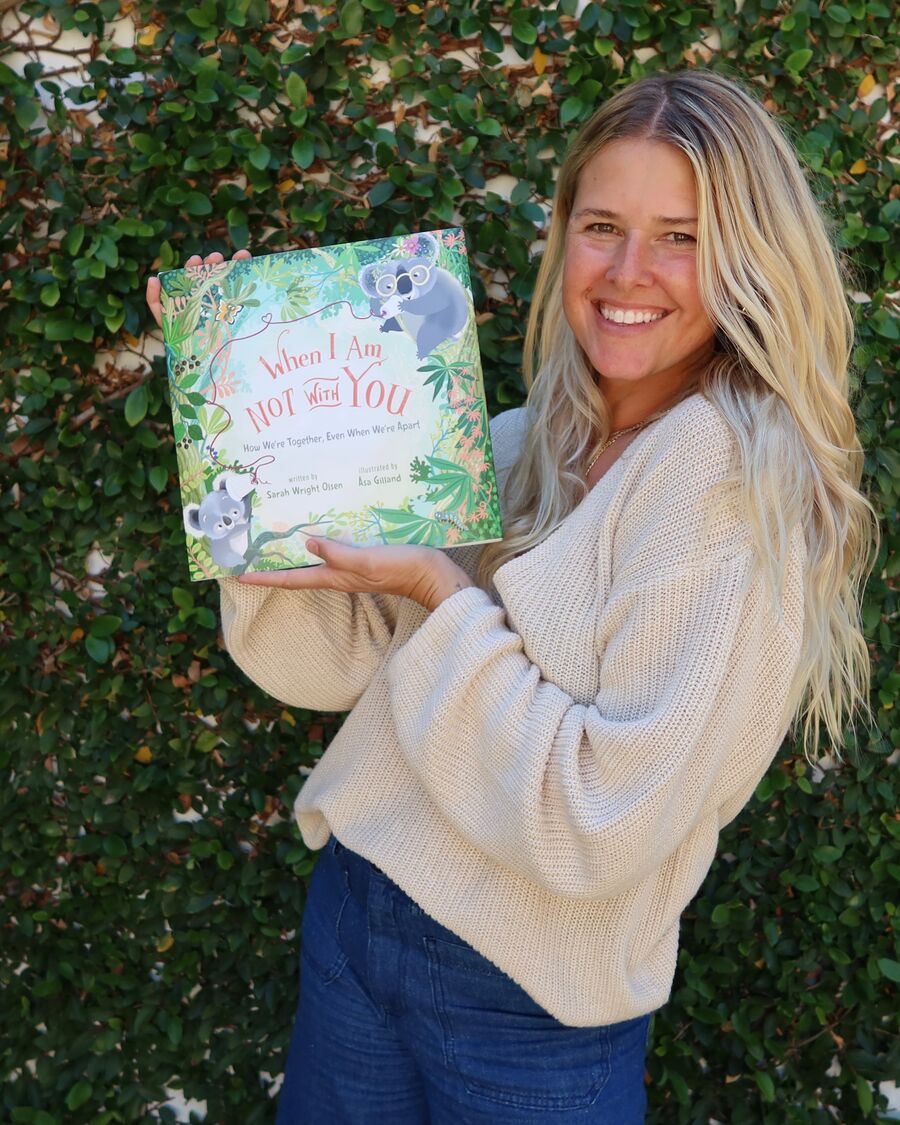
When I Am Not with You began years before it was a book, when her oldest started preschool and the goodbyes got hard. “I tried to find books that we could read together to help during this transition but nothing that we read felt like the tool that I needed,” she says. So she reached for one her family already had.
Her husband had a saying he’d use whenever he left for work, or they dropped the kids at school, or the family split up even for a few hours. He’d ask, “When I am not with you where am I?” And the kids would answer: “in my heart and in my head.” It’s a family call-and-response built to hold the people you love close no matter the distance. “It’s the book I needed as a mama dropping off my lil one at preschool,” she says. “It’s what I needed when I had to leave on my first trip away, it was also the tool I needed to comfort my little one when we lost my dad.”
Now the mother of four, with a thirteen-year-old, a ten-year-old, a six-year-old, and a one-year-old named Ocean, she knows the saying works across every kind of goodbye, small and enormous.
Making something big small enough for a page
Writing for children means saying something huge in almost no words, and the hardest part was the size of the subject itself. “When you are dealing with separation, loss, grief, goodbyes that are very big or small, that whole concept is quite large,” she says. Her solution was rhyme, something fun to read aloud, easy to recall, that could turn a goodnight or goodbye into a routine with a built-in toolkit and a lot of imagination.
The imagination is the part she loves most, because it hands the power back to the child. The book lets her littles choose exactly how they want to picture her when she’s gone. “Are we playing chess on the moon under a blanket of stars,” one line goes, “drinking peppermint tea watching earth from afar?”
The thing she stopped believing about balance
Ask Sarah what she believed about balance ten years ago and has since let go of completely, and she doesn’t hesitate. “That there was some perfect harmony out there that could exist and that you could balance it all and get everything done in a day.”
What replaced it is less tidy and far more livable. She makes a list, gets to the priorities first, and lets the rest slide to tomorrow. “When I run out of time in the day everything else shifts to the next day and I put it down and focus on my kids,” she says. “If it doesn’t have an immediate deadline I may not get to it for a few days.” She used to carry the weight of all of it on her shoulders and feel overwhelmed by it. Letting go was the only way through.
She keeps one line close for the moments the old pressure creeps back, borrowed from her friend Kerry Faherty, co-founder of the brand Faherty: “I know what to do, and I do it with ease.” When the overwhelm rises, she says it out loud a few times and lets herself believe it.
A genuinely good day, not the highlight version
A real good day in the Olsen house starts with coffee her husband makes while she stumbles in with the baby on her hip, toothbrush still going. They compare notes on who slept and which kid or dog woke them, then head to the garage, their makeshift gym, for a twenty to thirty minute Peloton strength session while Ocean crawls around the floor. One by one, the other three wander in for morning cuddles before their routines kick in.
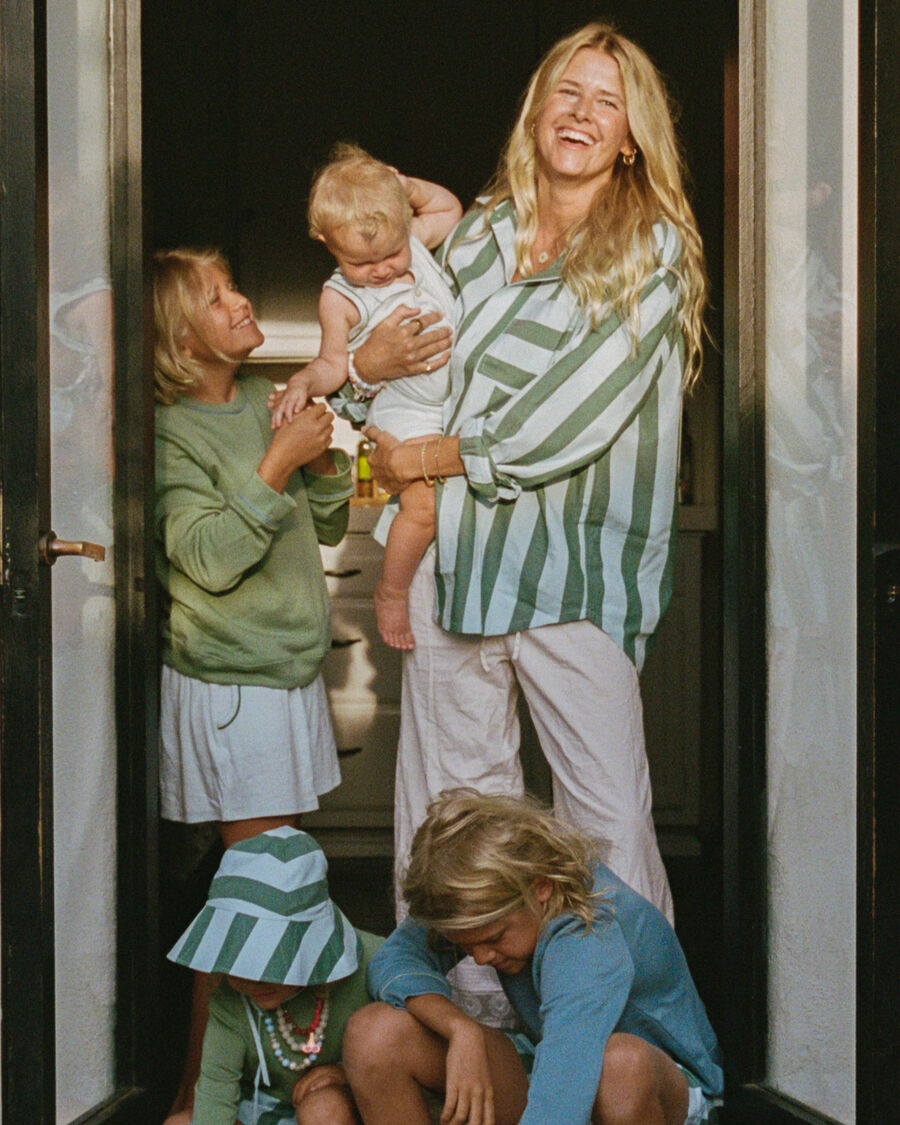
On a school day, everyone’s out the door by 8:15. Sometimes she and her husband steal thirty minutes for a morning date at the coffee shop before work; she works from home, nurses the baby down for a nap, the nanny helps with groceries, and they pack in what they can before pickups, sports, and family dinner at 5, followed by homework, an evening walk, and bed. There are laundry days and long drives and mornings that don’t feel like anything got finished, and she names those too. But her favorite part is fixed: dinner, and hearing everyone’s stories.
Four kids, four different approaches
With children spread across so many ages, her parenting has had to bend for each of them, though she’s quick to say it’s less about age than temperament. “It’s less about their age and more about who they are and what they need,” she says. Every kid meets conflict, sadness, joy, and nerves differently, and shows you what kind of boundary or guidance they need. “Parenting feels like an ever evolving learning experience. As our little ones grow we grow with them as parents.” What her one-year-old needs looks nothing like what her ten-year-old needs, and yet, she notes, they’re both asking for the same thing underneath: attention, closeness, and the sense that they’ve been heard and seen.
Mindful parenting on a day that isn’t
The word mindful can sound aspirational to a mother running on very little sleep, and Sarah is honest about what it looks like when the day goes sideways. “It looks like my shirt getting caught on a door knob. Me knocking my shin into the bedframe, breaking a plate in the dishwasher, stepping on a lego and spilling my coffee,” she says. When the pileup starts, she half-wonders if the universe is telling her to slow down.
On those days, mindful sometimes means raising her voice, apologizing to her kids, and telling them she needs a moment to take some deep breaths. She’s made peace with that being the lesson. “I think the best thing we can do in moments that are hard is to be honest with our children. We can model mindfulness and show them what it looks like to try again.”
Why she built BĀEO
Her skincare line came out of the same impulse as everything else: a gap she couldn’t recommend her way around. She was developing the brand in an era thick with greenwashing, before most people had a word for it. “There were companies claiming to be clean and yet they were filled with chemicals I would never want to put on my baby,” she says. She wanted products she could hand to her whole family and read every ingredient on, each one there for a reason.
It got personal with her son, whose sensitive skin and eczema flared on his elbows and the backs of his legs; everything she tried, he said, burned and inflamed it further. So she built the thing she needed: an organic bare butter meant to calm the redness and stop the itch, made for the whole family, with nothing on the label you’d have to look up.
For the mother reading this at midnight
Some days, Sarah admits, she feels split too, half in work and half at home, not fully hearing what anyone’s said. Her advice to the mother who never feels fully present anywhere is practical: look at the day and see if it can be reorganized so there’s a stretch to be wholly present at work and another to be wholly present at home. It won’t always hold. But even the attempt can help you show up where you most want to.
And to the mother reading at midnight, sure she’s the only one struggling to hold it together, she offers what her podcast community has taught her again and again. “We are all going through so many similar things in life and we all have struggles,” she says. The school emails, the appointments, the grocery runs, the drop-offs and pick-ups and dress-up days, the list she knows you know by heart. “Community is so important. Being surrounded by other mamas, hearing their stories and sharing your story is so important because we all struggle. It’s part of being human, and you are not alone.”
It’s part of being human, and you are not alone.
Order Sarah’s New Book
Sarah Wright Olsen’s new children’s book, When I Am Not With You: How We’re Together Even When We’re Apart, is a heartfelt reminder that love keeps us connected through every goodbye—big or small.
Related reading
- Brittany Ishibashi Is Redefining What Work-Life Balance Looks Like — and She Couldn’t Be Happier About It
- How Ava Paloma Balances Hollywood With Motherhood
- When Your Children Need You Differently, Who Do You Become?
- The Phrases That Raise Emotionally Intelligent Kids
- The Loneliness Epidemic Nobody Is Talking About