
Mindfulness has become one of those words that sounds like it requires a specific aesthetic: a calm, linen-toned room, incense, a very patient voice saying breathe in, and breathe out.
In reality, the core of mindfulness is much simpler: paying attention to what's happening right now, without judgment. That's something children are actually quite naturally good at — and something that, with gentle support, becomes a powerful tool for emotional regulation as they grow.
This is how to actually do it, age by age. No props required.
What the research actually shows
The research on mindfulness for kids has grown significantly in the last decade. A meta-analysis of 33 randomised controlled trials with over 3,600 children and adolescents — published in the Journal of Child Psychology and Psychiatry — found significant positive effects on attention and focus, anxiety and stress, depression and low mood, emotional regulation, and executive function.
These are not small benefits. Emotional regulation in particular is one of the strongest predictors of wellbeing and success across the lifespan — research published in Frontiers in Psychology consistently shows it underpins academic achievement, social relationships, and mental health from early childhood onward. And it's a skill, which means it can be learned.
The core principle for every age: keep it sensory and simple
Children learn mindfulness through their senses, not through concepts. Before you teach any child to meditate, teach them to notice.
This is the foundation of all the age-specific approaches below: bring attention to what can be seen, heard, felt, smelled, and tasted right now. That's mindfulness for children at every age, translated into something a 2-year-old or a 14-year-old can actually do.
Babies and young toddlers (0 to 2)
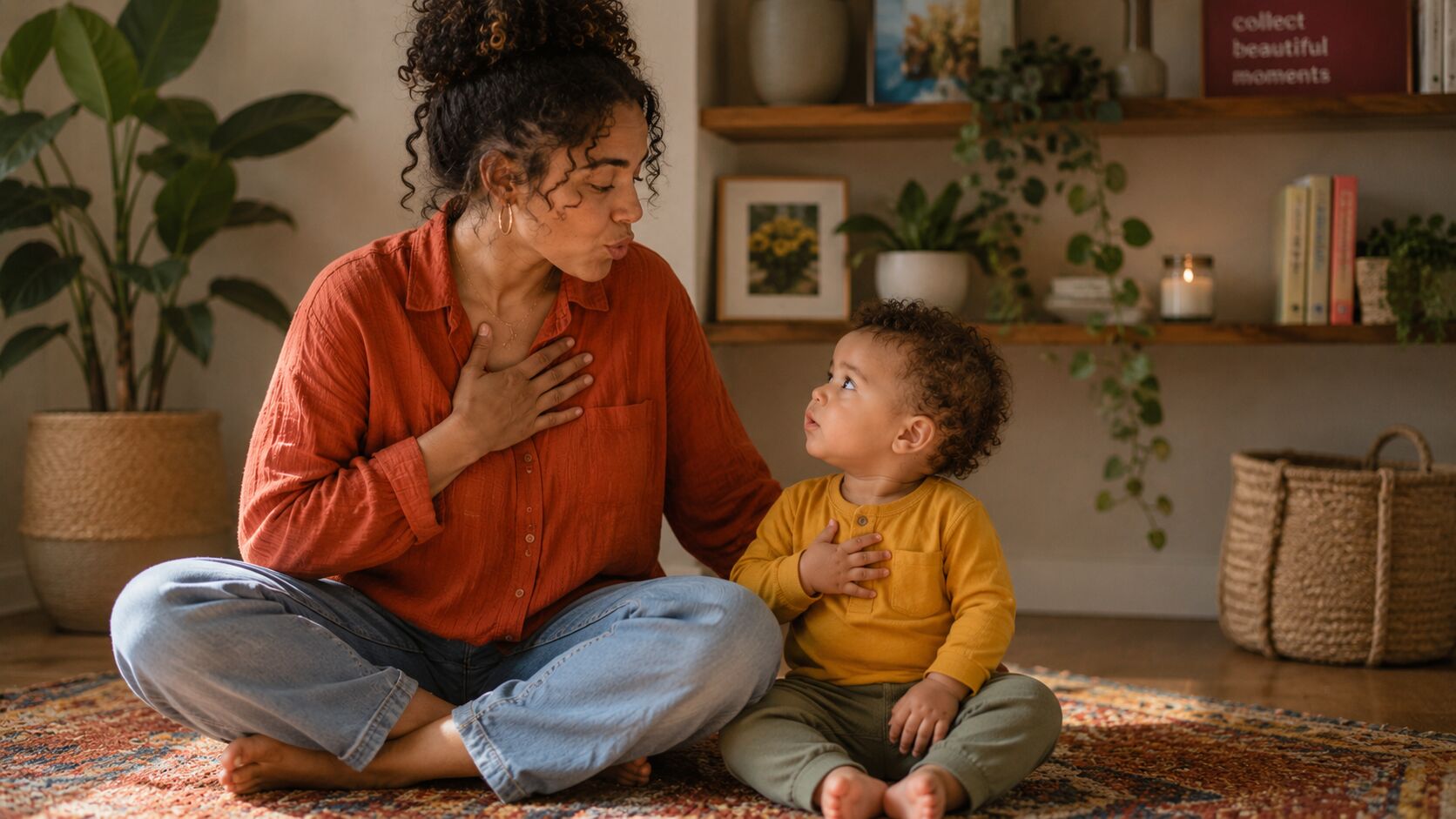
Mindfulness with very young children is about your presence more than theirs. The seed is planted through your own calm, present attention.
- Slow, narrated caregiving. "I'm washing your hands now. The water is warm." Naming what you're doing introduces the practice of paying attention to sensory experience — and slows you down at the same time.
- Eye contact during feeding and play — without screens, without phones, without distraction. The most basic form of mindful presence is simply being there.
- Naming your own emotional state simply. "Mum is feeling calm right now." "Mum is feeling a bit tired today." Babies absorb the modelling long before they have the words.
- Nature walks at their level. Crouch down. Notice what they notice — a leaf, a bird, a shadow on the path. The walk is not the goal. The notice is.
Toddlers (2 to 4)
Toddlers are concrete thinkers. Mindfulness at this age looks like sensory noticing games, never formal practice.
1. The 5-4-3-2-1 grounding exercise
Guide your toddler through the 5-4-3-2-1 sensory countdown: identify five sights, four sounds, three textures, two scents, and one flavour. Approaching this as a collaborative game is highly effective, especially when a child is on the verge of an emotional outburst. By focusing on immediate physical sensations, this technique anchors them in the current moment — bypassing the need for a direct discussion about their feelings.
2. Belly breathing with a stuffed animal
Lie down together. Put a small stuffed animal on their belly. Watch it rise and fall. Make the toy go as high as possible. According to Children's Health, deep breathing techniques activate the parasympathetic nervous system — the body's calm response — and redirect the mind away from anxious thoughts. Toddlers love this game, and it works.
3. The glitter jar
A jar filled with water and glitter that you shake and watch settle. Use it as a metaphor: when we feel upset, our thoughts are like the glitter, all swirled up. When we breathe and wait, they settle. This is genuinely effective for 3- and 4-year-olds, and gives them a visual they'll carry into the school-age years.
Mindfulness with toddlers is not a practice. It's a game with a quietly powerful side effect. (It's also one of the few tools that helps before and after a meltdown — for what to do in the thick of one, see our guide to handling toddler tantrums.)
School-age children (5 to 10)
School-age children can handle slightly more structure but still learn best through play and story.
1. Mindful colouring and drawing
Focused, intentional activity without outcome pressure. The attention to the present moment is the practice. No need to call it mindfulness — just protect the quiet time.
2. The bedtime body scan
Start at the toes and work up. Notice how each part of the body feels. Is it warm? Heavy? Comfortable? Research covered by Mental Health Center Kids shows that body scan practices help children fall asleep faster by moving the body from a stress-response state to a relaxed one — and they're particularly effective for children with anxiety. For a guided audio version to do together, Mindful offers a free 11-minute body scan made specifically for children.
3. Emotion naming with body sensation
"I notice my chest feels tight when I'm nervous." "My tummy gets fluttery before tests." This builds the connection between physical sensation and emotional state — the foundation of self-regulation, and a close cousin of the phrases that raise emotionally intelligent kids. Most adults still struggle with this skill. Teaching it at 7 changes a life.
4. Mindful eating
Occasionally focus a meal on sensory experience. What does this smell like? What's the texture? Is it warm or cold? Don't force it. Just introduce the question once a week.
Tweens and teens (11 and up)
Older children often resist anything that feels childish or forced. The approach changes, significantly.
1. Frame it as a performance skill
Athletes, musicians, and high-achievers use mindfulness. For teens, connecting mindfulness to performance and focus rather than wellness can dramatically reduce resistance. A 14-year-old who rolls their eyes at "calm" will lean in for "what NBA players do before a game."
2. Offer apps rather than instruction
Calm, Headspace, and Smiling Mind all offer teen-specific content. Notably, Smiling Mind is completely free — developed by psychologists and educators, it's the most accessible starting point. Suggesting an app rather than teaching directly respects their autonomy and their preference for not being lectured by a parent.
3. The one-breath rule
Before reacting to something that makes you angry or anxious, take one deliberate breath. That's it. This is genuinely sufficient as a starting practice, and it doesn't require buy-in to the broader concept.
4. Walk and notice (without phones)
Outdoor walking, noticing the environment. Less prescriptive than formal meditation, much easier to introduce without resistance — and teens often open up on walks in ways they won't across a kitchen table.
With teens, the goal is not to convince them to meditate. The goal is to plant tools they'll reach for at 22.
The most important thing: your own practice
Children learn mindfulness most powerfully by watching adults practise it.
When you take a visible breath before responding. When you say "I need a minute to calm down before I answer that." When you name your own emotions rather than suppressing them. When you don't pick up your phone the moment they look away.
This is the part you don't have to manufacture — you can borrow it from the regulation you're already learning for yourself. Our pieces on five-minute meditations for moms and nervous system regulation are written for exactly the harried, no-time version of this. Your children are watching you. Be the thing you're trying to teach.
Mindfulness for children doesn't require special equipment, training, or a dedicated time slot. It's built into the everyday moments you're already in.
Frequently asked questions
At what age can children start mindfulness practices?
From birth, through your own calm presence and sensory narration. Structured practices like breathing exercises and grounding games work well from age 2 to 3. Formal seated meditation isn't appropriate until much later — and isn't required at any age.
How long should mindfulness practice be for children?
Very short. Two to five minutes is plenty for young children. A single deliberate breath is a valid practice. Consistency over time matters far more than duration — a daily 60 seconds beats a weekly 30 minutes.
Does mindfulness actually help anxious children?
Research supports mindfulness as an effective intervention for childhood anxiety, particularly breathing-based practices and body scan techniques (Journal of Child Psychology and Psychiatry). It's not a replacement for professional support — significant anxiety in a child warrants a paediatrician or therapist conversation.
What's the best mindfulness app for kids?
Calm, Headspace, and Smiling Mind all offer well-designed kid- and teen-specific content. Smiling Mind is free, which makes it the most accessible starting point. The best app is the one your child will actually open. Let them choose.
Can mindfulness help with toddler tantrums?
Mindfulness can help reduce tantrum intensity over time by building emotional regulation skills, but it's not an in-the-moment fix during a tantrum. A toddler in full tantrum mode is not in a state where they can access mindfulness practices. That's neurobiology. The practice is for before and after, not during.
How do I introduce mindfulness to a teenager who thinks it's stupid?
Don't introduce it as mindfulness. Frame it as focus, performance, or stress management. Suggest an app rather than teaching directly. Model it yourself without commentary. Most teen resistance to mindfulness is resistance to being told what to do by a parent — not to the practice itself.
Is mindfulness safe for children?
For most children, yes. Some children with significant trauma histories may find body-focused practices activating. In those cases, work with a therapist trained in trauma-informed mindfulness. For typical children, the practices in this guide are safe and developmentally appropriate.
Related reading
- 5-Minute Meditations for Moms — 6 Resets That Actually Work
- The Phrases That Raise Emotionally Intelligent Kids
- How to Handle Toddler Tantrums Without Losing Your Mind
- Who Is Your Daughter Really Talking To?
This article is for general informational purposes and reflects the experience of Momé editors and the research we cite. It is not medical advice. Mindfulness is a supportive tool, not a treatment — if your child is experiencing significant or persistent anxiety, please speak with your paediatrician or a children's mental health professional.