Before she became a mother, Ava Paloma knew she wanted to act and have a family. She just wasn’t sure how the two would work together.
“I knew it with everything in me. I wanted both. Motherhood and acting,” she says. “Could I actually have both? That I wasn’t sure of. But I wasn’t going to let anyone, Hollywood or otherwise, limit me on that front.”
Where career meets motherhood
Paloma has several projects coming up, including The Razor’s Edge, starring James Franco and Tommy Lee Jones, where she plays opposite Paul Ben-Victor. She’ll also appear in Bad Day with Cameron Diaz and The Spot with Claire Danes and Ewan McGregor.
An ensemble member of The Collective NY, Paloma trained under the late Bill Esper and has worked in film, television, and national campaigns for brands including Ford and American Express.
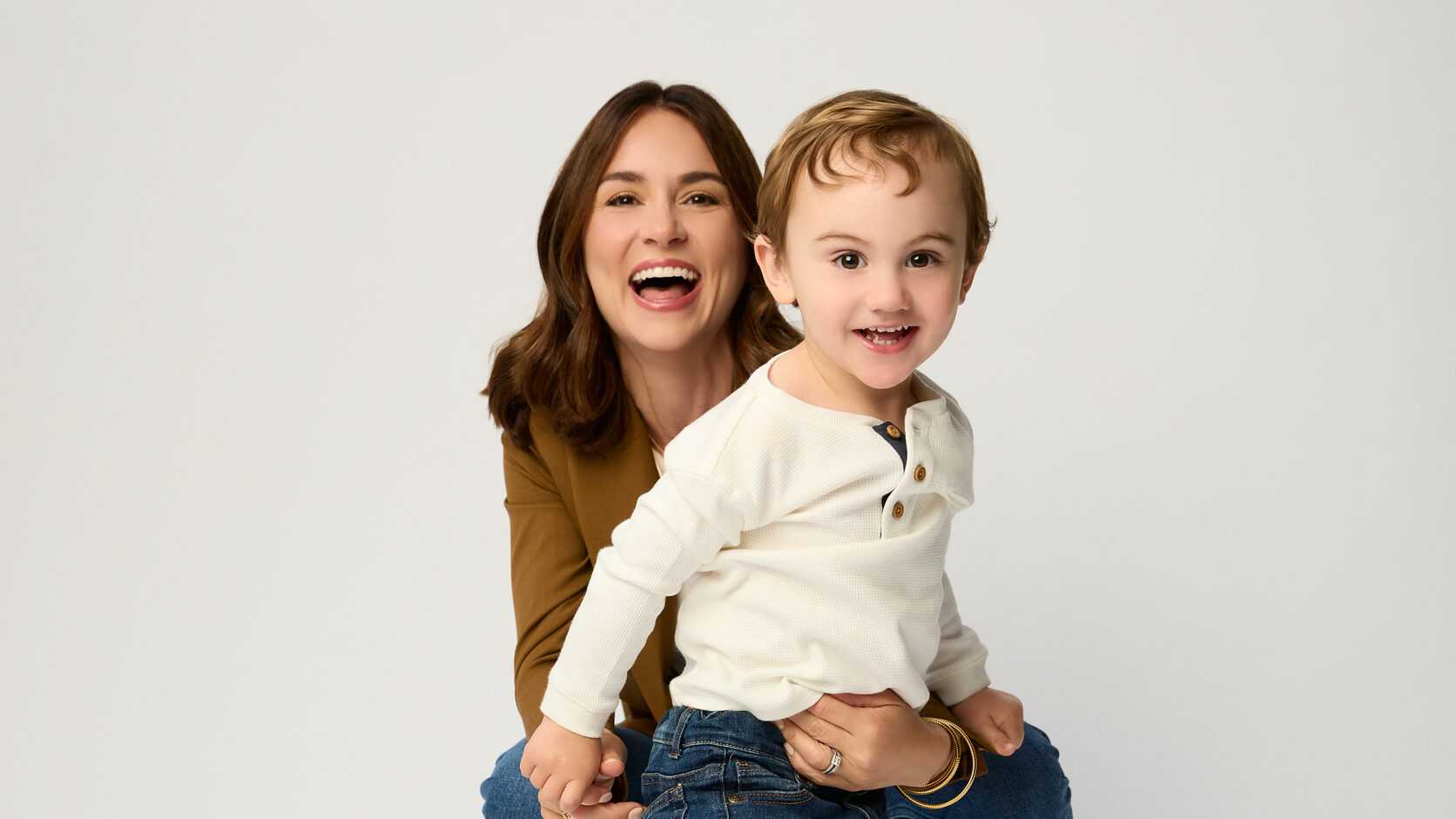
At home, Paloma is mom to two-year-old Bo, and acting often happens around his schedule. She learns lines during naps, tapes auditions before he wakes up, and sometimes heads to set after rocking him back to sleep.
It may not be the most predictable way to build a career, but Paloma has gotten used to switching between the two. A day that starts with preschool drop-off can still end with an audition.
The confidence she didn’t expect
Something shifted for Paloma during her pregnancy, and it wasn’t what she expected.
“When I got pregnant, I felt this growing sense of completion,” she says. “My presence shifted, a confidence and a power I hadn’t felt before.”
That confidence carried into her work. “That translated directly into my acting career and life in general,” she says. “Motherhood empowered me.”
Instead of making her question her career, becoming a mother made her more certain about it — the opposite of the disappearing act so many women brace for, and a reminder that the mother you turn out to be is rarely the one you rehearsed. “Once I gave birth, I felt like nothing could stop me. That’s when the conviction came,” she says.
Like a captain of a ship who had finally decided to set sail. Full speed ahead.
Accepting the chaos
Paloma’s days move between acting and life with Bo. One recent day started with a canceled sitter and ended with her running lines at a restaurant after a film screening, then heading home to tape an audition. The next morning, she was answering emails by 5:45, two hours before Bo woke up.
“That’s a typical Tuesday. The chaos is real, but I lean into it like a game, a puzzle to solve,” she says. “And honestly? I wouldn’t have it any other way.”
Rather than trying to do everything, Paloma chooses three priorities each morning, one for Bo, one for her career, and one for everything else. “I focus on those three things, and when I keep it that simple, I always get it done,” she says. It is a deliberately small answer to a famously large problem — the mental load that runs in the background of most mothers’ days, whether or not anyone else can see it.
The point isn’t to get through a long list or give everything equal attention. Some days work needs more of her. Other days, Bo does. She’s learned to adjust instead of expecting every day to look the same.
She also knows when to call in reinforcements. “My husband, a sitter, ordered dinner that night,” she says. “There’s no shame in it. Getting help is part of the game.”
What motherhood sharpened
Becoming a mother changed the stakes for Paloma, especially in a career where very little is guaranteed. “Acting is not a steady or consistent career,” she says. “The ups and downs, the uncertainty, the feast and famine of it, that doesn’t just affect me now. It affects all of us.”
“When the stakes are higher, you show up differently,” she says. “You prepare more. You waste less time. You stop overthinking and start doing.”
But it hasn’t changed how much she wants it. “Motherhood didn’t make me less ambitious,” she says. “It made every audition, every role, every opportunity feel more meaningful. Because it is.” It is the same recalibration behind the women rewriting the rules at the top of their fields: not less ambition after children, but ambition with the padding stripped out.

The trade-offs are real
Paloma doesn’t pretend doing both means doing everything. Some things have had to take a back seat, at least for now, and she’s realistic about that. For her, having the career and family she wanted has meant deciding what she’s willing to give up along the way.
“You might miss some TV shows. You might eat out a little less. You might put the travel plans on hold for a few years,” she says. “There are real trade-offs. But it can be done. And it can be done well.”
She hopes other women see that having both doesn’t have to mean getting every part of it right.
The goal isn’t perfection. It’s proof. I want women to look at my life and think, if she can do it, maybe I can too.
Sharing the joy
With The Razor’s Edge and other projects ahead, Paloma is in an exciting stretch of her career. Bo may be too young to understand what a new role or film screening means, but she’s still excited to have him along for it.
“I am so proud and genuinely excited to share this moment with him, even if he has no idea what’s happening yet,” she says.
“I think it matters for a child to see their parent doing something they love and doing it well,” she says. “Not just going through the motions, but truly alive in their work. I hope it plants a seed, that he grows up with a deep sense of confidence and belief in himself.”
Even at two and a half, Paloma believes Bo picks up on that. “I know he’s only two and a half, but I think my happiness is infectious,” she says. “At the very least, he sees me truly happy.”
The next version of herself
Motherhood has changed Paloma’s style, too. These days, she prefers clean lines, classic pieces, and clothes that work with life with a toddler — the same instinct behind a wardrobe built for the life you’re actually living.
“I’m in a season of life right now where I can’t be precious about my clothes,” she says. “I don’t want to be worried about what I’m wearing when I’m chasing a toddler around. And honestly? It doesn’t feel like a loss at all.”
She said she had years to dress “stylish, trendy, cute, a little sexy.” Now she’s embracing something different. “There’s something about a polished but practical mom that I’ve completely embraced,” she says. “It feels like the next version of myself. And I kind of love her.”
Showing up for others
While filming in South Georgia, Paloma volunteered at Tift Animal Rescue. What she saw stayed with her.
“An abuse case. A neglected animal. A sick, abandoned dog that had nothing and no one,” she says. “You don’t really know how prevalent it is until you see it firsthand. The underbelly of society. You can’t unsee it.”
The experience made her want to make an impact, however small. “That’s where the pull comes from for me,” she says. “I can’t forget what I’ve seen.”
Paloma hopes to eventually bring Bo along, too. “I believe watching me show up for others will plant something in him,” she says. “His own desire to improve the lives of those around him.”
Rethinking what’s on the table
Paloma’s family owns Wildom Farm, a regenerative farm in Deep Creek, Maryland, and it’s changed how she thinks about food.
“Honestly, I can’t look at food the same way anymore,” she says. “When your family grows it, raises it, and sells it, you become very intentional about what ends up on your table.”
Her sister Julie, who runs the farm, has taught her one rule she now follows: know your farmer.
“If you can go to a local farm and get to know the actual person growing your food, buy directly from that person,” Paloma says. “It’s good for your health and good for the local economy.” If that’s not an option, she recommends getting to know the vendors at a local farmers market — a small shift that tends to reshape everything downstream of it, right down to the one dinner everyone at the table eats.
“You’ll taste and feel the difference. Know Your Farmer. It’s that simple,” she says.
Setting an example for Bo
Paloma hopes Bo grows up knowing he doesn’t have to choose between what matters to him. “I hope he has a deep sense of family. Big dreams. Discipline and drive,” she says. “And the confidence to go for all of it, without ever feeling like he has to choose.”
She also wants him to see that none of it has to look perfect. “There is no perfection in any of this,” she says. “There will probably be a mess every single day.” What a child takes from that has less to do with the mess than with how a parent narrates it — which is most of what the language we use with our kids is quietly doing all day.
Paloma doesn’t measure balance by how smoothly a day goes. Some days one part of her life needs more from her, and she’s learned to be okay with that.
“You wake up, try your best, go for your goals, learn to laugh when it doesn’t go as planned, fall down, pick yourself back up, go to bed, and start again,” she says. “That’s the beauty of life, of motherhood. And when you look back, it will have all been worth it.”