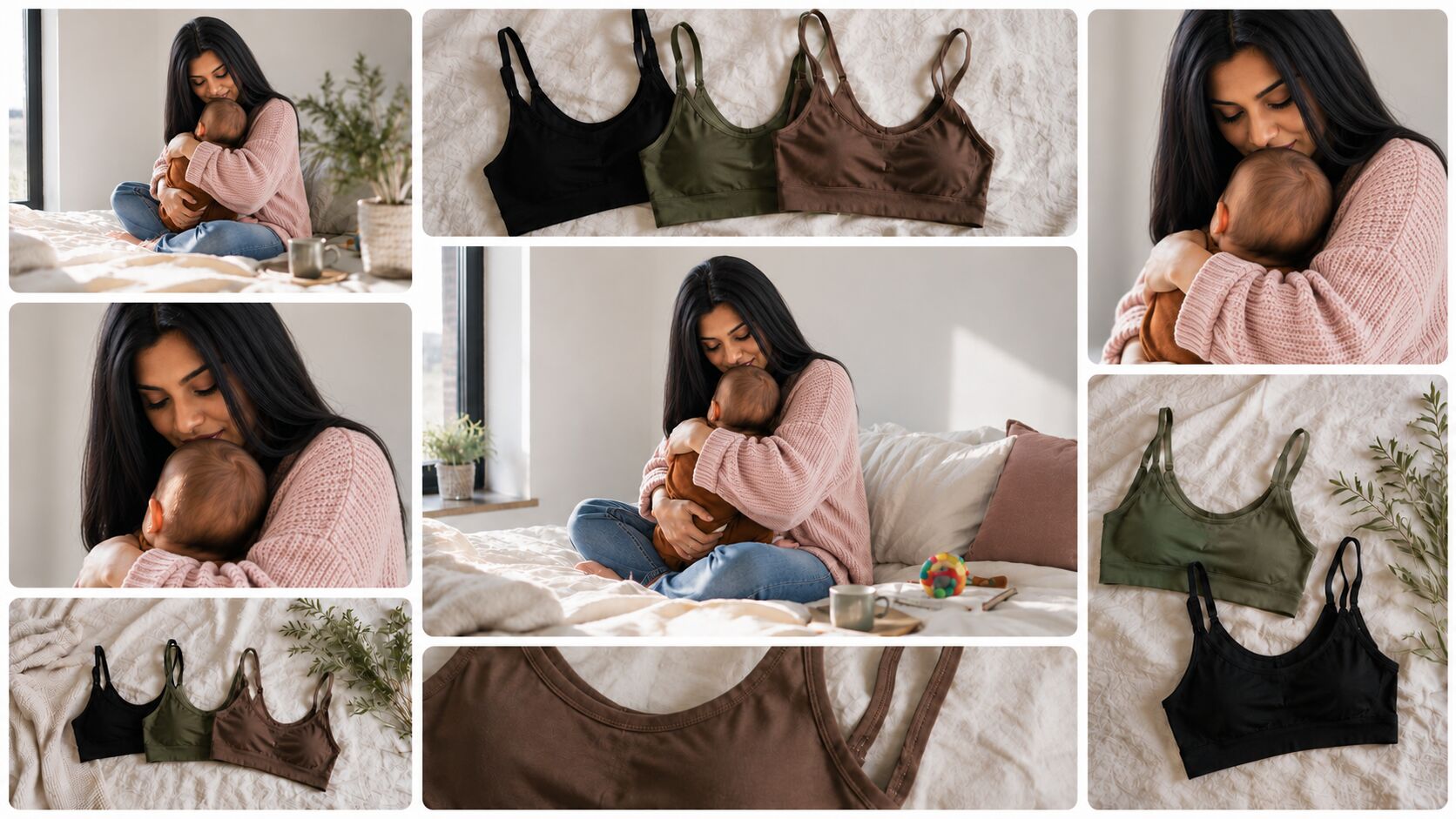

There is a moment every new mother hits, usually in the middle of the night, when she realizes the nursing bra she bought is not the one.
You purchased the pretty version. The one with the most reviews. The one your group chat recommended. The one that promised comfort, support, and effortless one-handed access. And then, at 3am, with a baby crying and one hand free, the truth presents itself: the clips refuse to open in the dark, the underband digs into a ribcage that has expanded by an inch since pregnancy, and the cup gaps in a place no woman has gapped before.
Or it works, technically, and you do not feel like yourself in it at all.
Here is the truth that does not get said clearly enough: a well-fitting nursing bra is one of the most consequential pieces of clothing a postpartum woman owns. You do not wear it occasionally. You wear it all day, every day, for months. It needs to work when you are half asleep, when you are leaving the house, and when your body is changing in real time. The wrong nursing bra makes breastfeeding harder than it has to be. The right one quietly carries you through the year.
This is the honest version of the guide. The bras that actually work, sorted by what you need them for, with the budget alternatives and the splurges in the same table so you can build the rotation that fits your real life.
The seven bras at a glance
| For | Most-Loved Pick | Budget Pick | |
|---|---|---|---|
| 01 | Everyday wear | Kindred Bravely Sublime Bamboo, $40 | H&M MAMA Seamless, $25 |
| 02 | Larger busts (D+) | Bravado Body Silk Seamless, $59 | Cake Maternity Sugar Candy, $46 |
| 03 | Sleep | Bodily The All-Nighter, $48 | Cake Maternity Cotton Candy, $36 |
| 04 | Hands-free pumping | Bodily The Do-Anything, $52 | Momcozy Hands-Free Pumping, $26 |
| 05 | Out-of-the-house wear | Storq Crossback, $58 | Target Auden Nursing Bra, $25 |
| 06 | Wirefree everyday | Cosabella Never Say Never Mommie, $73 | Hanes Ultimate ComfortFlex, $20 |
| 07 | Backup / multipack | Bravado Original, $49 | Amazon Essentials 2-pack, $28 |
Splurge total (one of each): about $379. Budget total (one of each): about $185. Realistic starter rotation (two everyday + one sleep + one pumping if applicable): around $130 in budget mode, $180 in splurge mode.
You do not need every bra in this table. Most mothers do well with three or four. The point is that each row exists for a different daily reality, and the right rotation is the one that covers yours.
What actually matters in a nursing bra
Before any specific recommendation, the criteria. Every bra worth wearing has to do five things:
Open with one hand, in the dark. This is the test. If you cannot unclip the cup with one hand while half asleep, the bra has failed before you have even tried it on. The best clips are magnetic or single-action plastic, not multi-step.
No underwire in the early postpartum weeks. Underwire can compress milk ducts and contribute to clogged ducts and mastitis. Most lactation consultants recommend wirefree exclusively for the first 6 to 8 weeks postpartum, and wireless support broadly during the first three months.
A wide, soft underband. A narrow band digs into a recovering ribcage. Wider bands distribute pressure more evenly, sit better, and stay in place when you are nursing or pumping. This single design feature separates the bras you live in from the bras that end up in the donate pile by week six.
Flexibility through size change. Your bust will fluctuate dramatically: across the day (an empty breast and a full breast can be a full cup size apart), across the first months (engorgement, regulation, weaning), and into the next year. The best nursing bras stretch through this. The worst ones fit perfectly for two weeks and then never again.
Real wearability under clothes. Eventually, you leave the house. The bra you live in cannot announce itself through every shirt you own.
If a bra fails any of those five, it is not worth keeping in the rotation.
The seven bras, in detail
Best everyday nursing bra: Kindred Bravely Sublime Bamboo
The Kindred Bravely Sublime is the bra most new mothers end up living in. Soft bamboo modal fabric, a wide soft underband, easy single-action clip-down access, and enough stretch through the cup to handle the real-time fluctuations of nursing. The Sublime is the runner-up across nearly every editor roundup of best nursing bras for a reason: it is genuinely comfortable for 16 hours of wear, and it is the closest thing to a bralette that still has enough structure for daytime.
For a more accessible alternative, the H&M MAMA Seamless Nursing Bra is the most-cited budget pick across mom forums. Soft, washable, lower lift than the Sublime but completely serviceable for everyday wear at half the price.
Best nursing bra for larger busts: Bravado Body Silk Seamless
Finding a supportive wirefree nursing bra above a D cup is genuinely hard. Bravado's Body Silk Seamless is the bra that has been solving this problem for over twenty years and remains the bestselling nursing bra in North America. Available in cup sizes B through K, with a wide back band, dual nursing clips, and enough structural support that it actually holds a larger bust without underwire. Most lactation consultants and pelvic-floor physiotherapists list it as their first recommendation.
The budget alternative for D+ cups is the Cake Maternity Sugar Candy, a wirefree seamless bra specifically engineered for fuller busts at a slightly lower price.
Best sleep nursing bra: Bodily The All-Nighter
Sleep nursing bras have one job: zero pressure, easy access, no thinking. Bodily's All-Nighter Sleep Bra has become the editor pick across postpartum publishing for the same reason every new mother who tries it keeps wearing it. Pull-aside access (no clips to fumble at 3am), a soft modal blend, no seams in pressure points, and a silhouette that looks like sleepwear rather than a medical garment. Genuinely comfortable through nightfeeds and overnight.
A more accessible alternative is the Cake Maternity Cotton Candy Sleep Bra, which has been a staple in this category for years and offers similar pull-aside access at a lower price.
Best hands-free pumping bra: Bodily The Do-Anything Bra
If you are pumping, a hands-free pumping bra is non-negotiable. The Bodily Do-Anything Bra is the current category leader: built to hold standard flanges and pump shields securely, comfortable enough to wear for full pumping sessions, and styled like an actual bra rather than a medical accessory. It also doubles as a nursing bra, which means you can wear one bra through both feeding and pumping rather than swapping mid-session.
The longstanding budget alternative is the Momcozy Hands-Free Pumping Bra at well under $30, with over 50,000 reviews on Amazon. Less elegant, equally functional.
Best nursing bra for leaving the house: Storq Crossback
The bra you wear when you are putting on real clothes again. The Storq Crossback Nursing Bra has a clean silhouette that disappears under fitted tops, a crossback strap configuration that distributes weight evenly without digging into shoulders, and easy clip-down access. It looks like an actual bra, not nursing equipment, which matters more in this season than the wellness internet acknowledges.
Best wirefree everyday alternative: Cosabella Never Say Never Mommie
For mothers who want a slightly more elevated everyday option, Cosabella's Never Say Never Mommie Nursing Bralette offers Italian lace, the brand's signature soft mesh, and clip-down nursing access in a silhouette that reads as lingerie rather than postpartum gear. Worth every dollar if you want to feel like yourself in your own underwear drawer again.
For a comparable wirefree everyday alternative at a fraction of the cost, the Hanes Ultimate ComfortFlex Nursing Bra is the quiet doula favorite. Cheap, durable, sold in multipacks, and a no-fuss everyday option for the rotation.
Best multipack for the rotation: Bravado Original
Most mothers benefit from owning at least two or three identical everyday nursing bras: one in the wash, one in the drawer, one on the body. The Bravado Original Nursing Bra is the longstanding bestseller specifically for this purpose. Sold individually rather than in packs, but worth buying in multiples of the same size and style.
The cheapest way to build a rotation is the Amazon Essentials Nursing Bra 2-pack, which gives you two functional everyday bras for about $28 total. Not the bras you wear when leaving the house, but reliable for the laundry-rotation tier of the wardrobe.
Related: 14 Things New Moms Actually Need for Postpartum — the honest fourth-trimester edit.
How many nursing bras do you actually need
Most postpartum publications recommend five to seven nursing bras, which is roughly twice as many as most mothers actually wear. A realistic working rotation looks more like this:
- Two everyday bras of the same style and size (one in the wash, one on the body). The Sublime, the Body Silk, or the H&M MAMA are all reasonable picks.
- One sleep bra for nights and recovery time. Bodily's All-Nighter or Cake Maternity's Cotton Candy.
- One out-of-the-house bra that disappears under real clothes. The Storq Crossback or the Cosabella Mommie.
- One pumping bra if you are pumping at all. Bodily Do-Anything or Momcozy.
That is four to five bras. If you are pumping, five. If you are not, four. Anything more than that, in most cases, sits unworn.
When to buy and when to refit
Timing is one of the most underdiscussed parts of nursing-bra purchasing.
In the last four weeks of pregnancy, buy two everyday nursing bras in your current size. You will wear them in the hospital and in the first weeks postpartum, before your body has stabilized. Do not buy a full rotation yet; you do not yet know what size you will be.
At about 6 to 8 weeks postpartum, your milk supply has begun to regulate and your bust will start to settle into its "stable" nursing size. This is the moment to refit. Most lactation consultants and bra fitters offer free virtual fittings, and brands like Bravado and Kindred Bravely run free fit guides on their websites. Buy the rest of the rotation now.
At weaning, expect another size shift as milk supply slows. According to Dr. Jacqueline Kent, a leading lactation researcher at the University of Western Australia, most women's breasts return to roughly their preconception size within three months of complete weaning. That said, a 2004 study published in Acta Paediatrica of nearly 500 mothers found that 73% reported some lasting change to breast size or firmness 18 months after birth, regardless of whether they breastfed. The takeaway: refit at this stage if your bras stop fitting well. The post-weaning bust is your new baseline, and for most women, it will be close to but not identical to where it began.
Can you wear underwire while breastfeeding?
The short answer is not at first, and not casually.
Underwire applies focused pressure on milk ducts in a way that wireless support does not, and that pressure is the leading mechanical contributor to clogged ducts and mastitis. Most lactation consultants and the major lactation organizations (La Leche League, IBCLC associations) recommend exclusively wirefree bras for the first 6 to 8 weeks postpartum and continuing to prioritize wirefree options through the first three months.
After that point, underwire is acceptable if it fits perfectly. The bar for "perfectly" is genuinely high: no pressure on breast tissue, no digging into the underbust, no flattening. A poorly fitting underwire bra can still cause clogged ducts at six months postpartum just as easily as at six weeks. If you want to wear underwire during nursing, get fitted by a professional. Do not eyeball it.
The bottom line
A good nursing bra is not a small thing. It is the piece of clothing your postpartum body lives inside for sixteen hours a day, and the difference between a bra that works and one that does not is the difference between a hard week and a slightly less hard week.
Find the rotation that fits your body, your routine, and your real life. Two everyday bras, one for sleep, one for leaving the house, one for pumping if you pump. That is the whole kit. The right ones quietly hold you up, all day, through the season that asks the most of you.
When something this small works better, everything around it gets easier.
Frequently asked questions
What is the best nursing bra for breastfeeding?
The best nursing bra is the one that opens with one hand, fits without underwire in the early weeks, and stretches through your size changes. The most-recommended picks across editor roundups are the Kindred Bravely Sublime for everyday wear and the Bravado Body Silk Seamless for larger busts. Both are wirefree, sized inclusively, and genuinely comfortable for full-day wear.
When should I start wearing nursing bras?
Most mothers start wearing nursing bras in the last four weeks of pregnancy and continue throughout breastfeeding and weaning. Buy two everyday bras in your late-pregnancy size first; refit and buy the rest of the rotation at 6 to 8 weeks postpartum, once milk supply has regulated.
Are pumping bras worth it?
Yes. A hands-free pumping bra makes pumping dramatically easier and faster, since you can read, eat, work, or hold the baby instead of holding the flanges in place. The Bodily Do-Anything and the Momcozy Hands-Free are the two most-recommended options, at very different price points.
How long do you wear nursing bras?
For as long as you are breastfeeding or pumping. Most mothers wear nursing bras for six months to over a year, sometimes longer. Many women continue wearing nursing-style soft bras well past weaning, simply because they are more comfortable than underwire bras for any postpartum body.
Can you wear regular bras while breastfeeding?
You can, technically, by lifting them or pulling them aside, but it is genuinely uncomfortable for sustained nursing and adds friction to feeds. A dedicated nursing bra is one of the few postpartum essentials that is worth investing in.
What is the best nursing bra for a large bust?
The Bravado Body Silk Seamless is the most-recommended wirefree nursing bra for D-cup and larger busts, with cup sizes available through K. The Cake Maternity Sugar Candy is a strong budget alternative engineered specifically for fuller busts.
How many nursing bras do you actually need?
Four to five total: two everyday bras (same style, same size, alternated), one sleep bra, one out-of-the-house bra, and one pumping bra if you pump. Most mothers do not wear more than that, regardless of how many they own.