
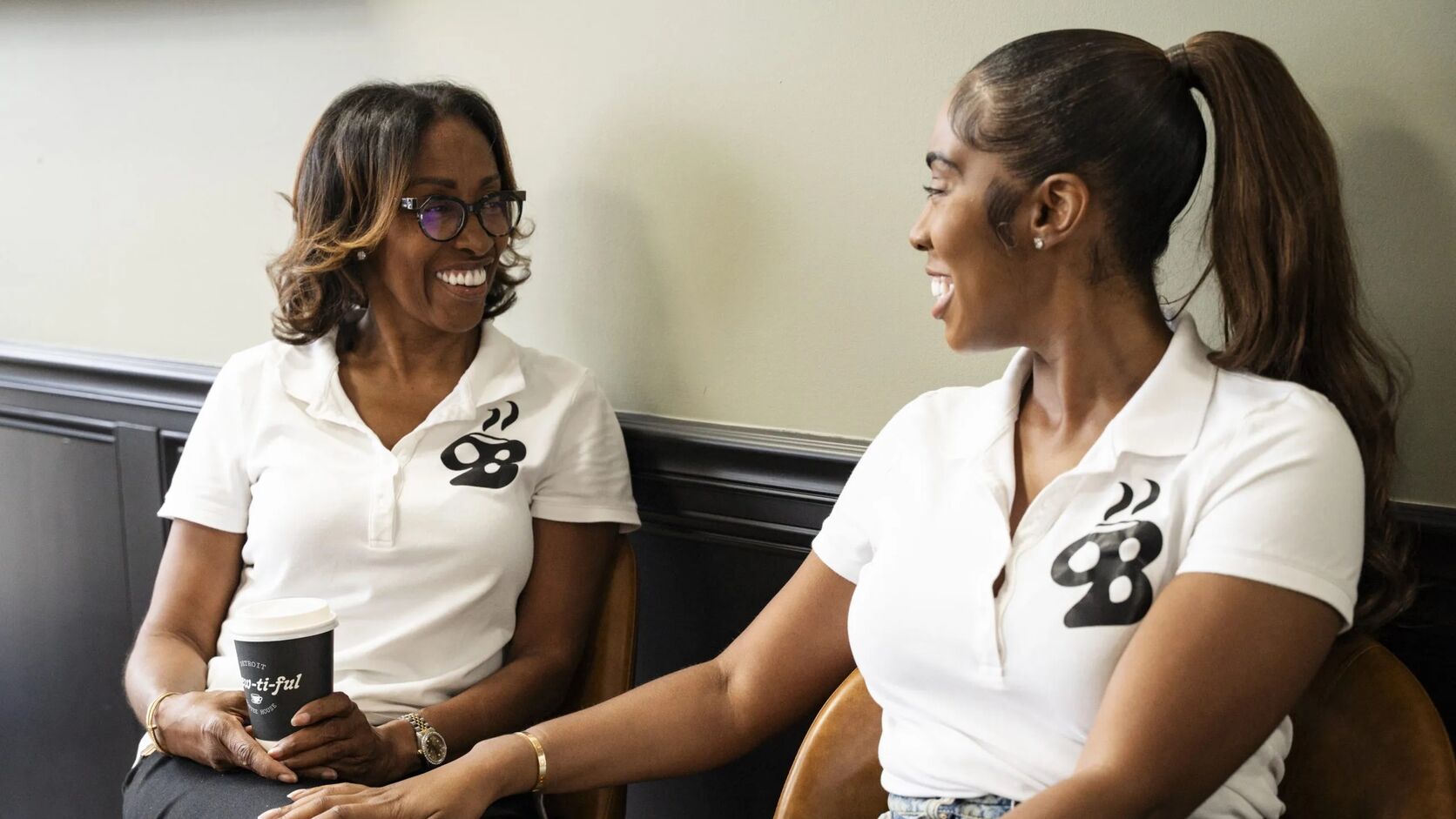
Neither Beverly Beal Sr. nor her daughter, Beverly Beal Jr., drinks coffee. They are tea and matcha women. So it says something that one of the businesses they chose to build together is a coffee house.
The idea for Detroit Brew-ti-ful Coffee House came the way many of Beverly Sr.’s ideas did: from paying attention.
She kept noticing people in her neighborhood, especially seniors, walking to the gas station for a cup of coffee and a little conversation. That detail stayed with her.
“There was a need for somewhere close to home where people could sit down, meet someone, get some work done, or simply enjoy being in their own neighborhood,” Beverly Sr. says. “Coffee was part of it, but the bigger need was a place to connect.”
That became Detroit Brew-ti-ful Coffee House. True to its origin, the coffee was never really the point.
“The coffee gave us the idea, but the people were always the purpose,” she says.
Beverly Sr. wanted to create a welcoming gathering place for everyone: someone working on a laptop, a student studying, friends meeting up or an older neighbor coming in simply to sit for a while.
“That is what makes the space special to me,” she says. “People feel like it belongs to them too.”
The Work She Was Already Doing
Long before the coffee house, there were the childcare centers.
For decades, Beverly Sr. owned and operated childcare centers in Detroit, employing members of the community and giving families a safe place to leave the children they loved most.
It was demanding, daily work: the kind that doesn’t leave much room to step back and consider the shape of what you are creating or who might be quietly studying it from the sidelines.
Beverly Sr. wasn’t thinking about the example she was setting at the time.
“I was focused on running the businesses, taking care of the children and families we served, and making sure everything was handled day to day,” she says.
As a mother, you hope your children are absorbing something from what you show them, but you don’t always know which lessons are landing.
“Looking at Beverly now, I can see that she was paying attention,” Beverly Sr. says. “She saw what it took to build something, take care of people, solve problems and keep going when things were not easy.”
Her daughter was absorbing all of it. She just didn’t have the words for it yet.
“The biggest thing was learning that you can create the solution yourself,” Beverly Jr. says. “My mom did not sit around waiting for the perfect opportunity or for someone to give her permission. If she saw a need, she figured out what she could build around it.”
It wasn’t a formal business lesson so much as the atmosphere Beverly Jr. grew up in.
“I did not have language for that as a child,” she says. “It was simply what I saw.”
Watching a woman own businesses, employ people, manage money and make decisions every day did something quiet and permanent.
“That normalized ownership for me very early,” she says.
The Lessons, Said Out Loud
Some of what Beverly Sr. passed down was deliberate.
Ask her what she wanted to teach her daughter, and the list is refreshingly straightforward: know your worth, be responsible for yourself, treat people with respect and don’t be afraid of hard work.
Underneath all of it was the financial literacy she wanted her daughter to carry: the habit of asking questions, reading the paperwork and understanding the numbers before saying yes.
Just as deliberate was the matter of staying grounded. Beverly Sr. wanted her daughter to know she could go anywhere and accomplish anything without ever being ashamed of where she came from.
“You can experience more, learn more, travel, grow, and still remember your people,” she says. “Staying grounded is about knowing who you are, treating people well, and remembering that success does not make you better than anybody else.”
Other lessons were taught by circumstance.
Beverly Sr. was once laid off and had to decide what would come next. That setback became part of her path into entrepreneurship, and she never hid the difficult parts from her daughter.
“Beverly grew up seeing that disappointment does not mean everything is over,” she says. “You may not control the setback, but you can control what you do next.”
Her daughter carries that inheritance with her, and she can name every piece of it.
“The confidence to build, the expectation that I should understand my money, the belief that I can recover when something does not work, and the responsibility to bring other people along with me all started at home,” Beverly Jr. says. “Every time I take a risk on myself, there is a little bit of her in that decision.”
When Her Path Became Her Own
For years, it may have looked like a daughter following in her mother’s footsteps. Then came law school.
“She had her own interests and her own vision for what she wanted her career to look like,” Beverly Sr. says.
Beverly Jr. became an intellectual property attorney, started her own law firm and continued creating opportunities for herself instead of waiting for someone else to hand her a career.
“That is when I knew she was building something uniquely hers,” her mother says.
Today, that “something” is plural.
Beverly Jr. is an attorney and serial entrepreneur whose ventures include her law firm, Fine Line Non-Alcoholic Spirits and GiftBiz. She has spoken at the ESSENCE Festival of Culture, and she also said yes when her mother invited her to help build a coffee house in their Detroit community.
To her, none of it is a departure from what she watched growing up. “Starting my own law firm, building Fine Line, creating GiftBiz, and saying yes to Brew-ti-ful all require that same willingness to trust yourself enough to move,” she says.
Where Beverly Sr. built deeply within one community, her daughter has carried the same instinct across several industries. Those ventures may initially appear unrelated, but Beverly Jr. sees the common thread clearly.
“Law, hospitality, wellness, nonprofit work, investing: to me, they are not random interests,” she says. “They are all different expressions of having more control over what you build, what you own and the kind of life you create.”
Becoming Business Partners
Going from mother and daughter to business partners is its own kind of leap. Neither of them treated the decision lightly, but the nerves weren’t where someone might expect.
Beverly Sr. wasn’t worried about working with her daughter.
“I already knew how she operated. I knew she was serious about business and would do the work,” she says.
More importantly, they agreed on their purpose.
“We wanted to create something positive in the community, so we started from the same place,” Beverly Sr. explains.
For Beverly Jr., the unfamiliar part wasn’t working with family. It was entering the hospitality industry.
“I am an attorney. I had never dreamed about owning a coffee shop, and neither of us had experience in hospitality,” she says.
What made the partnership work was her trust in her mother’s understanding of the neighborhood she had served for decades.
“Once I understood the bigger vision, I knew my role was to help us build the structure around it and figure the rest out.”
That division of strengths became the engine of their partnership.
“Beverly thinks several steps ahead,” Beverly Sr. says. “She is always thinking about the contract, the brand, what could happen next and whether we are protected. Working with her has made me think differently about those things.”
Her daughter recognizes what her mother brings in return.
“My mom has an incredible instinct for people,” Beverly Jr. says. “She knows her community, she can read a room, and she understands things about customer experience that you cannot learn from a spreadsheet.”
“I naturally want to create the system and analyze everything,” she adds. “She reminds me that sometimes you also need to look up and pay attention to the person right in front of you.”
When They Disagree
They do disagree. Beverly Jr. won’t pretend otherwise.
“We are both strong-minded women,” she says.
What prevents a difference of opinion from becoming something larger is their mutual respect for what the other person knows.
“My mom has decades of operational experience and understands this community in a way that I never want to dismiss,” Beverly Jr. says. “I bring a legal and strategic lens that she respects as well.”
“We can challenge each other, but ultimately, we both want the business to win. Once you come back to that, it becomes much easier to separate a disagreement from the relationship.”
Her mother puts it more simply.
“At the end of the day, she is still my daughter and I am still her mother,” Beverly Sr. says. “Business is not going to change that. We can disagree, talk it through and keep going.”
Why They Continue to Build in Detroit
Both women could have taken their skills elsewhere. Both chose to continue building in the Detroit community that shaped them, although their reasons are slightly different.
For Beverly Sr., it comes down to relationships.
“These are families I know. I have watched children grow up, and in some cases, I now know the next generation of their families,” she says. “When you have that kind of relationship with a place, you want to continue contributing to it.”
For Beverly Jr., it comes back to ownership, the word that runs through everything she builds.
“Detroit is home, but for me, this is also about what happens when people who are from a community have the opportunity to build within it,” she says. “I want us to be able to enjoy beautiful spaces, own businesses, create jobs and build wealth here.”
The thought brings her back to the beginning of her own entrepreneurial story.
“There is something powerful about being able to look around the neighborhood that helped shape you and know that, instead of only leaving to find opportunity somewhere else, you are also helping create more opportunity right here.”
What Mother and Daughter Taught Each Other
The most telling part of Beverly Jr. and Beverly Sr.’s relationship is that the teaching runs both ways.
Beverly Sr. plainly sees herself in her daughter: the work ethic, the care for people and the refusal to let go of something once she believes in it.
But she is also quick to recognize where her daughter has gone further.
“I probably taught her how to work, but she has definitely taught me a few things about how to build,” Beverly Sr. says.
That, in the end, is what she wanted all along: not a copy of her own career, but a daughter who could take what she had been given and extend it.
“You want them to take what you gave them and go further,” she says.
There is a particular kind of pride in watching from where she sits, having carried the same weight herself. “It is rewarding because I understand what it takes,” Beverly Sr. says. “I know the decisions, the responsibility, and the pressure that come with owning a business.”
Watching the world catch up to what she has always seen in her daughter, Beverly Sr. doesn’t reach for anything grand. She reaches for pride, the ordinary, enormous kind.
“Not just because of what she has accomplished,” she says, “but because of the woman she has become while accomplishing it.”
Learn more about Beverly’s work through Beverly Beal Law, GiftBiz and Fine Line Non-Alcoholic Spirits at drinkfineline.com. Visit detroitbrewtifulcoffeehouse.com to learn more.