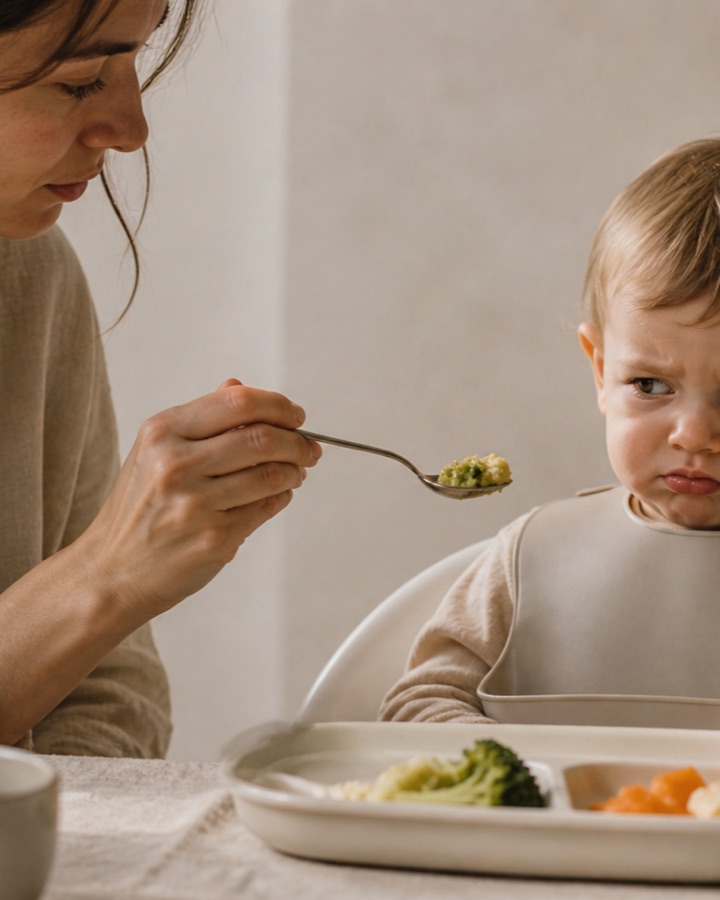

They ate everything for eight months. Sweet potato, broccoli, salmon, soft scrambled eggs. You watched your baby open her mouth for every spoonful with the quiet astonishment of a parent who had braced for the worst.
Then somewhere between twelve and eighteen months, something shifted. The same child who once demolished a bowl of lentil soup now regards a piece of plain pasta with the suspicious focus of someone defusing a bomb. The pediatrician says she is fine. Your mother says it is a phase. The internet is, as ever, simultaneously panicked and unhelpful. And in the meantime, you are standing at the kitchen counter at 5pm, staring at a plate of food you spent twenty minutes preparing, watching your toddler eat exactly two bites of plain bread and then ask for a snack at 5:45.
Welcome to toddler feeding. It is infuriating, confusing, deeply common, and — this is the part nobody quite says clearly enough — something you can navigate without turning every meal into a battleground.
This is what the research, the pediatric nutrition specialists, and a great many recovered formerly-picky-toddlers' parents will tell you actually works.
Why toddlers become picky: the actual reason
Understanding what is biologically happening changes how you respond to it.
Around twelve to eighteen months, toddlers experience a developmental shift called food neophobia — a fear of new foods that researchers believe is an evolutionary protective mechanism. When children begin walking and exploring independently, rejecting unfamiliar foods was historically a survival strategy. Your toddler's brain is doing exactly what it is designed to do, which is to say it is becoming highly suspicious of any plant, fruit, or texture it has not personally vetted.
At the same time, toddlers are asserting autonomy for the first time in their lives. Food is one of the rare areas where they have genuine, immediate control. They can simply refuse to open their mouths. This is developmentally appropriate, important, and necessary for healthy attachment — even when it is genuinely maddening at 6pm on a Wednesday.
Picky eating peaks between ages two and four. Most children expand their range significantly by school age, and the trajectory is improved more by what parents stop doing than by anything they start.
What makes it worse: the well-meant moves that backfire
A handful of common parental responses to food refusal have been shown in research to entrench picky eating rather than resolve it. If you are doing any of these — and most of us have — the first piece of good news is that stopping is enough. The second is that you are not alone. These are the cultural defaults; almost everyone tries them.
Pressuring or coercing a child to eat
"Clean your plate." "Just one more bite." "If you don't eat your dinner, you can't have…" Research from the International Journal of Behavioral Nutrition and Physical Activity and others shows that pressure measurably decreases a child's acceptance of new foods. The harder you push, the more anxious the child becomes around food — and anxiety is the worst possible mealtime ingredient.
Bribing with dessert
"Eat three bites of broccoli and you can have a cookie" communicates clearly that healthy food is something to be endured, and the dessert is the prize. Years of this teach a child to view vegetables as work and sweets as a reward, which is the precise opposite of what builds intuitive eating.
Preparing an entirely separate meal
Cooking a separate dish for the picky eater removes any incentive to engage with the family food and quietly entrenches the rotation of three or four "safe" foods. Some accommodation is reasonable; building a parallel kitchen is not.
Hiding vegetables in food
Sneaking spinach into brownies feels like a win in the short term, but it does not build acceptance of actual vegetable flavors or textures. The long-term goal is a child who eats a vegetable knowing it is a vegetable, which only happens through neutral, repeated exposure to it in its actual form.
Reacting with visible frustration or anxiety
Toddlers are studying you. If your face falls when she pushes the plate away, you have just taught her that food refusal is one of the most powerful tools in her toolkit. The single most useful muscle in toddler feeding is the ability to remove a plate, calmly and without commentary, when the meal is over.
The framework that actually works: division of responsibility
The most evidence-backed framework in toddler feeding comes from registered dietitian and family therapist Ellyn Satter, whose work has shaped pediatric nutrition guidance for over four decades. She calls it the Division of Responsibility in Feeding, and the structure is genuinely simple:
The parent is responsible for what is offered, when, and where.
The child is responsible for whether they eat, and how much.
Read those two sentences again. The reframe inside them is what resolves most toddler feeding power struggles, because the power struggle exists only when both parties are trying to control the same things. When you let go of whether and how much, the fight has nowhere to go.
Your job, in this model, is to put nourishing food on the table at predictable times in a calm setting. Their job is to decide what to eat from what is in front of them, and how much of it. That is the entire deal. When you stop trying to control what goes into their mouth, you reclaim mealtime as a relationship rather than a negotiation, and your toddler stops viewing dinner as something to win or lose.
Satter's book Child of Mine: Feeding with Love and Good Sense is the foundational reference text on this approach — worth owning if toddler eating is currently an active source of stress in your house.
What to actually do at the table
Inside the Division of Responsibility framework, the following practices are what consistently work in research and in pediatric feeding clinics.
Offer rejected foods, neutrally, on repeat
A 2008 review in Appetite and subsequent research consistently show that toddlers need to be exposed to a new food anywhere from 10 to 20 times before they accept it, and sometimes more. The critical word is neutrally: offered without pressure, without commentary, without you watching them with the desperate hopefulness of a sommelier waiting on a verdict. Put the food on the plate. Do not make it a topic. If it is refused, remove it without comment. Repeat next week. And the week after. Most foods are eventually accepted on this timeline; almost none are accepted under pressure.
Always include at least one food they reliably eat
Plain pasta. Buttered toast. Apple slices. Always have one safe item on the plate alongside whatever new or contested food you are offering. This ensures the child can always eat something, which removes desperation from the situation and lowers the stakes of every meal.
Eat together, eat the same food, and visibly enjoy it
Children learn what to eat by watching the people around them eat. The most consistently powerful tool in toddler feeding is the family meal where adults eat the same food the child is being offered, and enjoy it without comment or performance. Modeling matters more than almost any other intervention.
Involve them in the food
Toddlers who help prepare a meal are dramatically more likely to try it. Washing vegetables, tearing lettuce, stirring batter, choosing between two options at the grocery store, sprinkling cheese on top. The involvement builds ownership, which is the opposite of the resistance that drives food refusal.
Try the same food in different forms before giving up
A child who refuses cooked broccoli may accept it raw with hummus. A child who refuses soup may eat the same vegetables roasted on a sheet pan. This is not fussiness on their part; texture and presentation are genuine sensory experiences for toddlers, and a "no" to one preparation is not a "no" to the food.
Keep portions toddler-sized
A heaping serving of an unfamiliar food is overwhelming. One piece, one cube, one floret is manageable. Small portions reduce both anxiety and waste, and you can always offer more if it is well received.
For mothers looking for ongoing, evidence-based feeding guidance, registered dietitian Jennifer Anderson runs Kids Eat in Color, one of the most-followed pediatric nutrition resources online. Her content is research-backed, explicitly anti-pressure, and a genuinely useful day-to-day resource.
When to seek professional help
Most toddler picky eating is developmentally normal and resolves with time and a low-pressure approach. The categories below, however, are worth a conversation with your pediatrician or a feeding therapist:
- Your child is losing weight or not growing appropriately on the standard growth curves.
- Eating is causing significant distress, gagging, or choking on textures that are age-appropriate.
- Your child eats fewer than twenty foods total, and the list is shrinking rather than growing over time.
- Mealtimes are consistently highly distressing for the whole family in a way that does not respond to a low-pressure approach.
- You suspect underlying sensory processing differences, oral-motor issues, or anything more than typical toddler food preferences.
Avoidant Restrictive Food Intake Disorder (ARFID) and pediatric feeding disorder are real diagnoses with effective treatment, and the worst thing a parent can do is assume the situation is normal when it is not. A pediatric feeding specialist or a speech-language pathologist with feeding expertise can assess whether further support is warranted.
The bottom line
Toddler food refusal is normal, temporary, and workable. The work is not in convincing your child to eat. The work is in letting go of the parts of the meal that were never yours to control in the first place.
Stop the power struggle. Serve food neutrally. Keep offering without pressure or fanfare. Eat together. Give it time — a great deal more time than you think will be necessary.
Your job is to put good food on the table, in a calm setting, at predictable times.
Their job is the rest.
That, in fact, is the whole thing.
Frequently asked questions
Is toddler picky eating normal?
Yes. Food neophobia and picky eating peak between ages two and four and are a normal, developmentally appropriate part of toddlerhood. Most children expand their range significantly as they get older, especially when mealtimes have remained low-pressure.
How many times do I need to offer a food before my toddler accepts it?
Research suggests 10 to 20 neutral exposures before many toddlers accept a new food, and sometimes more. The critical factor is consistency without pressure, not the number of exposures itself.
Should I hide vegetables in my toddler's food?
Hiding vegetables can deliver short-term nutrition but does not build acceptance of actual vegetable flavors or textures. Neutral, repeated exposure to visible vegetables is the more effective long-term strategy. Many parents do both, which is reasonable.
What do I do when my toddler refuses dinner?
Serve the meal, include at least one food they reliably like, eat your own food with visible enjoyment, do not comment on what they do or do not eat, and remove plates without drama when the meal is over. Offer a small bedtime snack only if it is part of the regular routine, not as a rescue from a missed meal.
Should I make a separate meal for my picky toddler?
No. Some accommodations are reasonable (cutting their food differently, plain pasta on the side, a bowl of fruit they like), but preparing an entirely separate meal removes any incentive to engage with the family food and reinforces the rotation of "safe" foods.
At what age does picky eating typically end?
Picky eating peaks between ages two and four, and most children become noticeably more adventurous between ages five and seven. The trajectory is generally improved by what parents stop doing rather than what they start.
Can picky eating be a sign of a feeding disorder?
Sometimes. If your child eats fewer than 20 foods total, gags on age-appropriate textures, is losing weight, or shows significant distress around food beyond typical toddler refusal, it is worth speaking with a pediatrician or feeding specialist. ARFID and pediatric feeding disorder are real diagnoses with real treatment.