Starting solids isn't one moment — it's a six-month progression that takes your baby from runny purees at 6 months to modified family meals by their first birthday. The textures, foods, and portions that suit a 6-month-old look nothing like what a 9-month-old needs.
Getting the progression right matters more than most parents realise. Move too slowly and you risk texture aversion — babies who never learn to manage lumps or chewy foods. Move too fast and you risk choking, or overwhelming a baby who isn't developmentally ready.
This guide breaks down baby feeding stages by age, with a clear roadmap for textures, foods, portions, and milk feeding at every step from 6 to 12 months. (If you haven't begun yet, start with our guide to starting solids and the readiness signs that matter, then come back here for the progression.)
Stage 1: First Tastes (Around 6 Months)
Introducing smooth purees.
Developmental milestones at 6 months
Your baby is sitting with minimal support, has lost the tongue-thrust reflex, and is showing genuine interest in food. The tongue is learning to push food from front to back. Swallowing anything that isn't liquid is a brand-new skill. The American Academy of Pediatrics stresses that these readiness signs — not the exact date on the calendar — are what tell you it's time.
Best textures for 6-month-old babies
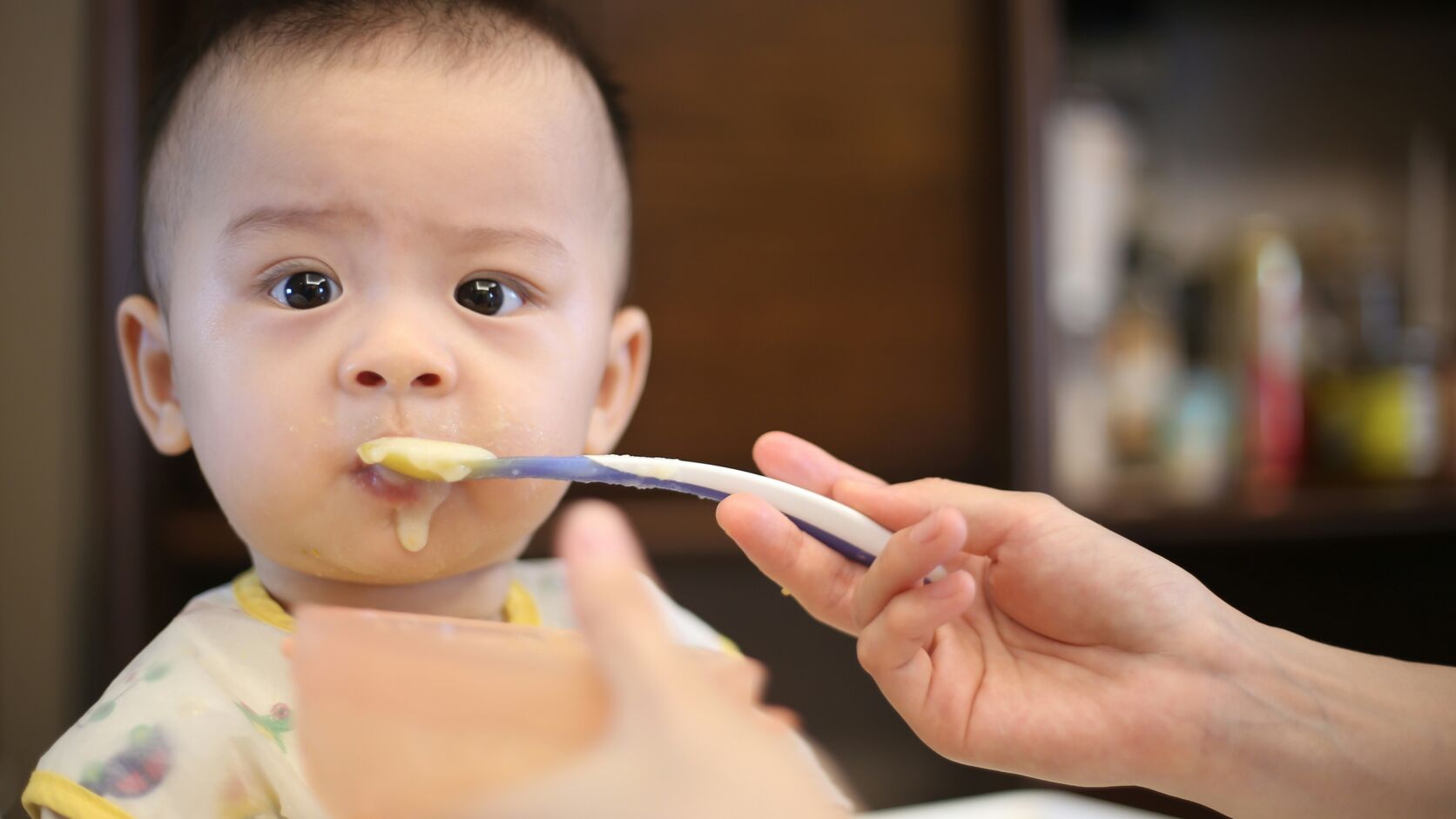
Smooth, lump-free purees with a runny consistency — think the texture of smooth yogurt. Food should flow easily off a spoon. This is the only stage where pure smoothness is the goal.
What foods to offer at 6 months
Single-ingredient vegetable and fruit purees: sweet potato, carrot, pea, apple, pear, banana, avocado. Introduce one new food every two to three days so you can monitor for reactions. (Our first baby purees, ranked by how easy they are to make, will get you through this stage without a cookbook.)
How much to feed
Start with 1 to 2 teaspoons. Build gradually to 2 to 3 tablespoons per meal. One meal per day initially.
Milk feeding at this stage
Breast milk or formula remains the primary source of nutrition. Offer solids after a milk feed, not before — your baby shouldn't be hungry for solids at this stage. They're learning, not feeding up.
Stage 2: Exploring Textures (7 to 8 Months)
Mashes, lumps, and early finger foods.
Developmental milestones at 7 to 8 months
The tongue is becoming more skilled. Your baby can begin to manage small, soft lumps. They're likely bringing their hands to their mouth and reaching for food on the table.
Best textures for 7- to 8-month-old babies
During this phase, transition to mashed or minced items containing soft lumps, aiming for a consistency similar to coarsely mashed bananas or potatoes. While smooth purees remain an option, it's essential to begin introducing these new textures now if they haven't been offered yet.
This is also when soft finger foods begin: pieces of soft-cooked vegetable, banana pieces, well-cooked pasta your baby can grip and gum.
What foods to offer at 7 to 8 months
All the stage 1 foods, now mashed rather than blended. Add proteins: lentil puree, flaked soft-cooked fish, scrambled egg, finely minced meat. Introduce common allergens now if you haven't already started — current guidance is that early, regular exposure helps reduce the risk of food allergies. Offer soft finger foods alongside mashed textures.
How much to feed
2 to 3 tablespoons per meal, twice a day. Move toward three meals a day as you approach 8 months.
Milk feeding at this stage
Still the primary source of nutrition, but feeds may naturally space out as solid intake increases.
Stage 3: Moving Toward Family Food (9 to 10 Months)
Soft chopped foods.
Developmental milestones at 9 to 10 months
As your baby reaches the 9- to 10-month mark, their coordination improves significantly with the emergence of the pincer grip, allowing them to grasp small items between their thumb and index finger. Despite a potential lack of teeth, their ability to chew is maturing — signalling a readiness for a rapid expansion in both food variety and more complex textures.
Best textures for 9- to 10-month-old babies
At this stage, finger foods play a central role in meals, as babies transition to soft, finely chopped items. Foods should have a consistency similar to soft-cooked vegetables or well-done pasta. You can serve most family dishes as long as they are prepared with a softer texture and cut into small, manageable pieces.
What foods to offer at 9 to 10 months
At this phase, you can offer adapted versions of your regular family meals. Focus on expanding variety to help prevent picky eating by introducing complex tastes and blended flavours. Ensure almost any dish the family enjoys is prepared to be softer, chopped into smaller pieces, and contains less salt. (This is exactly where cooking once for the whole family starts to pay off.)
How much to feed
Three meals a day plus one to two snacks. Portions increase to a few tablespoons per course.
Milk feeding at this stage
Gradually shifting — food is becoming the primary source of nutrition. Milk feeds reduce naturally. Still important. Don't rush the transition.
Stage 4: Approaching Toddler Eating (11 to 12 Months)
Modified family meals.
Developmental milestones at 11 to 12 months
Your baby is likely cruising or walking, feeding themselves with increasing skill, and developing strong preferences. The transition to family food is almost complete.
Best textures for 11- to 12-month-old babies
Soft versions of almost all family foods. Very few foods still need special preparation. The exceptions: whole grapes and cherry tomatoes (still quarter them), whole nuts, hard raw vegetables, and popcorn — all choking risks well past the first birthday.
What foods to offer at 11 to 12 months
Family meals, served at a texture and size appropriate for a baby. By 12 months, the goal is for your baby to be eating what the family eats, with simple modifications.
How much to feed
Three meals and two snacks per day. Toddler-sized portions — smaller than you think.
Milk feeding at this stage
If you're breastfeeding, continuing is beneficial. The World Health Organisation recommends breastfeeding up to two years of age or beyond alongside complementary foods. If you're not breastfeeding, formula can be replaced with whole cow's milk after 12 months.
Common Baby Feeding Problems and How to Solve Them
What if my baby refuses lumpy textures?
If you spent a long time on very smooth purees and are now struggling to introduce lumps, try offering very soft small pieces as finger food rather than on a spoon. Babies often self-feed textures they refuse from a spoon. Don't delay past 10 months.
What if my baby seems uninterested in solids?
This is common and usually temporary. Make sure you're offering solids when your baby is alert and not too hungry. Keep mealtimes relaxed and positive. Don't force.
Is it normal for babies to gag while eating?
Yes. Gagging is a normal protective reflex, not choking. It's how babies learn to manage food in their mouths. Stay calm and don't intervene unless there's true airway obstruction. The key difference: choking is silent; gagging is loud.
Baby Feeding Stages: Frequently Asked Questions
When should babies move from purees to lumpy food?
Around 7 to 8 months. Delaying beyond 9 to 10 months increases the risk of texture aversion.
When can babies eat the same food as the family?
By 12 months, most babies can eat modified family meals. The main modifications: lower salt, an appropriate texture (soft enough to squash between two fingers), and avoiding whole grapes, nuts, popcorn, and hard raw vegetables.
When should I offer 3 meals a day to my baby?
Most babies are ready for three meals a day by 8 to 9 months. Build up gradually from one meal at 6 months.
How long should each baby feeding stage last?
The four stages roughly map to 6, 7–8, 9–10, and 11–12 months. But every baby is different. Watch for developmental signs — sitting unsupported, the pincer grip, interest in family food — and progress when your baby is ready, not on a calendar.
Do I need to make separate baby food, or can I share family meals?
By 9 to 10 months, you can usually adapt the family meal — cook it softer, cut it smaller, go easy on the salt. Cooking once for everyone is a feeding stage in itself.
The Bottom Line on Baby Feeding Stages by Age
The progression from purees to table food is gradual, individual, and forgiving. Use this guide as a framework, not a rigid schedule. Your baby will tell you what they're ready for through their behaviour and developmental signs.
The goal isn't perfection at any one stage. The goal is a 12-month-old who eats a varied, nutritious diet alongside the family — and trusts mealtimes as a place of comfort and curiosity.
Trust the process. You're doing more right than you think.
Related reading
- Starting Solids: When and How to Begin
- First Baby Purees, Ranked by How Easy They Are to Make
- Cook Once, Feed Everyone: 8 Family Meals for Baby and the Whole Family
This article is for general informational purposes and reflects the experience of Momé editors and the parents we interviewed. It is not medical advice. Babies progress at their own pace; for questions specific to your child's feeding, growth, or any concerns about choking or allergies, please consult your pediatrician or a registered pediatric dietitian.