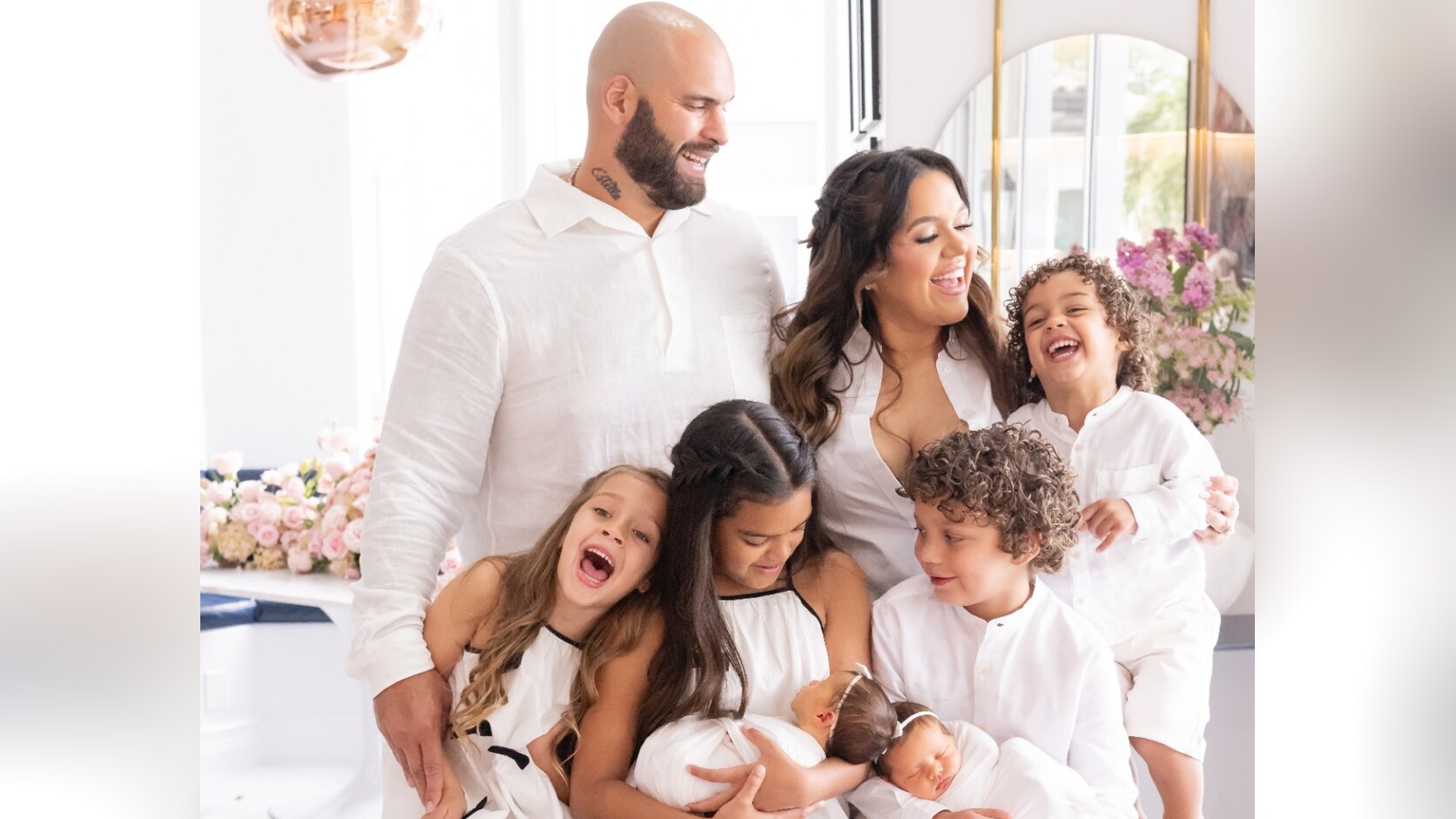
When Lawrence Guy signed a one-day contract to retire as a New England Patriot in the fall of 2025, he closed out fourteen seasons, a Super Bowl LIII ring, and a reputation as one of the most respected linemen of his era. What he opened, in the same breath, was something quieter and far more demanding. He came home. To Andrea, to a house that now holds six children with newborn twins among them, and to the everyday rhythm of a family that spent years building its steadiness around a calendar it could not control.
This is a story about that home. About a boy who was told he could not, and a woman who learned to turn her hardest days into someone else's soft landing. Mostly, it is a story about partnership, which is why we put our questions to both of them. Ask either Lawrence or Andrea how they have made it work, and the answer keeps circling back to the same two words.
They're on the same team.
The boy who learned differently
Lawrence was placed in special education classes as a child. The system, he says, fixed on what he could not do. The adults who believed in him fixed on everything else.
"They saw that I was capable, even though I learned differently," he says. "My father was my biggest advocate. He saw that I wasn't lazy or unable to learn. I just needed information presented to me in a way I could understand. The system focused on what I struggled with, but the people who believed in me focused on my determination, work ethic, and potential."
That belief hardened into a philosophy he still carries: no such thing as can't. "My father instilled that mentality in me. He never allowed me to use my learning differences as an excuse, or let somebody else's opinion decide who I could become," he says. He is passing it down on purpose. "With my kids, I remind them that it is okay for something to be difficult, but it is not okay to quit simply because it is difficult. We may have to slow down, ask for help, or find another way, but we keep going."
Dividing it up
For most of their marriage, football decided where the Guys lived and who was home. We asked them how two people split a life like that.
For most of your marriage, football decided where you lived and who was home. What did you have to build so the family felt steady no matter what the calendar said?
Andrea: "We had to build routines and traditions that belonged to our family, not to football. Teams, cities and schedules could change, but the way we communicated, celebrated birthdays, ate together and showed up for the children stayed consistent. I wanted home to feel safe and predictable even when Lawrence's career was not."
A season means one parent is largely gone for months. How did the two of you actually divide it, and what is the one thing you agreed you would never renegotiate?
Andrea: "During the season, I managed most of the day to day responsibilities because football required so much of Lawrence's time and body. When he was home, he was expected to be present and involved, not just physically in the house. The one thing we would never renegotiate was communication. Even when we were exhausted or apart, we needed to check in and remain connected as husband and wife, not only as parents managing a schedule."
It is a version of the arrangement so many mothers recognize — one parent holding the invisible architecture of a household while the other is somewhere else, earning. What is unusual here is that both of them say it out loud, and neither pretends it was evenly split.
Lawrence, how did that split look from your side?
Lawrence: "During the season, Andrea carried most of the daily responsibilities at home. She managed the children's schedules, school, appointments and everything that kept the family moving while I was practicing, traveling or recovering. When I was home, I tried to be fully involved instead of acting like my job ended when practice ended. Communication was the biggest thing. We had to be honest about what she needed and what I could take off her plate."
Home does not run like a locker room
Retirement, they will both tell you, was its own adjustment. Andrea had spent years engineering a household that could function without him. Then, all at once, he was in it every day.
"We both had to adjust to sharing space and responsibilities every day," she says. "I had built systems that allowed the house and the children's schedules to function while he was away, and suddenly another strong personality had ideas about how everything should be done. We had to learn a new rhythm and remember that he was not entering my system and I was not entering his. We were creating a new one together."
Lawrence felt the same friction from the other side. "The hardest adjustment is learning that home does not operate like a locker room," he says. "I cannot walk in with a schedule and expect six children and a busy household to follow it exactly." The trade, though, is one he would not give back. "The best part is being present for the moments I used to miss. School drop-offs, practices, bedtime, random conversations, the little everyday things that become the memories you value most."
Parenting, he admits, revealed a version of himself he had not expected. "How emotional and patient I can be," he says. "Football required toughness, but parenting has taught me that strength can also mean slowing down, listening and letting your children see your softer side. I am still firm, but I care much more about understanding what is behind their behavior than simply correcting it."
"Football required toughness, but parenting has taught me that strength can also mean slowing down, listening and letting your children see your softer side."
The mother behind the curtain
Some of the most important work the Guys do happens far from a football field. Their annual charity baby shower, run through the Lawrence Guy Family Foundation, has outfitted single and expecting mothers with everything from diapers to cribs to a full year of essentials. Andrea can trace the entire program back to a single afternoon.
She was recovering from complications after giving birth. On the other side of a curtain was another mother, her newborn in the NICU, calling person after person to ask for help. No one came.
"When the hospital social worker asked what she needed, she only requested diapers," Andrea says. "That broke my heart, because she was not asking for anything extravagant. She was simply trying to care for her baby."
Quietly, she and Lawrence made sure the woman had everything she would need for her child's first year. The mother never learned who they were. "She never knew who we were or how deeply that moment affected me," Andrea says. "Her son and our daughter share a birthday, and I still think about her. That experience made me realize how many mothers enter motherhood without a village, and it placed a responsibility on my heart to become part of that village."
It is the lesson she most wants her children to absorb. "I want them to understand that blessings come with responsibility," she says. "Helping people should not be something we only do when cameras are around or when it is convenient. I want them to see that their parents worked together, used what they had to serve others and treated every person with dignity."
Legacy, and what the kids will keep
For a man who gave the game fourteen years, Lawrence is unsentimental about the scoreboard.
"Legacy is no longer about statistics, games or how many years I played," he says. "It is about what my children learn from watching me and how many people are better because our family was willing to help. Football gave me a platform, but the work we do through our foundation and the example I set as a husband and father can last much longer than anything I did on the field."
Andrea hopes this particular chapter, exhausting as it is, is the one that sticks. "I hope they remember a full house, newborn twins, noise, laughter and both of their parents being present," she says. "This season is exhausting, but it is also beautiful. I hope they remember that even when life was busy, they felt loved individually and knew that home was always their safe place."
Quick questions
Some things are better asked straight.
A rule or ritual in your house you would never give up, even when it is inconvenient?
Lawrence: "Spending time together as a family, especially around meals and at bedtime. Our schedule can become chaotic, but sitting together, talking about everyone's day and making sure the children know we are present is important to us. It may not always look perfect, but we protect that connection."
The thing you disagree on most as parents, and how do you land it?
Lawrence: "We sometimes disagree about when to step in and when to let the children work through something themselves. One of us may want to protect them while the other wants them to learn from the situation. We talk it through away from the children, listen to why the other person feels strongly and try to make a decision that gives the child both support and accountability."
Andrea, was there a moment you realized the version of parenting you had imagined was not the one you would get?
Andrea: "Very early. Every child arrives with a different personality and a different set of needs. You cannot use the same approach with every child or control every outcome with a perfect schedule. Parenting became less about following the picture I had imagined and more about learning the children in front of me, adjusting and giving each one what they specifically needed."
Who is the softer one, and does that shift depending on the kid?
Lawrence: "I like to say Andrea is, but the kids would probably say it is me. I am especially soft with the girls, and every child knows which parent to approach for certain things. It definitely shifts because each child has a different personality and responds differently to us."
A genuinely good day
Ask them what a good day actually looks like, and their answers land in almost the same place.
"It starts with breakfast together and no one rushing out the door," Lawrence says. "We may go to the kids' games, spend time outside, go to the beach or take a family trip in the Sprinter. Then we come home, eat together, watch a movie and get everyone settled for bed. A good day does not have to be extravagant. It is a day when everyone is together, laughing and not distracted by everything else."
Andrea's version rhymes with his. "A genuinely good day is one when nobody is rushing and we can simply enjoy one another," she says. "With six children, a day will never be completely calm, but when everyone is healthy, laughing and together, that is a good day."
The same team
We gave Andrea the last word, and she used it to tell the truth about all of it.
"Motherhood and marriage both require letting go of perfection," she says. "There are beautiful moments, but there are also exhausting days, disagreements, fear and times when you feel as though you are not doing enough. What keeps us grounded is remembering that we are on the same team."
"Our life may look extraordinary from the outside because of football," she goes on, "but inside our home, we are simply two parents trying to raise kind, confident children while continuing to grow ourselves. We have learned that family is built in the ordinary moments. Showing up, apologizing, listening, laughing and choosing one another again every day."
The Lawrence Guy Family Foundation runs year-round programming for families in need, including its annual Baby Shower Bash for single and expecting mothers. Follow Lawrence Guy (@thatlguy) and Andrea Guy (@andreapguy) on Instagram to follow along.