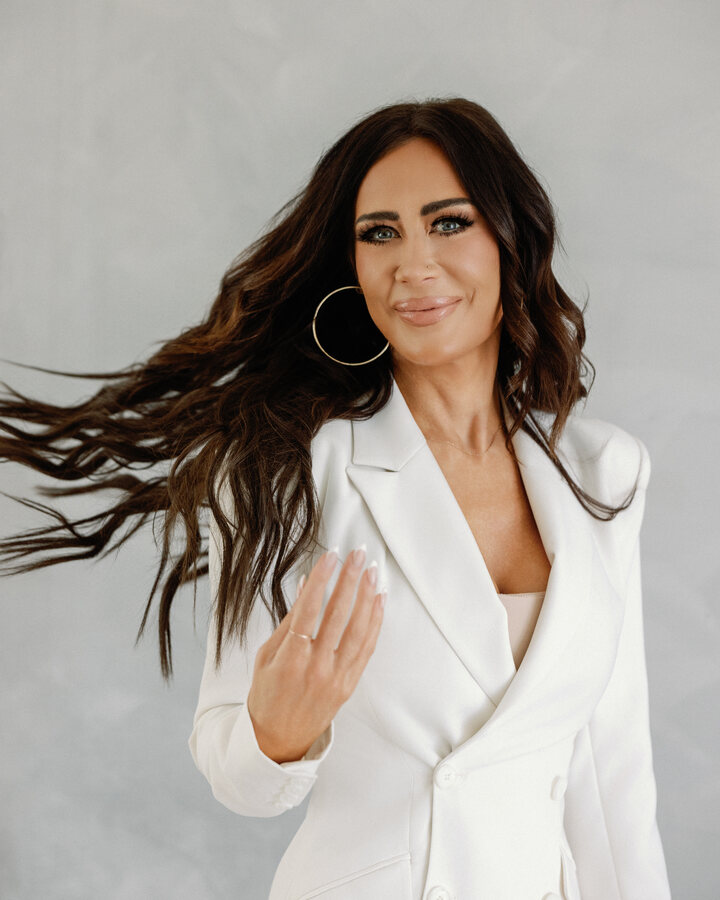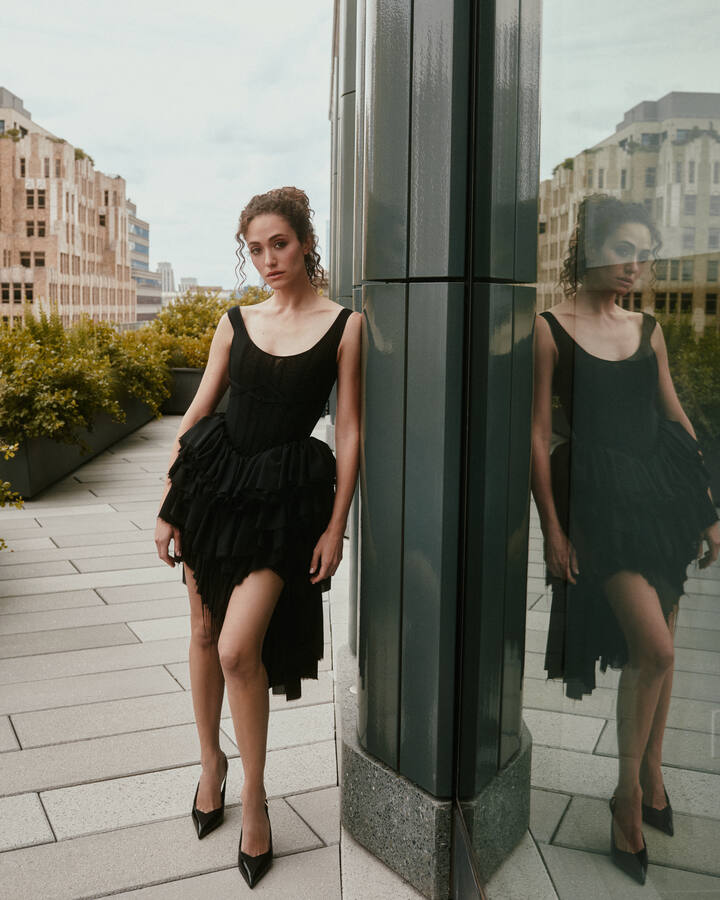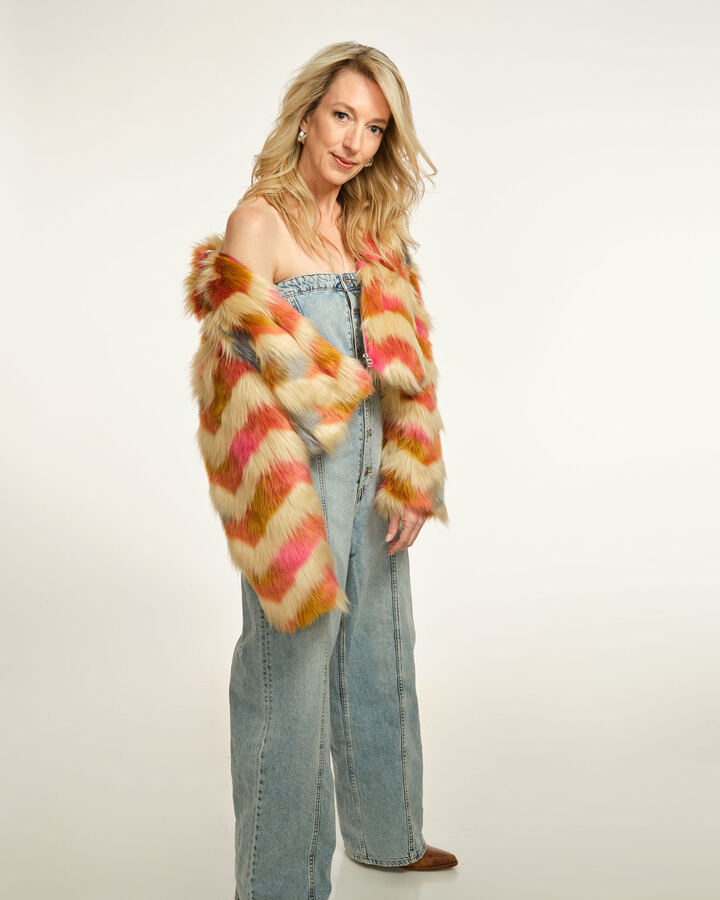
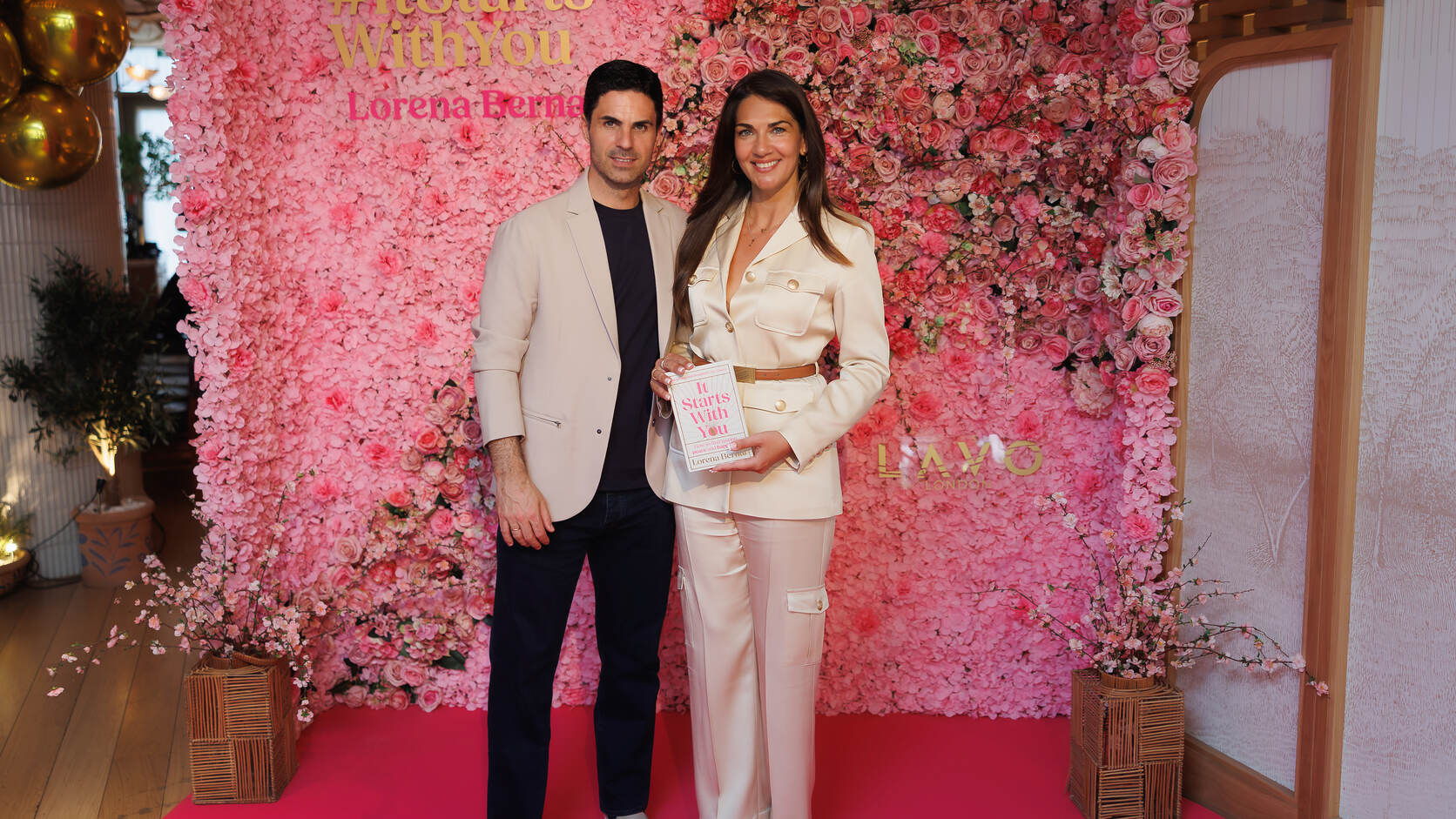
The world has a habit of introducing a woman like Lorena Bernal through the man beside her. It reaches her by way of the touchline, the Emirates, the more than twenty years spent next to Mikel Arteta. By the time it arrives at her, she has already been framed, cropped, and captioned. Filed under someone else's name.
She knows this. She is not wounded by it. And early in our conversation she hands me a single sentence that quietly dismantles the whole arrangement.
"If I hope for anything," she says, "it's not that people look at me, but that they are able to look through me."
Lorena Bernal offers us a glimpse into her heart, her life, her journey — as the whole woman. Miss Spain. Actress. Author. A transformational coach. Wife. Mother of three. For years, she kept each of these women in her own separate room.
"When I was working as an actress, I rarely spoke about being a mother," she mentions. At the school gates, she rarely spoke about her work. Raised between cultures, she had learned young to reveal only the part of herself that seemed to belong in the room she was standing in. "Very few people ever knew the whole of me."
Then something in her broke open, inevitably as it always does when the performance grows heavier to carry than the truth. "None of those identities were competing with each other," she says. "They were all me." Acting taught her empathy. Coaching deepened her mothering. Writing gave language to everything she had spent a life learning. "Today, I no longer switch identities depending on where I am. I bring my whole self into every room. And that has been one of the greatest feelings of freedom I've ever experienced."
Ask her which version feels most like home and she will not choose. "Home is the integration of all of them."
What follows is a candid conversation with Lorena, in her own words. This is a woman who has made peace with her own humanity, and who would like, more than anything, to help you make peace with yours.
The myth of the perfect mother
There is so much pressure on mothers to look like they have it all figured out. What do you most want other women to know does not have to be perfect?
One of the biggest things I see in the mothers I work with is the enormous pressure to be perfect. We've turned motherhood into something that feels like a job with measurable results, as if success depended on getting everything right. But I don't believe that's what motherhood is.
From everything I've observed, studied and experienced through years of coaching women, motherhood is much less about producing perfect outcomes and much more about expanding who you are. It is an invitation to discover yourself through emotions, challenges and forms of love that only motherhood can awaken.
Our real responsibility isn't to shape our children into someone we have imagined. It's to create an emotional environment where they feel safe enough to discover who they already are. We guide them, we accompany them, but we don't manufacture them.
When mothers truly understand this, an enormous weight lifts from their shoulders. They stop believing they have to control every decision, every emotion, and every moment of their children's lives. Ironically, it's that constant need for control that creates exhaustion and anxiety.
The calmer, more peaceful, and more connected a mother feels within herself, the healthier the atmosphere her children grow up in. Children don't need perfect mothers. They need mothers who are present, emotionally available and at peace with their own humanity.
I also believe we urgently need to stop comparing ourselves with other mothers. Comparison creates pressure, pressure creates anxiety, and anxious mothers unintentionally pass that emotional state on to their children. Motherhood becomes much lighter when we stop chasing perfection and start choosing presence.
What did you believe about motherhood before your children arrived — a belief they went on to completely dismantle?
I think most of us arrive at motherhood carrying beliefs that were never really ours. They're inherited — from our own upbringing, from the mothers and grandmothers around us, from society, and from the image we've been shown of what a "good mother" should be.
One of the biggest things I've observed, both personally and in the women I've coached, is that motherhood quickly dismantles the illusion that there is one right way to do it.
Every child is different. Every family is different. Every mother is different.
The mothers who suffer the most are often those trying to fit themselves into an ideal that doesn't truly belong to them. They spend more energy trying to become the mother they think they should be than discovering the mother they naturally are.
I believe motherhood invites us to let go of rigid ideas and become much more present. Less focused on following a perfect script, and more focused on building a real relationship with the unique human being in front of us.
In many ways, motherhood teaches us that certainty is far less valuable than awareness. The more we know ourselves, the more peacefully we can accompany our children in becoming themselves.
What is the hardest part of motherhood that nobody warned you about?
I think one of the hardest parts of motherhood is carrying the enormous responsibility of loving your children so deeply while also learning to let go of the need to control who they become.
As parents, we have more information than ever. We know what experts recommend, what is considered healthy, what supposedly leads to confidence, resilience or success. The challenge is that, because we love our children so much, it's very easy to confuse guiding them with trying to shape them into the version we believe they should be.
When a child is loud, we want them to be quieter. If they're constantly moving, we want them to slow down. If they're emotional, we want them to be calmer. If they're disorganised, we want them to be more organised. If they're reluctant to do something, we immediately want to motivate or change them. Little by little, we can find ourselves spending more time correcting who they are than discovering who they are.
To me, that's one of the greatest challenges of parenting.
Of course children need guidance, boundaries and values. That's part of our role. But before teaching them how to be, I think we need to spend time observing who they already are.
I often compare children to different animals. Some are like cheetahs — full of energy and movement. Others are like koalas — calm, thoughtful and slow. Others are like fish, completely at home in environments that might not suit someone else. The mistake is assuming they should all behave the same way simply because that's what makes us comfortable.
Our first responsibility isn't to change their nature. It's to see it, respect it and love it. From that place of acceptance, we can then guide them towards becoming the very best version of themselves — not the version we had imagined for them, but the one they came here to become.
"Children don't need perfect mothers. They need mothers who are present, emotionally available and at peace with their own humanity."
It starts with her
Your book is called It Starts With You. What did writing it help you understand about yourself that you had not yet put into words?
It Starts With You is, in many ways, an invitation to look inward before trying to change anything outside of ourselves.
As parents, our instinct is often to fix, teach, protect or shape our children. But what I've observed through my work with families is that before we try to transform a child or solve a situation, it's worth asking ourselves what is happening within us. Why do we need this child to change? Why do we need them to be happy, confident or successful in a particular way? What is that situation awakening inside us?
The book is built around one simple idea: beneath all our fears, conditioning and expectations, there is already love. I believe every human being is born with that love, but throughout life we build layers of protection around it — through our experiences, disappointments, fears and beliefs. We end up parenting more from those protective layers than from love itself.
Writing the book helped me articulate something I had been observing for years: that personal growth isn't about becoming someone new. It's about removing what prevents us from expressing who we already are.
When we begin to dissolve those walls, the first person touched by that love is ourselves. We become more peaceful, less reactive and less driven by fear. And then, naturally, our children become the next people to experience that love.
I believe there is an innate wisdom within every parent that knows how to love their child. Just as every living being instinctively knows how to nurture life, we carry that wisdom within us too. The challenge is that we've become disconnected from it. The purpose of It Starts With You is to help people reconnect with that inner wisdom, so that love stops being something they try to do and becomes something they naturally are.
When motherhood is lived from that place, it becomes much lighter. There is less striving, less control and much more trust. And there is something profoundly moving about discovering that the love you were searching for was already within you all along.
Motherhood has a way of confronting us with our own unfinished places. What have your children pushed you to heal that you did not see coming?
One of the most fascinating things I've observed through years of studying human behaviour and working with mothers is that children become extraordinary mirrors. From pregnancy onwards, motherhood has a way of revealing the parts of ourselves we haven't fully seen — our fears, insecurities, unresolved wounds, but also our greatest strengths.
Rather than seeing difficult moments with our children as problems to solve, I encourage mothers to see them as invitations to look inward. Every emotional reaction is pointing towards something within us that is asking for our attention.
For example, if a mother becomes deeply distressed because her child seems insecure, my first question isn't, "How do we make this child more confident?" It's, "Why does this affect you so deeply? What part of you feels uncomfortable with your child's insecurity? What inside you is asking to be healed?"
When we become curious about our own emotional responses instead of immediately trying to change our children, something remarkable often happens. As mothers begin healing the fear, insecurity or expectation within themselves, the dynamic with their children naturally starts to shift. It's almost as if the situation existed to guide the mother towards a deeper understanding of herself.
To me, that's one of the greatest gifts of motherhood. Our children don't just come to learn from us. They also come to teach us. They invite us to become more conscious, more peaceful and more authentic human beings. And I believe that when a mother grows in that way, everyone in the family benefits.
You are raising children at three different stages of life at once. What has that taught you about the way children actually need you to evolve as they do?
One of the most important things I've learned through working with families is that children's changing needs shouldn't worry us — they should reassure us. Change means they're growing exactly as they should.
The challenge isn't to expect our children to remain the same. The challenge is to learn how to accompany their evolution without taking it personally.
A young child naturally needs closeness, reassurance and a strong sense of security. An adolescent often needs distance, independence and space to discover who they are. Neither stage is better or worse — they simply require a different kind of presence from us.
Many parents interpret these changes through their own fears. When a teenager needs less of them, they wonder whether they've failed. When a younger child seems very dependent, they worry they're creating weakness. But very often, neither interpretation is true.
Children simply need us to understand what stage they're in, rather than expecting them to adapt to ours.
The parents I see creating the healthiest relationships are those who observe before reacting. They respect their children's timing, avoid projecting their own expectations or insecurities onto them, and remember that children experience life from a completely different perspective than adults.
Sometimes our greatest act of parenting is not teaching them to see life through our eyes, but making the effort to see it through theirs.
The hard, holy things
How do you talk to your children about the hard things — failure, sadness, the messy stuff?
My first thought is that we need to be careful about calling certain subjects "hard." Children don't naturally divide life into easy conversations and difficult conversations. We teach them that. If we approach a subject — whether it's death, failure or sadness — as something frightening or uncomfortable, they learn that it must be something to fear too.
The easier and more peacefully we can speak about life, the more naturally they will receive it.
The second thing I've learned is that children rarely sit down wanting a serious conversation. Every child is different, and it's important to observe how each one communicates. More often than not, they ask the deepest questions at the most unexpected moments — in the car, before bedtime, while playing, or completely out of the blue.
Those moments are precious.
When they ask, I believe we should answer as honestly and authentically as we can, using language that matches their level of emotional maturity rather than simply their age. Children are incredibly perceptive. If we hide behind half-truths or avoid the subject because we're uncomfortable, they don't just hear our words — they feel our discomfort.
But even more important than talking about difficult emotions is modelling how to live them.
The way your children watch you move through disappointment, grief, frustration or uncertainty teaches them far more than any conversation ever could. They see how you respond after a difficult day, how you speak to your partner after an argument, how you cope with loss, how you recover from mistakes. Whether we realise it or not, they are always learning from us.
That's why I encourage parents to verbalise their own emotional process. Let your children hear you say, "I'm feeling sad today," or "That disappointed me, but I know this feeling will pass." You're not teaching them to avoid emotions; you're teaching them that emotions can be experienced without being feared.
Ultimately, before trying to teach a child about failure, sadness or loss, I think it's worth asking ourselves a much deeper question: How do I relate to these experiences?
Am I at peace with them? Do I allow myself to feel them? Do I trust that they are part of life?
Because once we've made peace with those experiences ourselves, we don't need to create the perfect conversation. Our children will learn from our presence, our honesty and the way we live. And I believe that's where the deepest lessons are passed on.
With Mikel's schedule as demanding as it is, what does parenting really look like inside your home — and how do you show up on the days when all of it falls to you?
I don't believe there's one perfect way to parent or one formula that works for every family. Every household has its own circumstances, rhythms and challenges.
What I do believe is that, whatever those circumstances are, our children are constantly receiving something much more important than our schedules — they're receiving our emotional state.
Whether parenting responsibilities are shared equally or one parent is carrying more of the day-to-day demands at a particular time, children absorb how we feel about the life we're living. If they see parents who are at peace with their choices, who are grateful for what they have and who accept the season they're in, they grow up feeling that life is a safe and beautiful place to be.
In our family, because Mikel's work is incredibly demanding, much of the practical side of daily life naturally falls to me. But I've never wanted my children to experience that as a burden.
Of course, raising three children requires energy, commitment and presence. But this is also the life I've consciously chosen, and I genuinely love it. I don't want my children to grow up feeling that they were something I had to sacrifice myself for. I want them to feel that loving and raising them has been one of the greatest privileges of my life.
That doesn't mean every day is easy. It simply means I try not to carry those challenges with resentment.
I also don't try to be a perfect mother. I don't believe perfection exists.
My intention is much simpler than that: to do the best I can with the knowledge, energy and presence I have that day, and, above all, to enjoy my children — not only in the joyful moments, but also in the difficult ones.
I'm deeply aware that childhood is incredibly short. In just a few years, they'll be creating lives of their own.
I don't want to spend these precious years trying to be the perfect mother.
I want to spend time truly being with them.
The whole of her
You have carried so many identities — Miss Spain, actress, author, coach, and now mother of three. How do you hold all of those versions of yourself at once, and which one feels most like home?
For many years, I kept those different parts of myself completely separate.
When I was working as an actress, I rarely spoke about being a mother or about my work in personal development and spirituality. When I was at the school gates with other parents, I hardly ever spoke about my career. Even growing up between different cultures, I learned to adapt to each environment, showing only the part of myself that seemed to belong there.
Looking back, I realise that very few people ever knew the whole of me. They knew the version of me that fitted that particular context.
At some point, something shifted.
I realised that none of those identities were competing with each other. They were all me. Every experience had shaped me, and each part enriched the others. Being a mother made me a better coach. My work as a coach deepened the way I approached motherhood. Acting taught me empathy and emotional awareness. Writing gave me a language to express everything I had been learning throughout my life.
The more I embraced every part of myself, the more authentic I became.
It wasn't always easy. In some industries, talking openly about motherhood could be seen as a disadvantage. In others, speaking about spirituality wasn't always understood. But I reached a point where hiding parts of myself felt far more exhausting than simply being all of who I am.
Today, I no longer switch identities depending on where I am. I bring my whole self into every room.
And that has been one of the greatest feelings of freedom I've ever experienced.
So if I had to say which identity feels most like home, my answer would be this: none of them on their own. Home is the integration of all of them.
When I stopped trying to fit into different boxes and allowed every part of myself to coexist, I finally felt that I had come home to who I really am.
"Home is the integration of all of them."
How has becoming a mother changed the way you see yourself?
Motherhood changes the way you see yourself because it places you in situations and emotions you've never experienced before. It reveals parts of you that might otherwise have remained hidden. The most intense moments with our children often become the moments in which we see ourselves most clearly.
I think many mothers discover that they are both far more vulnerable and far stronger than they ever imagined. Those two qualities coexist. Motherhood expands your capacity to love, but it also exposes your fears, your limits and your deepest values.
One of the biggest shifts is that, almost overnight, you're no longer the centre of your own world. Your children naturally become a central part of your life, and that changes the way you see everything — including yourself.
It's a beautiful perspective, but I also think it's important to be careful. Many mothers become so focused on their children that they gradually stop seeing themselves. Sometimes they only measure their worth through how their children are doing or how they believe they're performing as mothers.
That's why I see motherhood as much more than raising children. I see it as one of the greatest opportunities for self-discovery.
Our children constantly invite us to observe ourselves. Sometimes we recognise ourselves in their behaviour. Sometimes they awaken emotions we didn't know we still carried. Sometimes they show us qualities we had forgotten we possessed.
If we're willing to stay curious, motherhood becomes an extraordinary journey of self-awareness. It gives us the opportunity to know ourselves more deeply, to accept ourselves more fully, and to consciously choose the kind of person we want to become — not only for our children, but for ourselves.
So many mothers quietly grieve an earlier version of themselves — their freedom, their ambition, their sense of self. Did you? And how did you find your way back to your own story?
I think it's completely natural to grieve previous versions of ourselves — not just in motherhood, but throughout life.
When we leave school, we might miss the child we once were. When we move to a new city, we miss the version of ourselves that belonged there. When we get married, we may miss the freedom of being single. Motherhood simply makes this process more visible because the transformation is so profound.
The truth is, we're not meant to remain the same person.
We're constantly being shaped by every relationship, every challenge, every joy, every success and every disappointment. If you look back ten years and you're exactly the same person, then perhaps you haven't allowed life to change you very much.
Rather than trying to return to who we were, I think the real invitation is to consciously choose who we want to become.
The important part is making sure those choices come from within, not from obligation or expectation. If you're sacrificing parts of yourself because you believe you should — for your partner, your children or society — it can be very difficult to embrace the person you're becoming. But if you're choosing that season of life because it genuinely reflects your values and the woman you want to be, then there is much more peace in that decision.
For example, there may be a period when you choose to dedicate much of your time to raising your children. If that choice comes from love and conviction, rather than guilt or pressure, it doesn't feel like losing yourself — it feels like expressing who you are in that chapter of your life.
Every stage has its purpose. Some parts of ourselves may reappear later in different forms, but we will never be exactly the same person again. And I think that's something to celebrate rather than fear.
If you truly miss a previous version of yourself, I would invite you to ask a deeper question.
What is it that you really miss?
Was it freedom? Creativity? Adventure? Connection? Purpose?
Because very often, it isn't the old version of ourselves that we're longing for. It's the feeling that version of us experienced.
And once we understand that, we can begin to create those same feelings within the life we have today, instead of trying to recreate a life that no longer exists.
You are so often seen through the lens of who your husband is. What do you wish people knew about the woman standing in her own right?
People see me through many different lenses. Some know me as an actress, which continues to be a profession I love deeply and one that I continue to pursue with the same passion I've had since I was a little girl. Others know me as an author, as a coach, through my work in wellbeing and spirituality, or as Mikel's wife. All of those are true. They're simply different expressions of the same person.
The truth is, I don't spend much time thinking about how people define me.
If I hope for anything, it's not that people look at me, but that they are able to look through me. That something I say, write, perform or share allows them to see life differently, to discover a truth they hadn't seen before, or to feel something that expands their own understanding of themselves or of the world. If that happens, then I've achieved everything I hoped my work could do.
Being Mikel's wife is a beautiful part of my identity. We've shared more than twenty years of life together, and accompanying him throughout his career has been one of the great privileges of my life. At the same time, I've continued nurturing my own path — as an actress, as an author, as a coach and as a student of human emotions and spirituality. I've never seen those worlds as separate or competing. On the contrary, I believe they enrich one another. Every role I play as an actress deepens my understanding of people. Every conversation I have as a coach enriches my work as a writer. Every experience in life makes me a better artist.
Whether people choose to see all of those parts of me or only one isn't something I can control, nor is it something that worries me. What matters to me is continuing to live authentically, creating work that moves people emotionally through acting, and sharing the knowledge and wisdom I've been fortunate enough to learn if it can help someone live with a little more peace, love and clarity.
At the end of the day, I'm not attached to titles. I'm attached to purpose. And whatever role I'm living — whether on a film set, writing a book, speaking to an audience or simply living my life — I hope it contributes something meaningful to the people it reaches.
The self she met
Between three children and a marriage to one of football's most demanding careers — how do you actually take care of yourself, on a real day, not the aspirational one?
For me, self-care isn't a routine or a checklist. It's about listening honestly to what brings me peace in each moment and having the courage to honour it.
Some days, that means giving my full attention to my children and forgetting everything else. Other days, it means dropping them at school and immersing myself completely in my work because I know that's where my energy needs to go. Sometimes it's training, going to the gym and looking after my body — not to achieve a certain image, but to feel strong, healthy and full of energy so I can live the life I want to live. And sometimes, self-care simply means lying on the sofa with a book or watching a film without feeling an ounce of guilt because that's what my body is asking for.
The important thing is that those decisions don't come from pressure or from an idea of what I should be doing. They come from a deeper intention that sits underneath everything I do.
That intention is very simple: I don't want life to pass me by without truly living it.
I don't feel the need to rush through life, to do everything perfectly or to win a prize for being the best at anything. I don't measure my days by how productive they were. I measure them by how present I was.
I want to enjoy this extraordinary gift of being alive. I want to enjoy loving my children, my husband, my family and my friends. I want to appreciate every conversation, every journey, every professional project, every ordinary moment that life places in front of me.
Having that clarity makes decisions much easier because my priorities are already clear. I simply ask myself what feels most aligned with them today.
Then I do what I can. I don't ask more of myself than that. I don't compare myself to anyone else. And I finish each day feeling grateful for the life I've been given.
You have built a life in wellbeing and personal development. When you strip away the trends and the routines, what does caring for yourself actually mean to you?
I think we've reduced self-care to a list of things we're supposed to do. We hear that we should meditate, exercise, have massages, take baths or switch off our phones. Those things can be wonderful, but to me, self-care begins much deeper than that.
I see every human being as a combination of mind, body and spirit. Taking care of ourselves means honouring all three. And the only way we can truly do that is through self-knowledge.
You need to know who you are. You need to understand how your mind works, what gives you energy, what drains you, how your emotions move, how your body feels in different seasons of life, what your values are and what kind of life you genuinely want to live. The more you know yourself, the easier it becomes to recognise what you need in any given moment.
That's why my self-care doesn't always look the same.
After spending months writing and editing my book, I realised my body was asking me to move again. So taking care of myself meant going back to the gym, becoming physically stronger and reconnecting with my body.
At other times, self-care is sitting with close friends over a coffee or a cup of tea, sharing life and allowing myself to express what I'm feeling. Sometimes it's spending uninterrupted time with my children because loving them, laughing with them and seeing the world through their eyes nourishes something very deep within me.
What I don't do is follow a formula simply because someone says it's good for me.
Without self-awareness, self-care easily becomes imitation. We end up doing what the world tells us should make us feel better instead of listening to what we actually need.
I also think it's important to be honest about our motivations. A woman can spend hours looking after her appearance, and there's nothing wrong with that if it comes from love, enjoyment and self-expression. But if those choices are driven by fear — fear of ageing, fear of not being enough, fear of not being accepted — then that's not really self-care. It's self-protection.
For me, real self-care isn't about following trends or routines. It's about respecting your own rhythm, listening to your inner wisdom and having the courage to honour it.
When you're deeply connected to yourself, you stop asking, "What should I do to take care of myself?" and instead you naturally know what you need.
I think that's what true wellbeing looks like. It isn't something we perform. It's the consequence of living in alignment with who we really are.
The window
She has one more thing to say to you. The older she gets, she admits, the less she cares about being admired and the more she simply wants to understand life. Acting still moves her. So does creating, writing, and the slow work of studying people. What draws her back, again and again, is a curiosity she can't shake: what makes us suffer, what makes us love, and what finally allows us to find peace. Every part of her life bends toward that same question, whether she's making a film, sitting in conversation, writing a book, or raising her children.
She's made her peace with imperfection. We aren't here, she believes, to become polished versions of ourselves. We're here to experience life fully — to love deeply, to keep learning, and to leave people a little lighter than we found them.
And if her work can offer someone a single pause — a moment to see life differently, to reconnect with the love already waiting inside them — then she counts herself grateful. That, she says, is more than enough.
She asked us not to look at her, but through her. Not at the coach's wife. Not at the former Miss Spain. But look through her the way you look through any window thrown open — and notice what floods in. Presence, where you expected performance. Peace, where you braced for perfection. A woman who stopped auditioning for her own life and found her whole self waiting for her to finally embrace all of who she is. This is the quiet, radical transformation Lorena Bernal offers every mother who reads her.
Lorena will not ask you to become someone new. She will ask you to set down the layers you were handed — the borrowed beliefs, the inherited shame, the performance that grew heavier to carry than the truth — and to meet the woman who has been standing underneath them all along.
Do that, and you give your children exactly what she has given hers: a mother at peace with her own humanity. You become the window in your own home. And you leave the people you love a little lighter than they were before they met you.
It starts, exactly as she has been telling us all along, with you.
Lorena Bernal is an actress, author, and life and spiritual coach, and the founder of Live Love Better. Her book, It Starts With You: How to Find Lasting Peace and Happiness, is out now. She shares her work on Instagram at @lober99.