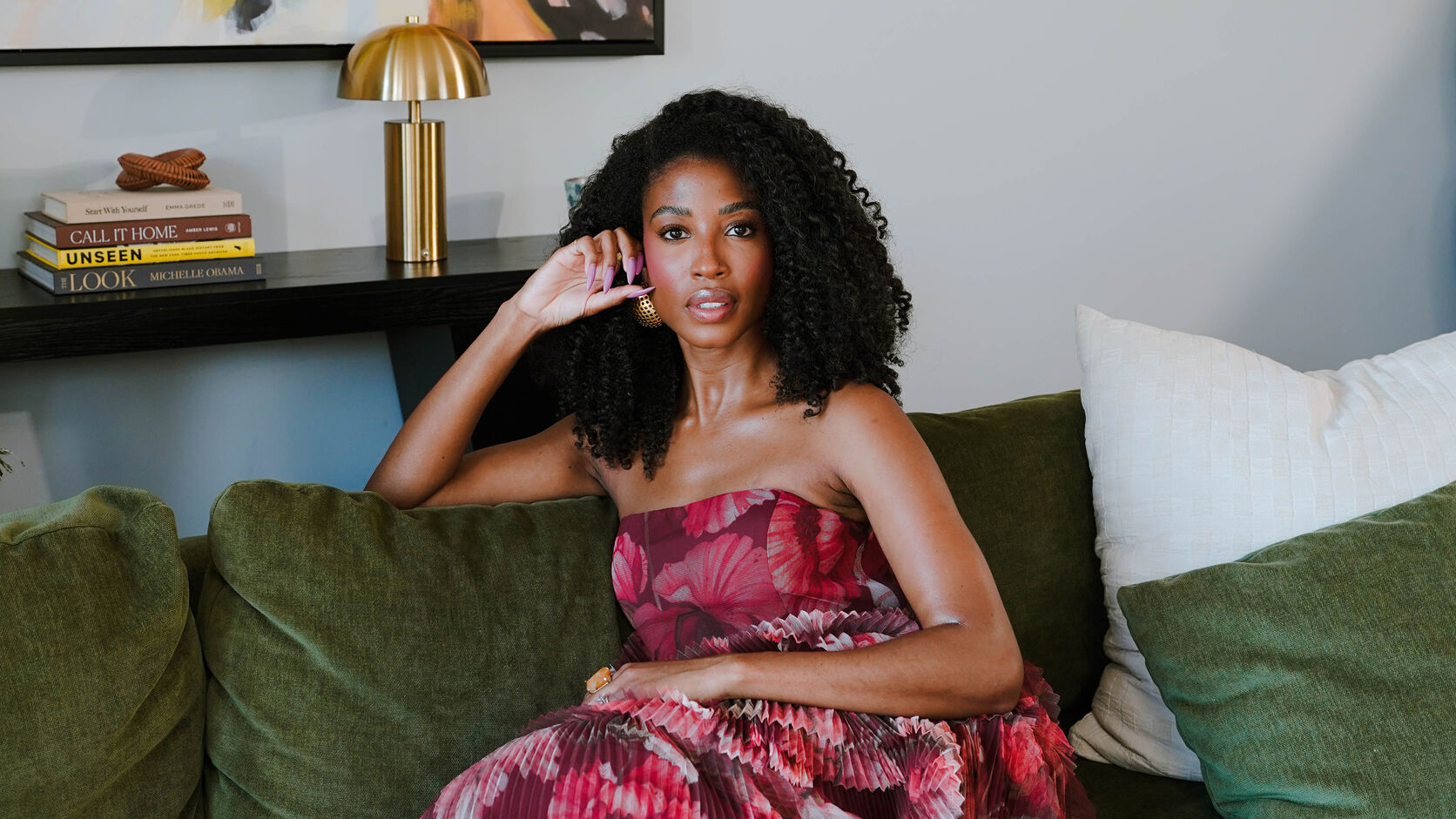
Aisha Beau Frisbey did everything in the right order. School, good grades, a job straight out of college, a clear picture of the title and the salary she was working toward. Then she got there. “I had gotten the position I had worked so hard for over the years, and I realized I wasn’t actually happy,” she says. “The dream I’d had for myself had actually changed over the years, and I wasn’t allowing myself to see it, or giving myself permission to acknowledge, that this wasn’t my dream anymore.”
The hobby that would become her career was already there: helping people, sharing her experiences. So she made a decision that terrified her type-A heart. She stopped putting clients at the forefront and became her own client.
The difference between scary and dangerous
Leaping without a view of the outcome went against everything in her wiring. But she had a framework that made the fear negotiable. “I always like to compare things by whether they’re scary or dangerous,” she says. “Scary is taking a leap of faith, doing something new, putting yourself out there. Dangerous is staying in a position, in a room where the people don’t value you, in a relationship that makes you shrink yourself, in a mindset that makes you second-guess your worth.”
This was scary. It was not dangerous. “I had to trust my gut that I’d make something work.”
Permission to rewrite the narrative
Reinvention is not new to Aisha; it is practically her native language. “I was always that kid who was excited for the first day of school, because I just knew I was going to have the best year ever and I was going to reinvent myself,” she says. That instinct followed her into adulthood as a standing permission to grow, learn, and become someone new whenever she wanted to.
What she had to unlearn was the audience she kept performing for. “I was living my life based off of the perception of other people,” she admits, chasing what she thought her family wanted, glancing sideways at friends with traditional jobs, hesitating at a creator industry that was still brand new. “I had to shed that sense of people pleasing or wanting to be understood and accepted in order to really begin to thrive.” Her message to the younger version of herself is simple: “You have permission to not only reinvent yourself but also to move in the direction that serves you. It may not make sense to everyone else, but if it feels right to you in your heart and for where you know you deserve to be, then just do it.”
When you can’t fix it yourself
The pressure to have it all figured out, career and parenting and identity at once, met her hardest at the start of motherhood. “I went through a really difficult time with postpartum depression at first, and I quickly came to realize it wasn’t something I could navigate on my own.”
For a woman who had always made a way where there seemed to be none, that was its own reckoning. “I had to lean on the people around me. My village. My family, my mom, my husband, my best friends, all of my friends who had already had kids.” Opening up did more than get her through it; it dissolved the myth of the balanced super mom. “It opened my eyes to the fact that there are so many other women going through the same thing, and we are all literally figuring it out day by day.” She stopped fighting the current. “Who I was before I got pregnant isn’t who I am now. Yes, there is Aisha at her core, but she has evolved into somebody different.”
The slowdown nobody photographs
Aisha was already years into entrepreneurship when she got pregnant, but she was mid-pivot, moving from influencer and creator to founder and podcast host. Two enormous things were growing at once, and neither cooperated on schedule. “Pregnancy tired is no joke,” she says, and the content shift toward direct-to-camera work as a speaker and host came with a real cost. “With that comes a lot of change and a slowdown as it pertains to brand deals and engagement.”
Then she hit the panic button. “As an entrepreneur, when things slow down, they really slow down.” Fewer deals, softer engagement, and a fear that cut deep: that she would bring this beautiful life into the world and not be able to support him. The way out was not to push harder. “I had to give myself some grace and move at my own pace, and not force the shift in a way that had me doing things that didn’t really feel connected to my bigger purpose. I had to get rid of that scarcity mindset and understand that everything is honestly going to work out.”
Betting on herself, out loud
She is still in the thick of it, still investing time and money into growing her podcast platform toward a bigger vision. It is scary. She does it anyway, and she is deliberate about who is watching. “I want my son to see that his mother was fearless,” she says. “She may have obstacles in front of her, and there might be people who try to place doubt in front of her, but she still pushed through. I want him to feel that power and that capability to do whatever he sets his heart and mind to.”
The cost is honest, and she names it: the late hours at her desk, the speaking engagements, the shoots that pull her away even though she works from home. “I wish I had so much more time with him right now,” she says. “It’s never going to be fifty-fifty. But I’m giving myself grace and understanding that I’m there for everything that matters, and I’m still a very present force in his life.”
Success, redefined
At 37, with Shai turning two in November, Aisha has watched her own definition of success quietly rewrite itself. It used to be titles, salary numbers, a specific amount of notoriety. “Now when I think about success, I think about freedom, I think about choice, and I think about ease,” she says. “If I’m able to build a life that affords me freedom to choose how I spend my time and to live a more easeful life, that to me is a sense of success.”
She refuses to treat it as a finish line. “Success is not a destination. There isn’t a particular pinnacle you get to and then that’s it. I am a success story, and I’m just getting started.”
The signature stays
When Aisha announced she was keeping her long acrylic nails through pregnancy and beyond, people were surprised. She was not. “I told you, this is my signature. This is my look. This is my vibe. I’m going to continue to be this way even as a mother.” Her beauty and pampering routines are not vanity; they are fuel. “These are the things that make me feel like Aisha at my core.”
Part of protecting that identity, she says, is having married the right person. Her husband David never “babysits” their son. “No. I’m going to do what I need to do, run my errands, take care of myself, and he’s going to fly solo and watch Shai on his own. That’s just how it is, and vice versa. It’s always very mutual.”
Not balance, recalibration
Ask her about balancing ambition, wellness, relationships, and motherhood, and she rejects the word outright. “I wouldn’t even call it balance, because at some point something is going to get fed more than the other.” She knows her own pattern: the workaholic tendency, the ambition that takes over because she loves what she is building, and the wellness that slips first. “I’m tired, I’m irritable, I’m not as creative as I need to be, and my relationships start to be a little off balance.”
So she recalibrates. “Whenever I feel myself tipping too far to one side, I take a moment, pause, and pour more into another area.” The foundation underneath it is a set of non-negotiable rituals, borrowed language and all: journaling, morning breath work, moving her body, eating what makes her feel good, laughing a lot. “My therapist calls it using all the tools you have,” she says. “Building a bigger life is about the small rituals and routines that keep you grounded. Everything may not be balanced, but you at least have that foundation to always go back to.”
The tea she wishes she’d gotten
For all the online talk about how hard motherhood is, Aisha feels her friends spared her the real truth. “I don’t feel like they really gave me the real tea on just how tough it is to settle into being a new mom, just how hard the newborn stage is, and how much sleep deprivation can be a detriment to everything else.”
She is candid that she might not have listened anyway. “I probably wouldn’t have been ready to hear it, because I’m somebody who can always figure it out.” What it left her with is grace, aimed backward at the friends who did it younger than she is now. “I wish I had truly been able to help them in the trenches of those newborn stages. I miss sleep so much.”
The village she was raised to expect
The last word she gives to her mother, who moved closer after Shai was born and now helps care for him during the week while Aisha and David build their careers. “Having an intergenerational household is something that is missing for a lot of people these days, and it was really common in the past,” she says. It shaped her son visibly: smart, friendly, outgoing, well-mannered. “I definitely owe a lot of that to my mom and her presence.”
Her mother did something else, too. She loosened Aisha’s grip. “She’s helped me not to be so worrisome about every single detail, and to focus on what’s important as a mom. I allow my son so much freedom and space to be who he is.” It is the kind of support Aisha wishes more women her age could feel. “I am not a helicopter mom,” she says, and you get the sense that is its own quiet victory.
Follow Aisha Beau Frisbey on Instagram at @aishabeau, listen to her podcast, Meanwhile, She, and find more at aishabeau.com.
Related reading
- Motherhood Gave Dr. Christina Rahm’s Science a New ‘Why’
- Postpartum Depression Is More Common Than Anyone Told You. Here Is What to Know
- Matrescence: The Word That Finally Names What You’re Going Through
- The Career Pivot Playbook: How Mothers Are Reinventing Their Professions After Kids
- You Were a Whole Person Before You Had Kids. Here’s How to Remember Who That Was.