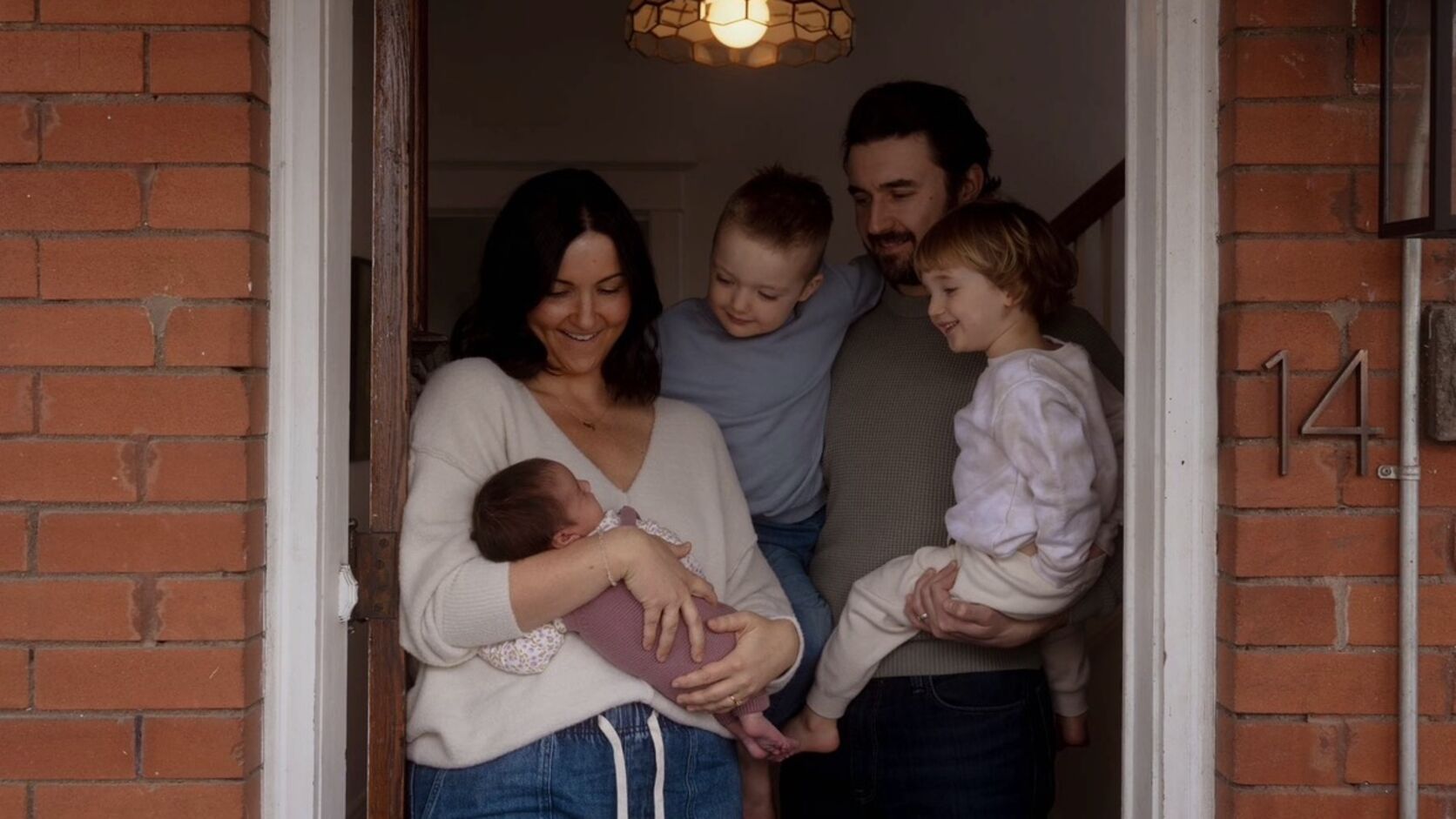
Page Cunningham can tell you the exact moment her first birth turned into something she never planned, and it happened before the birth even began. It was the walk from the car to the hospital doors.
Cunningham is a mother of three, and if you ask her about motherhood, she does not reach for the tidy version. She reaches for the truth: three births that each remade her, more than five years of breastfeeding, and a hard-won faith in her own body that no one, she says, can take from her. But to understand where that faith came from, you have to start where she started, at a loss.
“Walking from the car into the hospital in labour with my first, knowing I was about to have a c-section, was the most excruciatingly painful moment of my life,” she says. She had planned for something else entirely. Her hope, from the day she found out she was pregnant, was for as natural a birth as possible. Then, at thirty-seven weeks, her baby turned breech, and the plan she had prepared for and dreamed about was, as she puts it, “completely out of the question.”
What she grieves now is not only the surgery. It is what the surgery took with it. “Before my c-section, I hadn’t considered or given much thought to the sacredness of the moment I would meet my baby,” she says. As a first-time mother, her focus had been on how her son would be born, not on how she wanted to feel as she met him. “The sacredness was not protected in that setting.”
Some births leave a mother with a story she tells once and sets down. This one she carries. “There are moments from that birth that I relive over and over again in my head and wish things had been different,” she says. “I didn’t feel like I was in control.”
The redemption
By the time she was pregnant with her second, she knew what she needed, and she knew where to look for the picture of it. Her sister had already given birth to two babies at home. “I wanted to be in charge of my birth,” she says. “I was the expert of my body and baby.”
That birth, at home, was the one that gave it all back to her. She describes it in one word first: redemptive. She almost did not believe it was real labor, because it felt so far from the fear and pain she remembered. “I felt intensity but it was completely manageable,” she says. She swayed through her contractions and moved through a twelve-hour labor, in her words, “with ease and mainly by myself.”
By her third, there was nothing left to prove and no one left to convince. “I knew my power as a woman, had full trust in my body and only had room for a supportive team that trusted my body and intuition as well,” she says. Her water broke, something she had never experienced in the first two, and the contractions came hard and fast. Two hours later, she was holding her baby. She had caught her daughter herself.
“I have never felt like more of a goddess than I did after birthing my third baby completely by myself,” she says. Her support team was there. Her husband was there. “But not one other person touched my baby during her birth. It was a wild experience that I wish I could do over and over again.”
I have never felt like more of a goddess than I did after birthing my third baby completely by myself.
What she wishes more mothers knew
She has lost count of how many people have questioned her, certain that a vaginal birth after a cesarean simply was not possible. Her answer to any mother sitting where she once sat is not a slogan. It is a request to get informed.
“Do your own research,” she says. “Ensure you give informed consent to your providers, meaning get ALL the facts for both options. Know the risks and benefits of having a repeat cesarean versus a planned vaginal delivery. Ask for specifics, become informed and know that you are the expert of your body and baby.”
The home birth itself, she says, was “a no brainer” once she understood what she wanted to protect. She had carried trauma from how she was treated during her cesarean, and she was not willing to risk it again. Home meant comfort, safety, control, and that word she keeps returning to: sacredness. The comfort, she believes, is what allowed her body to open. “The comfort I felt is what I believe allowed my body to progress deep into labour and birth my baby with no interventions and completely undisturbed.”
It let her family in, too. Home visits from her team folded the pregnancy into everyday life, and when each baby arrived, the older siblings met the new one within moments, all of them cuddled together in the family bed.
More than five years of milk
She has been breastfeeding, without a break, for more than five years. It did not begin gently.
Her own mother nursed her for four years, and she grew up surrounded by women who breastfed with confidence, so she expected it to come. Instead, it nearly undid her. “I would wake up every night in tears and would dread when the 2-3 hours between feeds would go by and I’d have to feed him again,” she says of the early months with her first. Lactation consultants could not solve it. What finally did was a family friend, an experienced doula, who spotted what everyone else had missed: her supply was so abundant that her baby never had to work for the milk, and so he was not latching deeply enough.
“After this visit, everything changed for me,” she says. “My nipples healed, my baby was thriving and I enjoyed breastfeeding so much.” She had come close, more than once, to feeding him another way. She stayed. “I felt so determined to try everything I possibly could.”
That determination became a kind of fluency. She went on to breastfeed each of her babies without pain, and twice she tandem fed, nursing a newborn and a toddler at once. It was never something she set out to do; it was something she could not bring herself to end. “Weaning felt like more work to me than just continuing to nurse both of them,” she says. “I just listened to my heart, and my instincts as a mother.” She is honest that it was not always tender. “There were times when it felt really awful for me too, it wasn’t always rainbows and butterflies,” she says. When it did, she would pop them off, take a second for herself, and regroup. She weaned each of her older children after they turned three, when everyone was ready.
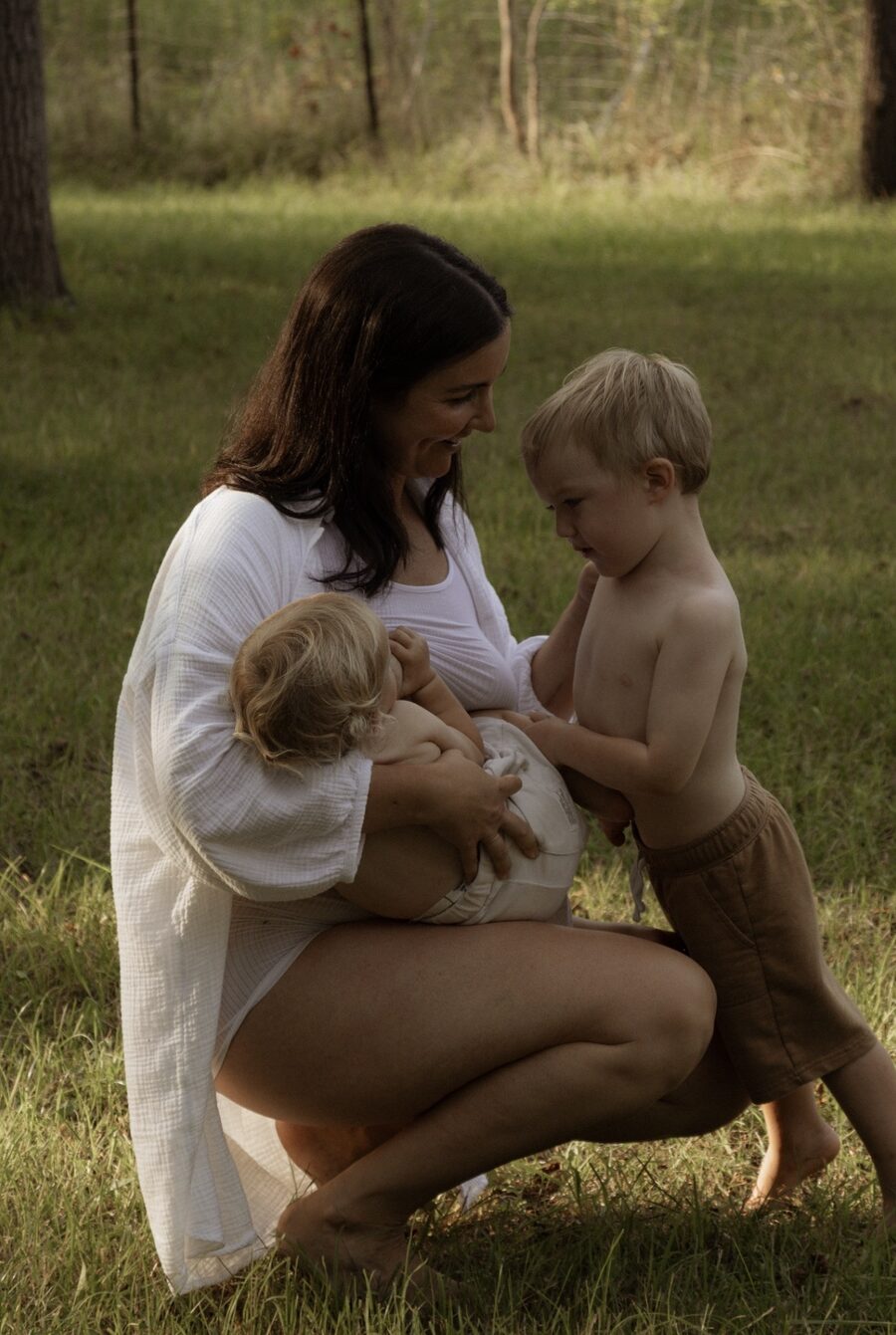
If she could hand one thing to a mother about to start, it would be permission, and a warning. The permission: “You are learning to be a mother and breastfeed for the first time, just like your baby is learning to live outside of you for the first time. Give yourself grace.” The warning is about engorgement, which she calls, in all capitals, insanity. “It is painful, uncomfortable and felt really alarming to me,” she says. “You have to move through it. It will not last forever.”
You are learning to be a mother and breastfeed for the first time, just like your baby is learning to live outside of you for the first time. Give yourself grace.
The family bed
Co-sleeping, for her, was never a decision so much as an instinct she never questioned. She grew up sharing a bed with her mother and sisters, and even with rooms of their own, the girls found their way back to each other at night. “It is biological to crave closeness especially as a newborn baby who lived inside you for 40 weeks,” she says. “Of course they don’t want to be away from you.” She sees it in how easily her children go to sleep, and she has no intention of hurrying them out of it. “I love sleeping with my babies and I will never rush them through this phase of life.”
What postpartum actually asked of her
For all the intensity of her home births, the recovery that broke her open was the first one. “My c-section recovery was definitely my hardest postpartum for many reasons,” she says. She was healing from major surgery, learning to breastfeed with no idea how, and, in her words, she “did very little prep in my pregnancy for my fourth trimester.” She did not yet know what real rest and nourishment required.
The births that followed taught her. She learned to build teams, to be cared for in ways she had not known to want. Her advice is plain, and hard-won: “Ask for and accept help. You NEED to take the appropriate rest and feel supported physically and mentally so you can focus on your beautiful new baby and yourself.”
The noise, and the trust
Ask her what she is most proud of, and she does not name a birth or a breastfeeding milestone. She names the quiet: the ability to tune out the opinions. “I trust myself, my heart and my intuition,” she says, “and no one can take that from me.” She wishes every parent could do it. When she thinks about the people who question how she is raising her children, she wonders, mostly, why they care at all.
I trust myself, my heart and my intuition, and no one can take that from me.
She loves the body that carried her here, and she is not shy about saying so. “It has brought me three gorgeous, healthy humans, fed them and kept them healthy for 5+ years,” she says. “It is truly amazing that the female body can grow, stretch, birth, bleed, shrink, nourish and do it all again and again.”
And underneath all of it is a certainty that steadies everything else. “If I’m being completely honest, I feel like being a mother is what I was made to do,” she says. “It just feels right.” Her children, she says, are her greatest teachers.
When they are grown, she knows exactly what she hopes they will say. Not that she was perfect. Something simpler than that. “That was fun. My mum really liked being with us.” She wants them to remember a happy family, and a mother who was happy to be theirs.
She leaves the last word as a hand on the shoulder of every mother reading, herself included.
“Motherhood is the hardest thing I have ever done, but also the best,” she says. “We are just children now learning to be parents alongside our children learning to live and exist in the world. Give yourself and your children grace. You are in this together, working as a team. Breathe, trust yourself, apologize when needed, get outside and be happy.”