
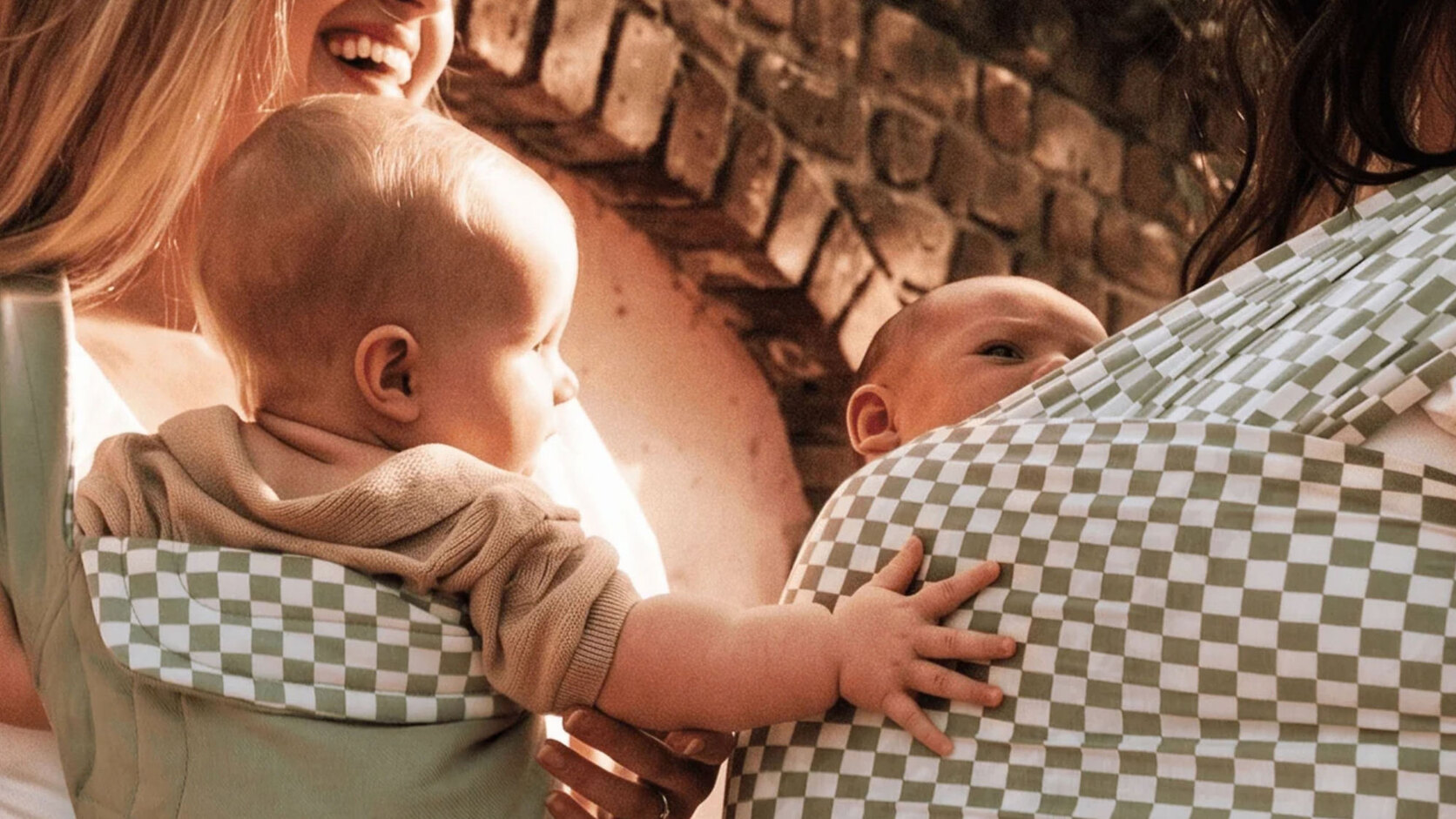

She was three weeks postpartum and had not yet figured out how to put the baby down without waking him.
Not because she was doing anything wrong. Because he was a newborn, and newborns are designed to resist the transition from body to surface in a way that feels almost personal but is in fact entirely physiological. The womb was warm, close, dark, and full of the heartbeat he had been hearing for nine months. The bassinet was none of those things. Every time she transferred him, the absence registered. Every time the absence registered, the crying began. She was doing thirteen transfers a day, and each one was a negotiation she lost.
Then a friend dropped off a Solly Baby Wrap. She watched a three-minute tutorial. She wrapped it on. She tucked him in.
He slept for two and a half hours. She ate a hot meal and answered four emails and cried a little, mostly from relief. The wrap had given her back something she had not realised she was missing: her hands, and the particular quality of peace that comes with them.
What it is, exactly
The price of the Solly Baby Wrap — less than most mothers spend on a single nursing bra, and considerably less than the cost of the postpartum massage they have been putting off since the birth. For the hours of hands-free calm it delivers in the newborn period, it is one of the highest-value purchases on the market.
The Solly Baby Wrap is not a structured carrier. It has no buckles, no clasps, no hard components of any kind. It is, at its most reductive, a very long, very soft piece of fabric — 5.5 yards of TENCEL modal, a material made from sustainable beech wood pulp that is twice as soft as cotton, naturally breathable, and gentle enough for the skin of a person who has been in existence for fewer than 72 hours.
You wrap it around your body in a specific configuration that creates a secure, ergonomic pocket against your chest, and you place the baby in. The baby is held in the fetal tuck position — knees above hips, spine curved naturally, face visible and unobstructed — which is simultaneously the position the International Hip Dysplasia Institute identifies as optimal for healthy hip development and the position that most closely approximates the in-utero environment the baby has just left.
It is designed specifically for the newborn period — from birth through approximately 25 pounds, which in practice means approximately the first year of life. It is not a carrier that will take you through toddlerhood. It is a carrier designed to be exceptional at the specific thing that the newborn period most urgently requires: keeping a very small, very new human being close to a body while freeing the hands attached to that body for something else. It is, in other words, a tool built for the fourth trimester — those first twelve weeks when a newborn is still recalibrating to life outside the womb.
At $65, it is priced at the premium end of the wrap category and at the budget end of the structured carrier category. For what it delivers in the newborn window, it represents one of the better value-per-use calculations available in the baby product space.
The science behind babywearing
The benefits of babywearing are not marketing language. They are documented in the research literature with enough consistency that the American Academy of Pediatrics includes babywearing in its guidance on infant care and development.
Infant crying and colic
A landmark randomised controlled trial published in Pediatrics found that carrying infants for an additional three hours per day reduced crying and fussiness by 43% overall and by 51% during evening hours. The mechanism is not fully understood but is believed to involve the regulation of the infant's immature autonomic nervous system through the rhythmic movement, warmth, and proximity to the caregiver's heartbeat that babywearing provides. For the approximately 10 to 25% of infants who experience colic — defined as crying for more than three hours per day, more than three days per week — the evidence for babywearing as a meaningful intervention is particularly compelling.
Attachment and bonding
The attachment theory research developed by John Bowlby and expanded by subsequent researchers — documented extensively in the work of Attachment Parenting International — identifies close, consistent physical contact in the early weeks of life as one of the primary mechanisms through which secure attachment is established. Babywearing facilitates the sustained physical proximity, the responsiveness to infant cues, and the skin-to-skin contact that attachment research consistently identifies as foundational to the parent-infant bond.
Breastfeeding support
The scoping review of the biological and behavioral effects of babywearing on mothers and infants published in JOGNN found that babywearing is associated with higher rates of breastfeeding initiation and longer breastfeeding duration, likely because close proximity facilitates more frequent feeding, more responsive feeding cued by early hunger signals, and the skin-to-skin contact that supports prolactin production and milk supply. For mothers who are navigating the early challenges of establishing breastfeeding, the Solly's thin, stretchy fabric makes discreet nursing in the wrap possible in a way that more structured carriers do not accommodate as naturally. (If you are nursing, what you eat while breastfeeding matters less than the internet insists — but staying fed and hydrated genuinely helps.)
Maternal mental health
Research on the relationship between babywearing and maternal mood — including the JOGNN scoping review of babywearing's biological and behavioral effects — found that mothers who babywear report lower rates of postpartum depression symptoms, higher rates of maternal confidence, and greater reported satisfaction in the parenting role. The mechanism is likely multifactorial: the calmer infant produces a less stressed mother, the hands-free capacity reduces the sense of helplessness that can characterise the early postpartum period, and the sustained physical closeness supports the oxytocin release that underlies feelings of warmth and connection. None of it replaces real support — there is a psychological transformation in early motherhood that no product can carry for you — but a calmer baby and a free pair of hands are not nothing.
What makes the Solly different from other wraps
The baby wrap category is not small. There are cotton wraps, woven wraps, ring slings, hybrid carriers, and a range of products at every price point. The Solly occupies a specific position within this landscape that is worth understanding before you make the purchase.
The fabric is the differentiator
The TENCEL modal blend that Solly uses is genuinely different from the cotton and cotton-spandex blends that most entry-level and mid-range wraps use. It is lighter, more breathable, and softer against both the infant's skin and the wearer's body. In practical terms, this means it is suitable for year-round use in a way that heavier wraps are not, and it means that the sensory experience of wearing a Solly is consistently described by parents who have tried multiple carriers as categorically different from other options they have used.
The fit is genuinely universal
The Solly comes in a single 5.5-yard length that accommodates petite wearers, plus-size wearers, and everyone in between, with the adjustment happening in how the fabric is wrapped and tied rather than in the carrier's structural dimensions. Extended sizing is available for wearers who prefer additional fabric. This makes it an unusually functional gift option — a wrap that does not require knowing the recipient's size or body type to be appropriate.
The learning curve is manageable
Every wrap has a learning curve. The Solly's is at the lower end of the category — most wearers report becoming comfortable with the basic wrap technique within three to five wears. Solly provides free virtual babywearing consultations, which distinguishes it from competitors who provide written instructions only. For mothers navigating the early postpartum fog, the option to video call with an actual human who can see what you are doing and correct it in real time is not a small thing.
The aesthetic is intentional
This matters more than it might seem to matter. The Solly wraps are genuinely beautiful — they come in a range of prints and solids that are designed to look like something you chose to wear rather than something that happened to you. For mothers who are working to maintain any sense of their own aesthetic identity in the postpartum period, wearing a wrap that feels like a choice rather than a concession has a small but real effect on how they feel about themselves on the days when that is already hard.
Who it is for
The Solly Baby Wrap is ideal for:
- Parents of newborns who are navigating the specific challenge of a baby who will only sleep on a body. The wrap allows the body in question to do other things while the sleeping happens. (For more on those early months, sleep expert Andria Gordon on why you can't ruin a newborn's sleep is worth the read.)
- Second-time parents who need both hands free for an older child while managing a newborn. The testimonials from mothers of two who describe the Solly as what made the early weeks survivable are too numerous and too specific to discount.
- Parents who value skin-to-skin contact and the bonding and breastfeeding benefits associated with it, and who want to extend those benefits beyond the immediate postpartum period into the daily rhythm of the first months.
- Anyone who will be spending time in warm weather with a newborn. The TENCEL modal fabric is meaningfully more breathable than cotton alternatives, and in summer months or warmer climates, this is not a trivial consideration.
- Partners and co-parents who want to participate in the calming and bonding functions of the newborn period. The Solly works on any body type and is consistently described by partners who use it as having meaningfully changed their experience of the early weeks.
The registry case
The Solly Baby Wrap is not the kind of product that photographs well on a registry. It does not have obvious features to enumerate. It is not technically complex. It does not beep, vibrate, project, or swing. It is a piece of fabric that, in the right configuration, holds your baby close to your body and gives you your hands back.
The mothers who have used it describe it in the specific language of relief: the hot meal that finally got eaten, the shower that finally happened, the toddler who finally got the attention she needed. The sleep that finally came, for the baby and therefore for the mother. The particular feeling of having solved the most urgent problem of the early weeks with something that weighs less than a pound and folds to the size of a large grapefruit.
It belongs on every registry. Not as a luxury item and not as a gadget, but as the functional, research-supported, genuinely transformative tool that it is — for the baby who needs the closeness, and for the mother who needs her hands.
Shop the Solly Baby Wrap · Free virtual babywearing support